All Updates
Page 428 of 872
March 23, 2026
Jiaotu Rebrands as Qi An Xin AI
Beijing Jiaotu Technology renamed to Qi An Xin Artificial Intelligence Technology (Beijing) Co., Ltd. Qi Xiangdong took over as legal representative, manager, and director, replacing Chen Ming; multiple exec changes occurred. Wholly owned by Qi An Xin Tech Group, it focuses on AI systems, security services since 2010.
AI Glasses: Costly Foldable Screen?
AI glasses are critiqued as merely another foldable screen. They incur high costs while solving minor problems. Questions value of such hardware innovations.
Qwen Launches One-Sentence AI Ride-Hailing
Qwen has introduced an AI ride-hailing feature allowing users to book rides with a single sentence specifying car type, locations, and time. Over 130 million users have also experienced AI shopping for the first time on the platform.
Stepwise: Neuro-Symbolic Proof Search
Stepwise introduces a neuro-symbolic framework for automating proof search in formal verification using LLMs and ITP tools. It employs best-first tree search, LLM fine-tuning on proof states, and symbolic repairs to outperform prior methods. On seL4 benchmarks, it proves 77.6% of theorems, surpassing Sledgehammer and showing strong generalization.
Rose Rock Bridge Opens Energy Cohort Apps
Rose Rock Bridge, a Tulsa non-profit, accelerates energy startups via pilots with major corporates like Devon Energy. Accepting Spring 2026 cohort applications until April 6. Focus areas include robotics, reservoir enhancement, and fluid systems.
PowerLens: LLM Agents Tame Mobile Battery
PowerLens harnesses LLMs for safe, personalized Android power management by bridging user activities to system parameters via commonsense reasoning. It uses a multi-agent architecture, PDL constraints for safety, and implicit feedback learning converging in 3-5 days. Experiments yield 81.7% accuracy and 38.8% energy savings over stock Android.
Partially Grounded Encoding Boosts Planning
Researchers propose three SAT encodings for classical planning that keep actions lifted while partially grounding predicates, avoiding full grounding's exponential blowup. Unlike prior quadratic scaling with plan length, this approach scales linearly. It empirically outperforms state-of-the-art in length-optimal planning on hard-to-ground domains.
PA2D-MORL Boosts Multi-Objective RL
PA2D-MORL proposes an efficient decomposition and policy improvement for multi-objective RL, achieving superior Pareto policy approximations in complex tasks. It uses Pareto ascent directions for scalarization weights and joint policy gradients, with evolutionary optimization of multiple policies and adaptive fine-tuning. Experiments on robot control tasks show it outperforms SOTA in quality and stability.
MiRA Supercharges Open LLM Agents Past GPT-4
Researchers propose a subgoal-driven framework and MiRA RL method to tackle long-horizon planning in LLM agents for web navigation. MiRA elevates Gemma3-12B's WebArena-Lite success rate from 6.4% to 43%, outperforming GPT-4-Turbo (17.6%) and GPT-4o (13.9%). This combo of planning and milestone rewards boosts autonomous AI capabilities.
LLMs Master Formal Counterexample Generation
Researchers fine-tune LLMs to generate verifiable counterexamples for disproving theorems using Lean 4. A symbolic mutation strategy creates diverse training data by modifying theorems. Multi-reward expert iteration boosts performance on new benchmarks for counterexample and theorem tasks.
ItinBench: Multi-Cognitive LLM Planning Benchmark
ItinBench is a new benchmark integrating spatial reasoning (route optimization) into trip itinerary planning alongside verbal tasks to evaluate LLMs across cognitive domains. It tests models like Llama 3.1 8B, Mistral Large, Gemini 1.5 Pro, and GPT family, showing LLMs struggle with consistent performance on multiple dimensions. Code and dataset are available at https://ethanwtl.github.io/IBweb/.
Hyperagents Enable Open-Ended AI Self-Improvement
Hyperagents integrate task and meta agents into a single editable program for metacognitive self-modification. DGM-H extends the Darwin GΓΆdel Machine for domain-general self-improvement, outperforming baselines across diverse tasks. Meta-improvements like persistent memory transfer across domains and accumulate over runs.
HyEvo: Self-Evolving Hybrid Agentic Workflows
HyEvo is an automated workflow-generation framework that combines probabilistic LLM nodes for semantic reasoning with deterministic code nodes for efficient execution. It employs an LLM-driven multi-island evolutionary strategy with reflect-then-generate to optimize hybrid workflows via execution feedback. Experiments demonstrate superior performance on reasoning and coding benchmarks, with up to 19x inference cost and 16x latency reductions over SOTA baselines.
FormalEvolve Evolves Prover-Effective Autoformalization
FormalEvolve is a neuro-symbolic evolutionary framework that generates diverse, semantically consistent formalizations for improved prover performance in autoformalization. It employs LLM-driven mutations, crossovers with patch repair, and AST rewrites under a strict budget of 100 calls. Achieves 58.0% semantic hit rate on CombiBench and 84.9% on ProofNet, with code to be released publicly.
Embodied AI Closes Science Discovery Loop
Proposes embodied science paradigm integrating agentic AI reasoning with physical experiments. Introduces PLAD framework for perception, language reasoning, action execution, and discovery loops. Enables autonomous systems in life and chemical sciences via physical feedback.
Agent Sketches One Part at a Time
Researchers developed a multi-modal LLM agent that generates vector sketches part-by-part using multi-turn process-reward RL after supervised fine-tuning. They created the ControlSketch-Part dataset with rich part-level annotations via an automatic segmentation and labeling pipeline. This enables interpretable, controllable, and editable text-to-vector sketch generation with visual feedback.
OpenClaw Founder Confirms 360's Vuln Discovery
OpenClaw's founder has confirmed via reply that 360 exclusively discovered a vulnerability in the platform. This development advances practical security defenses for intelligent agent applications.
Zhongguancun AI Agent Competition Concludes
The Zhongguancun Beilong Shrimp Competition has successfully concluded. It rationally explores the infinite possibilities of AI application evolution in the intelligent agent era.
Tencent Bets on Innovative Drugs
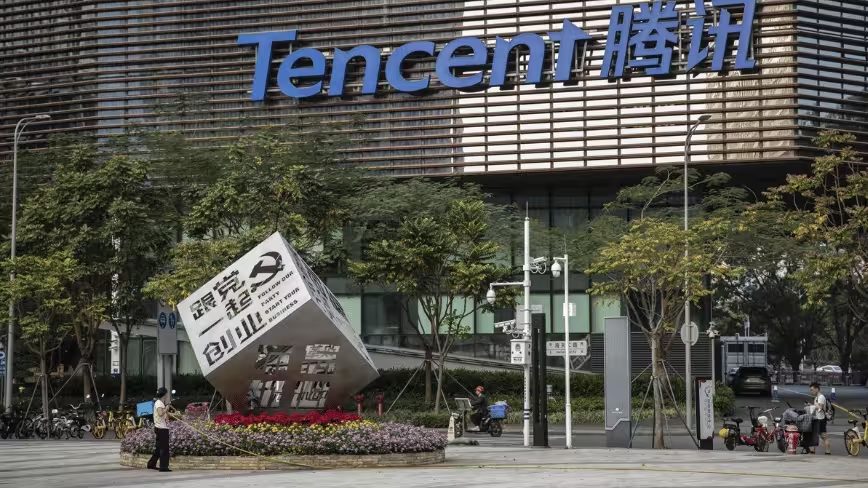
Tencent is targeting innovative drugs in a strategic move. This ambitious gamble by the tech giant is just beginning to unfold.
Upstage in Talks for 10K AMD AI Chips
Korean AI startup Upstage is negotiating with AMD to acquire 10,000 of its latest AI accelerators. The deal aims to establish large-scale computing infrastructure within Korea.