DeepSeek DSpark Earns Praise from PyTorch Core Maintainer
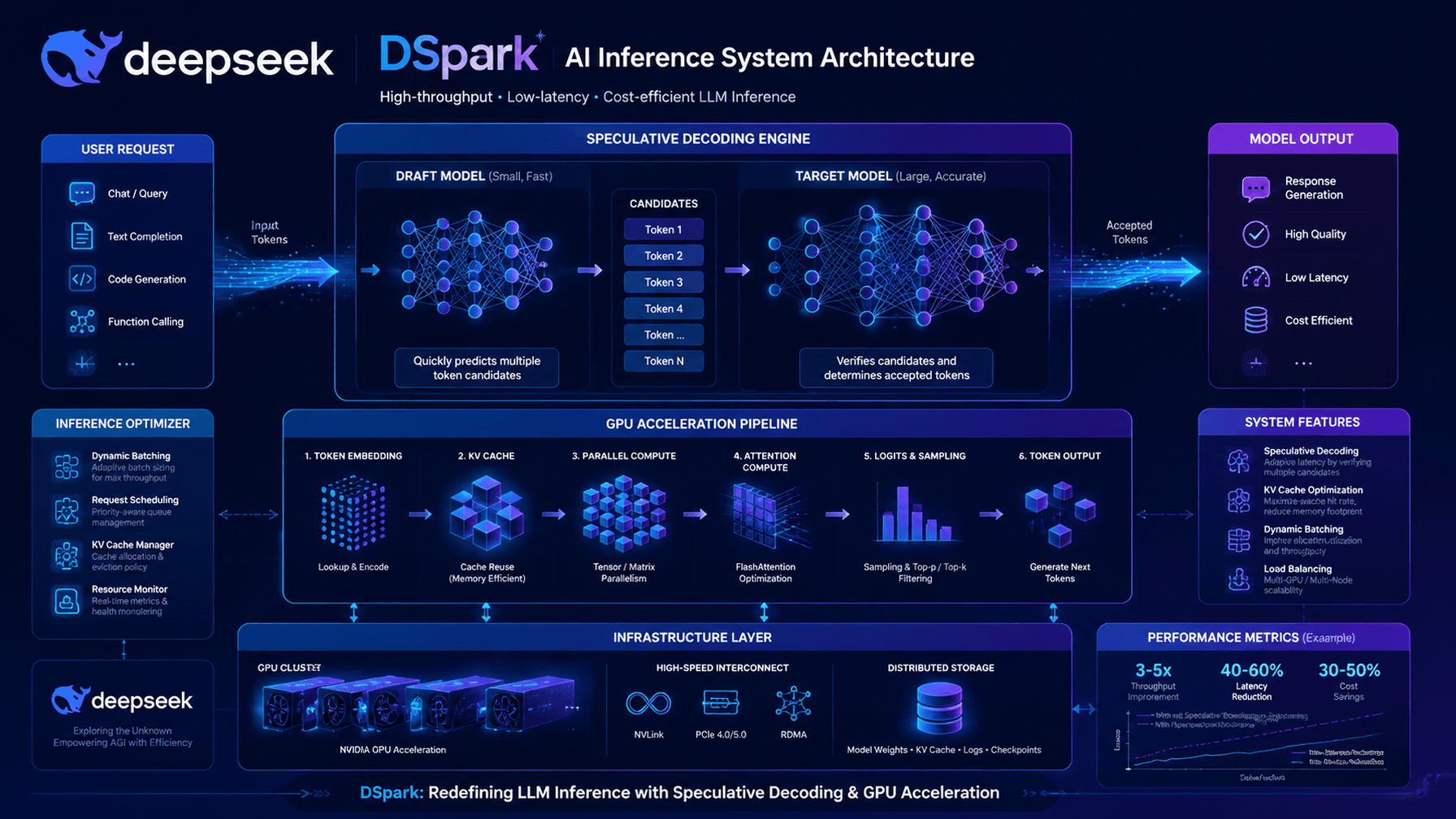
See why a PyTorch core maintainer is praising this new inference system's engineering.
30-Second TL;DR
What Changed
DSpark utilizes semi-parallel drafting to optimize inference latency.
Why It Matters
This validation from a key PyTorch maintainer signals that DSpark is a serious contender in the inference optimization space. It may encourage wider adoption of DSpark's techniques in high-performance AI infrastructure.
What To Do Next
Review the DSpark technical breakdown on GitHub to identify specific architectural patterns for your own inference pipelines.
Key Points
- •DSpark utilizes semi-parallel drafting to optimize inference latency.
- •PyTorch core maintainer Dmytro Dzhulgakov provided a positive technical breakdown.
- •The system demonstrates production-grade engineering suitable for large-scale deployment.
Deep Insight
AI-generated analysis for this event — not the original article.
Enhanced Key Takeaways
- •DSpark leverages a novel 'Speculative Decoding' variant that optimizes memory bandwidth by offloading drafting tasks to specialized hardware kernels.
- •The system integrates directly with PyTorch's 'torch.compile' and AOTInductor, allowing for seamless adoption in existing PyTorch-based inference pipelines.
- •Dmytro Dzhulgakov specifically highlighted DSpark's efficient handling of KV cache management, which significantly reduces memory fragmentation during long-context inference.
- •The collaboration between DeepSeek and Peking University focuses on bridging the gap between academic research in speculative decoding and industrial-scale throughput requirements.
- •DSpark's architecture includes a custom-built communication backend designed to minimize latency overhead in multi-GPU distributed inference environments.
Competitor Analysis
- DSpark
- Semi-Parallel
- vLLM
- PagedAttention/Speculative
- TensorRT-LLM
- TensorRT-optimized Speculative
- DSpark
- Native/AOTInductor
- vLLM
- Plugin-based
- TensorRT-LLM
- C++ Runtime/Plugin
- DSpark
- Latency/Memory Efficiency
- vLLM
- Throughput/Ease of Use
- TensorRT-LLM
- Hardware-specific Optimization
| Feature | DSpark | vLLM | TensorRT-LLM |
|---|---|---|---|
| Drafting Method | Semi-Parallel | PagedAttention/Speculative | TensorRT-optimized Speculative |
| PyTorch Integration | Native/AOTInductor | Plugin-based | C++ Runtime/Plugin |
| Primary Focus | Latency/Memory Efficiency | Throughput/Ease of Use | Hardware-specific Optimization |
Technical Deep Dive
- Semi-Parallel Drafting: Unlike standard speculative decoding which is sequential, DSpark executes multiple draft tokens in parallel across different compute streams to maximize GPU utilization.
- KV Cache Optimization: Implements a dynamic memory allocation strategy that minimizes the need for contiguous memory blocks, improving performance on fragmented GPU memory.
- Kernel Fusion: Utilizes custom Triton-based kernels to fuse drafting and verification steps, reducing the number of kernel launches and global memory round-trips.
- AOTInductor Integration: Leverages Ahead-of-Time compilation to generate optimized machine code for specific model architectures, bypassing the overhead of dynamic graph execution.
Future ImplicationsAI analysis grounded in cited sources
Timeline
- 2025-03DeepSeek and Peking University announce initial research collaboration on efficient inference.
- 2025-11DSpark alpha version released for internal testing and select academic partners.
- 2026-05DSpark v1.0 stable release with support for major DeepSeek model architectures.
- 2026-06PyTorch core maintainer Dmytro Dzhulgakov publishes technical review of DSpark.
Event Coverage
Weekly AI Recap
Read this week's curated digest of top AI events →
Related Updates



AI-curated news aggregator. All content rights belong to original publishers.
Original source: Pandaily ↗
This is a summary, not the original. Read the source, or get the weekly briefing.
The weekly digest
One email a week. Unsubscribe anytime.