CXMT Secures $3B Memory Deal with Tencent
💡Understand how supply chain shifts in Chinese memory hardware impact AI infrastructure and cloud scalability.
⚡ 30-Second TL;DR
What Changed
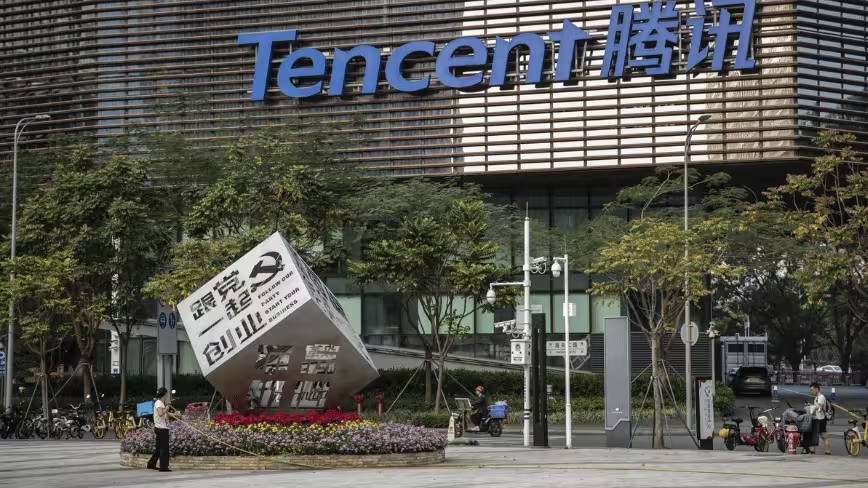
CXMT to supply $3B in DRAM to Tencent
Why It Matters
This move highlights the increasing reliance of Chinese tech giants on domestic semiconductor manufacturing to mitigate geopolitical supply chain risks.
What To Do Next
Monitor domestic Chinese semiconductor availability if you are building infrastructure for the Chinese market.
Key Points
- •CXMT to supply $3B in DRAM to Tencent
- •Deal signals shift toward domestic memory hardware for Chinese cloud providers
- •Agreement remains unconfirmed by either company
🧠 Deep Insight
AI-generated analysis for this event — not the original article.
🔑 Enhanced Key Takeaways
- •The deal reportedly focuses on CXMT's LPDDR4 and DDR4 memory modules, which are increasingly being integrated into Tencent's AI server clusters to reduce reliance on US-sanctioned suppliers.
- •This partnership is part of a broader 'Xinchuang' (IT innovation) initiative in China, aimed at replacing foreign hardware in critical cloud and government infrastructure by 2027.
- •CXMT has accelerated its R&D efforts to transition from 19nm to 17nm and 10nm-class process nodes, a necessary technical leap to meet the performance requirements of Tencent's large-scale data centers.
- •Industry analysts suggest the $3 billion valuation reflects a multi-year supply agreement rather than a single-batch purchase, providing CXMT with long-term capital for capacity expansion.
- •The agreement follows increased export controls from the US and its allies, which have restricted Chinese firms' access to advanced HBM (High Bandwidth Memory) and high-end DRAM from companies like Micron, Samsung, and SK Hynix.
📊 Competitor Analysis▸ Show
| Feature | CXMT (DDR4/LPDDR4) | Micron (DDR4/LPDDR4) | Samsung (DDR4/LPDDR4) |
|---|---|---|---|
| Process Node | 17nm / 19nm | 1α / 1β nm | 1α / 1β nm |
| Market Position | Domestic Chinese Leader | Global Tier-1 | Global Tier-1 |
| Sanction Risk | Low (Domestic) | High (Export Controls) | Moderate (Export Controls) |
| Performance | Competitive for Cloud | Industry Standard | Industry Standard |
🛠️ Technical Deep Dive
- CXMT utilizes a proprietary DRAM architecture that leverages a capacitor-over-bitline (COB) structure to optimize cell density.
- The company has been scaling production of 17nm-class DRAM, which serves as the primary alternative for legacy and mid-tier AI inference workloads in the Chinese market.
- Integration with Tencent's cloud infrastructure involves custom firmware tuning to ensure compatibility with domestic server CPUs (such as those based on ARM or x86-compatible Chinese architectures).
- The memory modules are designed to operate within the specific thermal and power envelopes required by high-density rack-mount servers used in Tencent's data centers.
🔮 Future ImplicationsAI analysis grounded in cited sources
⏳ Timeline
Weekly AI Recap
Read this week's curated digest of top AI events →
👉Related Updates



AI-curated news aggregator. All content rights belong to original publishers.
Original source: The Next Web (TNW) ↗
This is a summary, not the original. Read the source, or get the weekly briefing.
Weekly AI briefing
One email a week. Unsubscribe anytime.