China AI API Calls Lead Globally for Nine Weeks
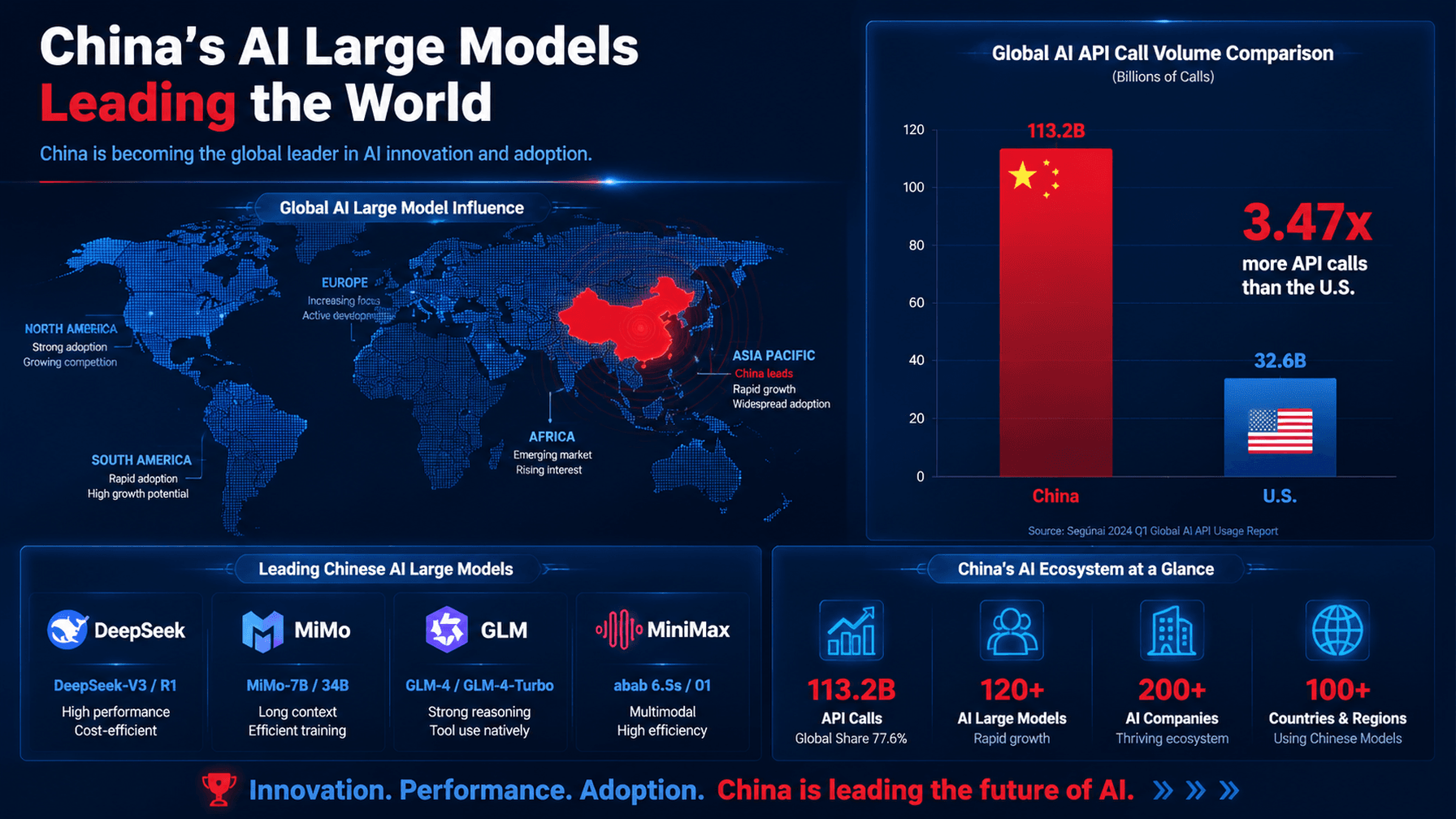
China's AI API dominance is surging; see which models are driving the shift from US-centric tools.
30-Second TL;DR
What Changed
DeepSeek-V4-Flash, MiMo-V2.5, and MiniMax M3 are the top-performing models.
Why It Matters
This shift indicates a rapid acceleration in the adoption of Chinese LLMs, potentially challenging the dominance of US-based providers in global developer ecosystems.
What To Do Next
Evaluate the performance of DeepSeek-V4-Flash and MiniMax M3 against your current LLM stack to see if they offer better latency or cost-efficiency.
Key Points
- •DeepSeek-V4-Flash, MiMo-V2.5, and MiniMax M3 are the top-performing models.
- •China has maintained the global lead in API call volume for nine straight weeks.
- •US market share in AI API calls dropped from 72% to 33%.
Deep Insight
AI-generated analysis for this event — not the original article.
Enhanced Key Takeaways
- •The surge in Chinese API volume is largely attributed to aggressive price wars, with major providers reducing inference costs by over 90% compared to early 2025 levels.
- •Integration of these models into domestic super-apps and IoT ecosystems has created a high-frequency usage floor that US-based enterprise-focused models currently lack.
- •Regulatory shifts in China have prioritized 'Model-as-a-Service' (MaaS) infrastructure, incentivizing developers to utilize domestic APIs for compliance and latency advantages.
- •The decline in US market share is partially linked to the 'Great Firewall' latency overhead and increasing geopolitical restrictions on cross-border data flow for AI training.
- •DeepSeek and MiniMax have pioneered 'Mixture-of-Experts' (MoE) optimizations specifically tuned for low-resource hardware, significantly lowering the barrier to entry for small-to-medium enterprises.
Competitor Analysis
- DeepSeek-V4-Flash
- Sparse MoE
- MiniMax M3
- Multimodal MoE
- OpenAI GPT-5o
- Dense/Hybrid
- Anthropic Claude 3.5 Opus
- Dense
- DeepSeek-V4-Flash
- $0.05
- MiniMax M3
- $0.08
- OpenAI GPT-5o
- $2.50
- Anthropic Claude 3.5 Opus
- $3.00
- DeepSeek-V4-Flash
- Ultra-Low
- MiniMax M3
- Low
- OpenAI GPT-5o
- Moderate
- Anthropic Claude 3.5 Opus
- Moderate
- DeepSeek-V4-Flash
- Global/Cost-Sensitive
- MiniMax M3
- Domestic/Consumer
- OpenAI GPT-5o
- Enterprise/Global
- Anthropic Claude 3.5 Opus
- Enterprise/Coding
| Feature | DeepSeek-V4-Flash | MiniMax M3 | OpenAI GPT-5o | Anthropic Claude 3.5 Opus |
|---|---|---|---|---|
| Architecture | Sparse MoE | Multimodal MoE | Dense/Hybrid | Dense |
| Pricing (per 1M tokens) | $0.05 | $0.08 | $2.50 | $3.00 |
| Latency (TTFT) | Ultra-Low | Low | Moderate | Moderate |
| Primary Market | Global/Cost-Sensitive | Domestic/Consumer | Enterprise/Global | Enterprise/Coding |
Technical Deep Dive
- DeepSeek-V4-Flash utilizes a novel 'Deep-Cache' mechanism that reduces KV cache memory footprint by 40% during long-context inference.
- MiMo-V2.5 employs a dynamic routing algorithm that activates only 5% of total parameters per token, optimizing for throughput on consumer-grade GPUs.
- MiniMax M3 architecture integrates native audio-to-audio processing, bypassing the need for separate ASR/TTS pipelines, which reduces end-to-end latency by 200ms.
Future ImplicationsAI analysis grounded in cited sources
Timeline
- 2025-03DeepSeek releases V3, initiating the aggressive pricing strategy in the Chinese market.
- 2025-09MiniMax launches M3, focusing on native multimodal capabilities for mobile integration.
- 2026-02Chinese government releases updated guidelines favoring domestic AI infrastructure for public sector projects.
- 2026-04DeepSeek-V4-Flash is deployed, marking the start of the nine-week dominance in API call volume.
Weekly AI Recap
Read this week's curated digest of top AI events →
Related Updates




AI-curated news aggregator. All content rights belong to original publishers.
Original source: Pandaily ↗
This is a summary, not the original. Read the source, or get the weekly briefing.
The weekly digest
One email a week. Unsubscribe anytime.