Build Agents Where Data Lives
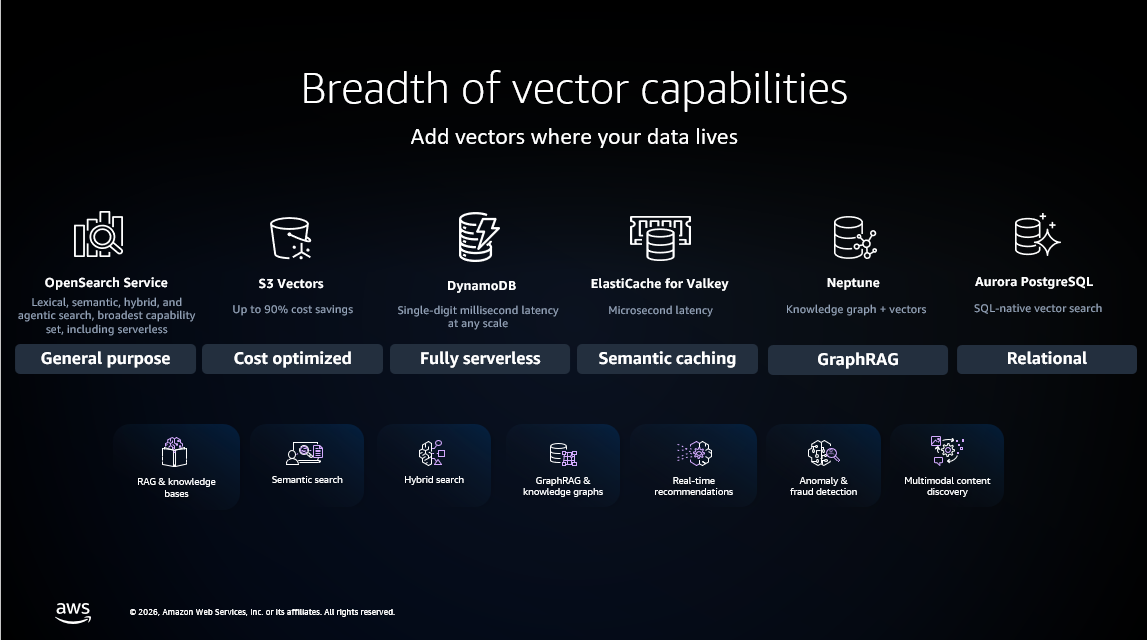
💡Compare six AWS-native vector options before adding a standalone vector database to your RAG stack.
⚡ 30-Second TL;DR
What Changed
Offers vector search directly within databases and storage services already holding enterprise data
Why It Matters
Keeping vector indexes close to source data can reduce architectural complexity and synchronization overhead for retrieval-augmented generation applications. The broad service portfolio also gives teams more choices, but requires careful evaluation of scale, latency, query features, and operational cost.
What To Do Next
Map your RAG data to the AWS service that already stores it, then benchmark native vector search against your current retrieval stack on latency and relevance.
Key Points
- •Offers vector search directly within databases and storage services already holding enterprise data
- •Avoids standalone vector database deployment and associated data migration
- •Covers six purpose-built services with a selection framework and customer examples
🧠 Deep Insight
Background and context from public sources — not the original article. 27 sources cited.
🔑 Enhanced Key Takeaways
- •Amazon DynamoDB now offers native real-time vector search, allowing embeddings to be stored directly with operational data, supporting up to 4096 dimensions with Euclidean, Cosine, and Dot product distance functions, and eliminating the need for data replication to a separate vector store.
- •Amazon S3 Vectors provides a cost-optimized object storage solution for billions of vectors, offering sub-second query performance for cold queries and reducing costs by up to 90% compared to some standalone vector databases like Pinecone or Weaviate.
- •Amazon OpenSearch Service, including its serverless Vector Engine, natively combines full-text and vector search with features like Neural Search for automatic hybrid result merging and GPU-accelerated indexing for faster large-scale ingestion.
- •Amazon Neptune Analytics enables vector similarity search for graph data, where embeddings can be 'graph-aware,' representing not just node properties but also their neighborhood in the graph, enhancing context for AI applications.
- •AWS offers ultra-low latency vector search (sub-millisecond) through Amazon MemoryDB, a Redis-compatible in-memory database, making it suitable for real-time recommendation engines and high-throughput applications with multi-Availability Zone durability.
🛠️ Technical Deep Dive
- Amazon DynamoDB: Supports vector embeddings up to 4096 dimensions. Offers Euclidean, Cosine, and Dot product distance functions. Utilizes a new index type built on vector embeddings stored in table attributes and employs Approximate Nearest Neighbor (ANN) search for efficient querying.
- Amazon OpenSearch Service (Vector Engine): Supports
knn_vectorfield type for dense vectors with configurable dimensions up to 16,000. Implements k-NN and Approximate k-NN search using algorithms like Hierarchical Navigable Small World (HNSW). Supports Euclidean, Cosine, and Dot product distance metrics. Features Neural Search for automated hybrid (keyword + vector) search and GPU-accelerated vector indexing for faster ingestion. - Amazon Aurora PostgreSQL-Compatible Edition: Integrates with the
pgvectorextension. Supports both exact and approximate nearest neighbor search, with approximate methods including HNSW and IVF FLAT. Offers distance operators such as dot-product for similarity calculations. - Amazon S3 Vectors: Designed for highly elastic and durable storage of large vector datasets (billions of vectors). Delivers sub-second query performance for cold queries and as low as 100ms for warm queries. Utilizes vector buckets and dedicated APIs for storing, accessing, and querying vector data without provisioning infrastructure.
- Amazon Neptune Analytics: Supports various Vector Similarity Search (VSS) algorithms. Allows for a fixed vector dimension between 1 and 65,535. Embeddings can be graph-aware, capturing the context of a node's neighborhood in the graph.
- Amazon MemoryDB: Provides sub-millisecond query latencies and multi-Availability Zone durability. Supports vectors up to 32,768 dimensions.
- Amazon DocumentDB (with MongoDB compatibility): Supports Hierarchical Navigable Small World (HNSW) indexing for vector search.
🔮 Future ImplicationsAI analysis grounded in cited sources
⏳ Timeline
📎 Sources (27)
Factual claims are grounded in the sources below. Forward-looking analysis is AI-generated interpretation.
Weekly AI Recap
Read this week's curated digest of top AI events →
👉Related Updates

AI-curated news aggregator. All content rights belong to original publishers.
Original source: AWS Machine Learning Blog ↗
This is a summary, not the original. Read the source, or get the weekly briefing.
Weekly AI briefing
One email a week. Unsubscribe anytime.