Smarter Security for Healthcare APIs
💡See how Amazon Bedrock can monitor FHIR access and automate compliance without slowing clinical workflows.
⚡ 30-Second TL;DR
What Changed
Applies Amazon Bedrock to context-aware security monitoring for FHIR APIs
Why It Matters
Healthcare organizations can use generative AI to strengthen API monitoring and compliance operations without disrupting time-sensitive clinical systems. Developers may be able to reduce manual review effort while gaining more actionable visibility into sensitive-data access.
What To Do Next
Prototype a security-monitoring pipeline that sends sanitized FHIR access events to Amazon Bedrock for anomaly analysis and compliance summaries.
Key Points
- •Applies Amazon Bedrock to context-aware security monitoring for FHIR APIs
- •Detects anomalous healthcare data access patterns
- •Automatically classifies data sensitivity and generates natural-language compliance reports
- •Designed to avoid adding latency to clinical workflows
🧠 Deep Insight
Background and context from public sources — not the original article. 16 sources cited.
🔑 Enhanced Key Takeaways
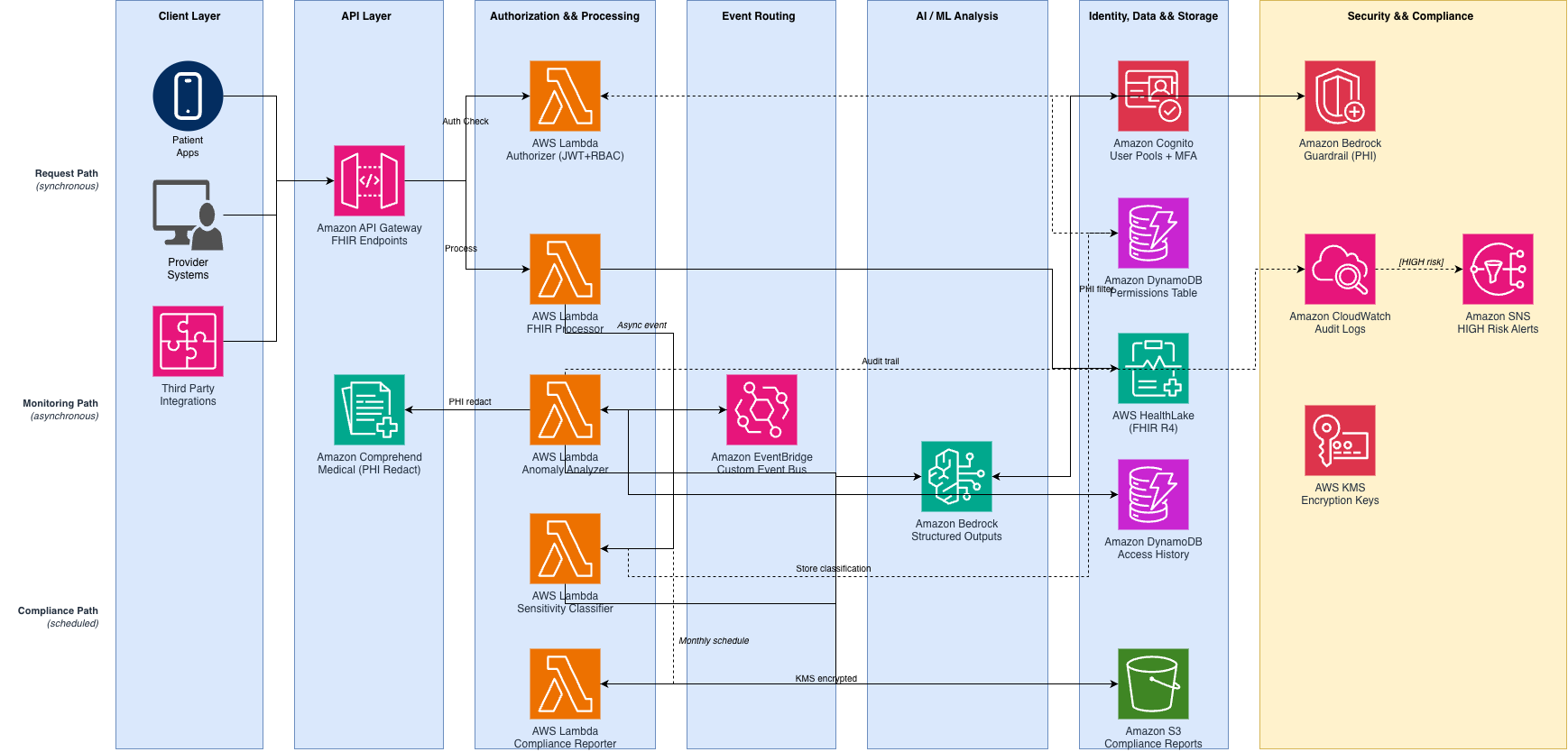
- •The solution operates asynchronously, ensuring that security monitoring processes do not introduce latency into critical clinical workflows.
- •Specific Amazon Bedrock foundation models, such as Claude Sonnet 4.5, are utilized for behavioral anomaly analysis, while Claude Haiku 4.5 is employed for data sensitivity classification.
- •Key HIPAA safeguards integrated into the solution include Bedrock Guardrails for anonymizing Protected Health Information (PHI) in prompts and responses, Amazon Comprehend Medical for redacting PHI before audit logging, and the use of Structured Outputs to enforce predictable JSON responses, preventing free-text parsing issues.
- •The architecture distinctly separates the synchronous FHIR API request path from the asynchronous security monitoring path, enhancing both performance and security.
- •The solution leverages AWS HealthLake as a HIPAA-eligible, FHIR-native data repository, providing a secure and compliant foundation for storing and querying healthcare data.
🛠️ Technical Deep Dive
- The solution is built on a serverless architecture, utilizing AWS services such as AWS Lambda for processing, Amazon API Gateway for exposing FHIR endpoints, Amazon Cognito for authentication, Amazon EventBridge for event routing, and Amazon S3 for data storage.
- Anomaly detection in healthcare often employs machine learning techniques like Isolation Forests and LSTMs to identify unusual patterns in user behavior, network traffic, and device telemetry.
- Amazon Bedrock Guardrails are configured to filter harmful content, detect denied topics, and identify sensitive information, providing an additional layer of security at the model boundary.
- Amazon Comprehend Medical is specifically used to redact PHI from Bedrock responses before they are written to audit logs, ensuring compliance.
- The 'Structured Outputs' feature of Amazon Bedrock is crucial for enforcing JSON schema responses with enum-constrained fields, which prevents free-text parsing and ensures data consistency.
- The asynchronous monitoring path involves the FHIR processor emitting access events to Amazon EventBridge, which then triggers a Lambda function to invoke Amazon Bedrock models for behavioral analysis and sensitivity classification.
- For production deployments, recommended best practices include implementing full JSON Web Token (JWT) signature verification, placing Lambda functions within a Virtual Private Cloud (VPC) for secure access to services like HealthLake, applying Web Application Firewall (WAF) rules on API Gateway for OWASP protection, and enabling AWS CloudTrail for comprehensive API-level audit logging.
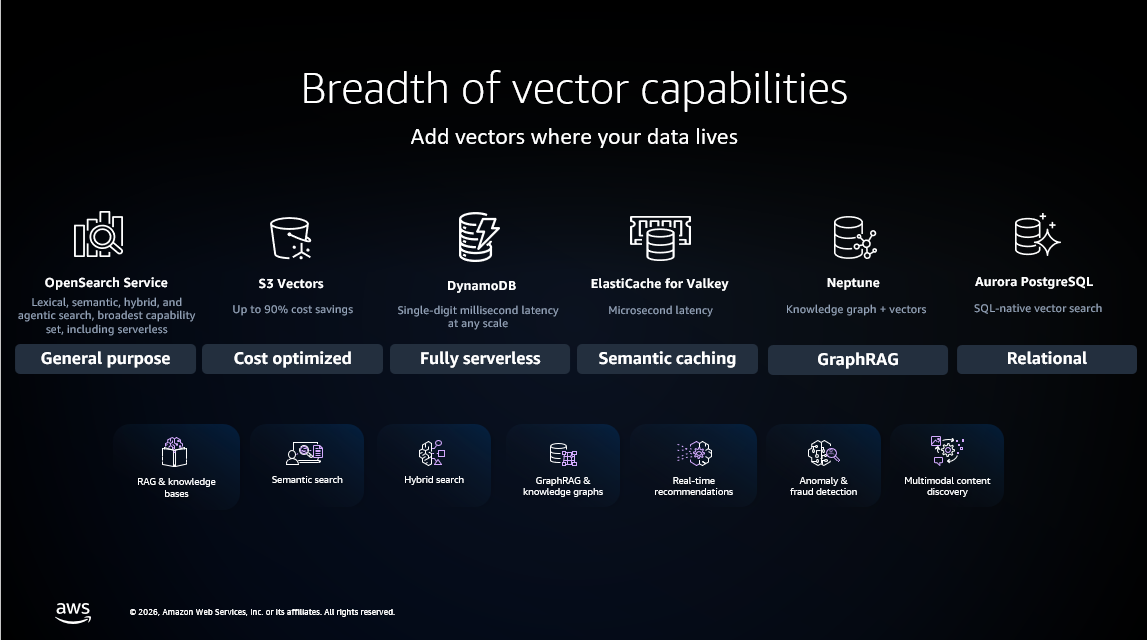
- Amazon Bedrock Knowledge Bases, used for Retrieval-Augmented Generation (RAG), can utilize Amazon OpenSearch Serverless or Amazon S3 Vectors for vector storage, with S3 Vectors offering up to 90% cost reduction compared to specialized vector databases.
🔮 Future ImplicationsAI analysis grounded in cited sources
⏳ Timeline
📎 Sources (16)
Factual claims are grounded in the sources below. Forward-looking analysis is AI-generated interpretation.
Weekly AI Recap
Read this week's curated digest of top AI events →
👉Related Updates
AI-curated news aggregator. All content rights belong to original publishers.
Original source: AWS Machine Learning Blog ↗
This is a summary, not the original. Read the source, or get the weekly briefing.
Weekly AI briefing
One email a week. Unsubscribe anytime.