Scale Agentic AI Without Lock-In
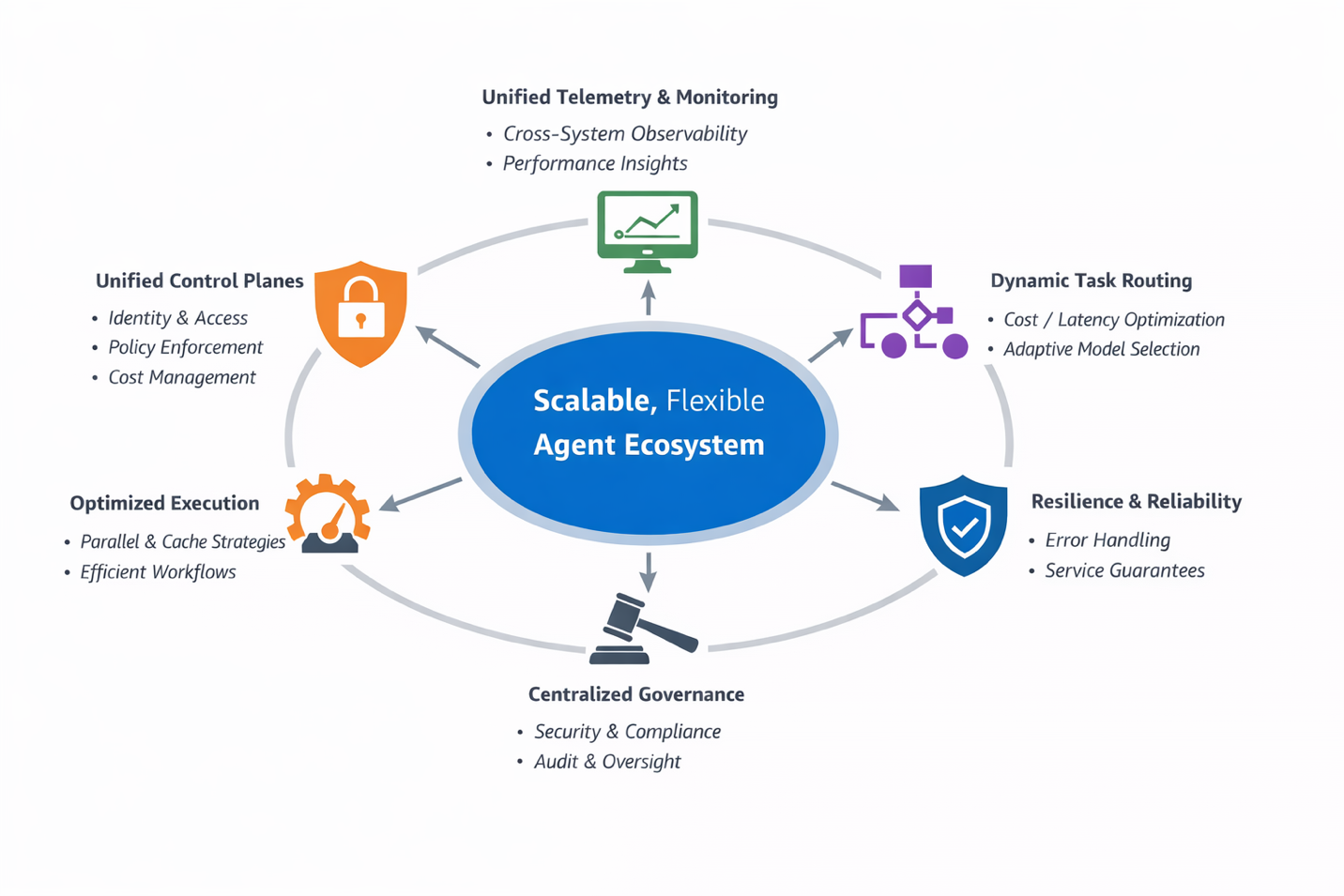
💡Learn enterprise patterns for scaling multi-agent systems across models, frameworks, and providers.
⚡ 30-Second TL;DR
What Changed
Targets enterprise operation of multiple agentic AI systems at scale
Why It Matters
The patterns could help enterprise ML teams avoid rebuilding agent systems when changing models, frameworks, or providers. They also encourage platform teams to design for interoperability from the beginning rather than treating portability as a later migration concern.
What To Do Next
Create a small portability test that runs one agent workflow across two model providers and records framework, tool, and observability dependencies.
Key Points
- •Targets enterprise operation of multiple agentic AI systems at scale
- •Addresses interoperability across diverse frameworks, models, and cloud providers
- •Emphasizes architecture principles that preserve portability and reduce vendor dependence
🧠 Deep Insight
Background and context from public sources — not the original article. 24 sources cited.
🔑 Enhanced Key Takeaways
- •AWS Bedrock Agents is a fully managed service designed to build and deploy generative AI bots capable of autonomously executing complex tasks, integrating with enterprise data sources, and utilizing tools.
- •AWS actively supports and contributes to open protocols for agent interoperability, such as the Agent-to-Agent (A2A) protocol and the Model Context Protocol (MCP), to facilitate seamless communication between agents built on various frameworks and platforms.
- •Amazon Bedrock provides multi-agent collaboration capabilities, enabling specialized AI agents to work together on complex, multi-step workflows, often structured with a hierarchical supervisor and collaborator agent model.
- •AWS offers a Multi-Agent Orchestrator framework that supports both Python and TypeScript, featuring components like Lambda Agents for connecting to other services, Chain Agents for sequential execution, and Comprehend Filter Agents for content analysis.
- •AWS's guidance for agentic AI emphasizes a 'decision-first' operating mindset, where success metrics extend beyond mere task completion to include decision quality, time-to-action, and responsiveness to evolving conditions.
📊 Competitor Analysis▸ Show
| Feature / Platform | AWS (Bedrock Agents, AgentCore) | Google Cloud (Gemini Enterprise Agent Platform, formerly Vertex AI Agent Builder) | Microsoft Azure (Azure AI Foundry, Copilot Studio) |
|---|---|---|---|
| Core Offering | Fully managed service for building, deploying, and orchestrating generative AI agents and multi-agent systems. | Enterprise platform for building, deploying, and governing production AI agents and multi-agent systems. | Suite of tools for building, integrating, and fine-tuning agentic AI solutions, including enhancing Microsoft 365 Copilot. |
| Agent Development | Managed service handles prompt engineering, memory, monitoring, API invocation. Supports integration with open-source frameworks like CrewAI. | Offers Agent Development Kit (ADK) for code-first development and Agent Studio for low-code visual building. Supports LangChain and LangGraph. | Provides tools for building and integrating agents, with an emphasis on extensibility and advanced model fine-tuning. |
| Multi-Agent Orchestration | Supports hierarchical multi-agent collaboration with supervisor and collaborator agents. Uses AWS Step Functions, EventBridge, DynamoDB for orchestration. | Includes multi-agent orchestration capabilities and an Agent Engine for managed deployment. | Enables Power Automate flows to execute tasks, think, plan, and act based on business goals. |
| Interoperability / Openness | Actively supports and contributes to open standards like Agent-to-Agent (A2A) protocol and Model Context Protocol (MCP) for cross-framework communication. Open-sourced Strands Agents framework. | Includes Agent2Agent (A2A) protocol for connecting agents across different vendors and frameworks. ADK is open-source. | Emphasizes extensibility through open standards for tool integration. |
| Enterprise Integration | Seamlessly connects with CRMs, ERPs (e.g., SAP S/4HANA), APIs, databases, and knowledge stores. | Integrates with existing processes and technology stacks. | Integrates with Azure OpenAI, Copilot Studio, and Power Automate. |
🛠️ Technical Deep Dive
- Amazon Bedrock Agents: A fully managed, serverless service that handles prompt engineering, memory management, monitoring, encryption, user permissions, and API invocation for generative AI agents.
- Multi-Agent Collaboration: Implemented with a hierarchical model consisting of a supervisor agent and one or more specialized collaborator agents to tackle complex, multi-step workflows.
- Orchestration Services: Leverages AWS Step Functions for coordinated execution, Amazon EventBridge for event-driven messaging, AWS AppConfig for dynamic configuration toggling, and Amazon DynamoDB for lightweight, tenant-aware state persistence and fast context retrieval.
- Interoperability Protocols: Supports the Model Context Protocol (MCP) for connecting agents to tools and the Agent-to-Agent (A2A) protocol for standardized communication between agents, regardless of their underlying framework, model, or hosting infrastructure.
- Strands Agents SDK: An open-source, provider-independent, and model-agnostic framework that enables developers to build agentic AI workflows and use foundation models across platforms while maintaining deep AWS service integration.
- AgentCore Runtime: Provides the underlying support for building scalable, interoperable multi-agent systems, including A2A protocol support.
- Serverless Integration: AWS Lambda functions act as secure, event-driven gateways to access enterprise systems like SAP S/4HANA, ensuring low latency and no idle costs.
🔮 Future ImplicationsAI analysis grounded in cited sources
⏳ Timeline
📎 Sources (24)
Factual claims are grounded in the sources below. Forward-looking analysis is AI-generated interpretation.
Weekly AI Recap
Read this week's curated digest of top AI events →
👉Related Updates
AI-curated news aggregator. All content rights belong to original publishers.
Original source: AWS Machine Learning Blog ↗
This is a summary, not the original. Read the source, or get the weekly briefing.
Weekly AI briefing
One email a week. Unsubscribe anytime.