AgentCore Automates Cloud Migration
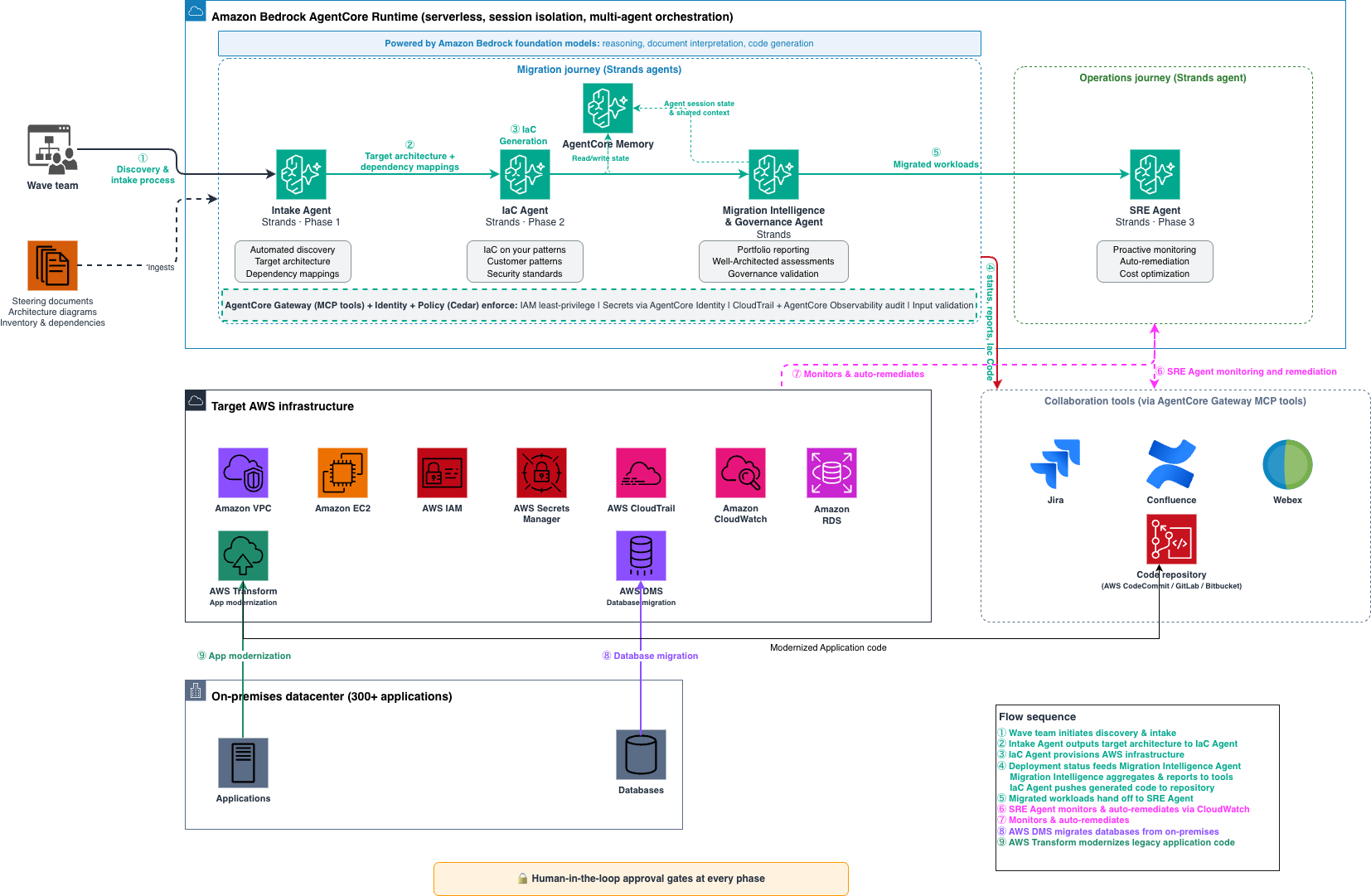
💡See how specialized agents turn cloud migration work from weeks of IaC coding into minutes.
⚡ 30-Second TL;DR
What Changed
Uses Amazon Bedrock AgentCore as the foundation for an enterprise migration agent framework
Why It Matters
This approach could materially reduce the manual effort involved in large cloud migration programs, especially for repeatable assessment and IaC tasks. Enterprises should still validate generated infrastructure, governance decisions, and operational handoffs before production deployment.
What To Do Next
Prototype the discovery-to-IaC workflow in Amazon Bedrock AgentCore on a non-production application and measure generated IaC review time.
Key Points
- •Uses Amazon Bedrock AgentCore as the foundation for an enterprise migration agent framework
- •Assigns purpose-built agents to discovery, IaC generation, governance, and operations
- •Claims to reduce infrastructure-as-code development time from weeks to minutes
🧠 Deep Insight
Background and context from public sources — not the original article. 10 sources cited.
🔑 Enhanced Key Takeaways
- •Amazon Bedrock AgentCore functions as a comprehensive platform for building, deploying, and operating highly capable AI agents securely at scale, supporting any framework, model, or protocol.
- •The platform aims to eliminate the 'undifferentiated heavy lifting' associated with building specialized agent infrastructure, thereby accelerating the transition of AI agents from development to production.
- •AgentCore offers modular services including Runtime for secure execution, Memory for context retention, Gateway for tool integration (converting APIs/Lambda to MCP-compatible tools), Identity for access management, and Observability for monitoring.
- •It is designed to be framework-agnostic, allowing compatibility with popular open-source frameworks such as CrewAI, LangGraph, LlamaIndex, and Strands Agents, as well as various foundation models available both within and outside Amazon Bedrock.
- •AWS Professional Services leverages AgentCore, alongside AWS Transform and advanced development tools like Kiro and Amazon Q Developer CLI, to deliver enterprise migration and modernization solutions.
🛠️ Technical Deep Dive
- Amazon Bedrock AgentCore Runtime: Provides a secure, serverless, scalable environment for hosting and running agents, capable of handling asynchronous processing and long-running agents for up to eight hours, with configurable extensions.
- Amazon Bedrock AgentCore Memory: Offers a managed memory system that enables agents to retain context from interactions, maintaining both immediate and long-term knowledge for personalized conversations.
- Amazon Bedrock AgentCore Gateway: Simplifies the creation, securing, and discovery of tools by converting APIs, Lambda functions, and existing services into Model Context Protocol (MCP)-compatible tools, also supporting semantic tool selection to reduce context size for reasoning models.
- Amazon Bedrock AgentCore Identity: Provides a secure, scalable agent identity and access management service, allowing assignment of unique, verifiable identities to agents for fine-grained access control and secure interactions with enterprise systems.
- Amazon Bedrock AgentCore Observability: Delivers logging and monitoring capabilities, offering real-time visibility into agent performance and behavior for debugging and optimization.
- Built-in Tools: Includes a code interpreter for secure code execution in sandbox environments and a browser tool for agents to interact with websites at scale.
- AgentCore supports any foundation model available in or outside Amazon Bedrock and is compatible with various open-source frameworks such as CrewAI, LangGraph, LlamaIndex, and Strands Agents.
- The platform includes a Policy feature, launched in December 2025, which allows organizations to define boundaries for agent actions using natural language, controlling tool and data access, and permissible actions under specific conditions.
- A managed agent harness feature, introduced in April 2026, simplifies agent creation by replacing upfront build with configuration, allowing agents to be declared and run in three API calls without writing orchestration code.
🔮 Future ImplicationsAI analysis grounded in cited sources
⏳ Timeline
📎 Sources (10)
Factual claims are grounded in the sources below. Forward-looking analysis is AI-generated interpretation.
Weekly AI Recap
Read this week's curated digest of top AI events →
👉Related Updates
AI-curated news aggregator. All content rights belong to original publishers.
Original source: AWS Machine Learning Blog ↗
This is a summary, not the original. Read the source, or get the weekly briefing.
Weekly AI briefing
One email a week. Unsubscribe anytime.