Waymo Reveals Its Custom Robotaxi Chip
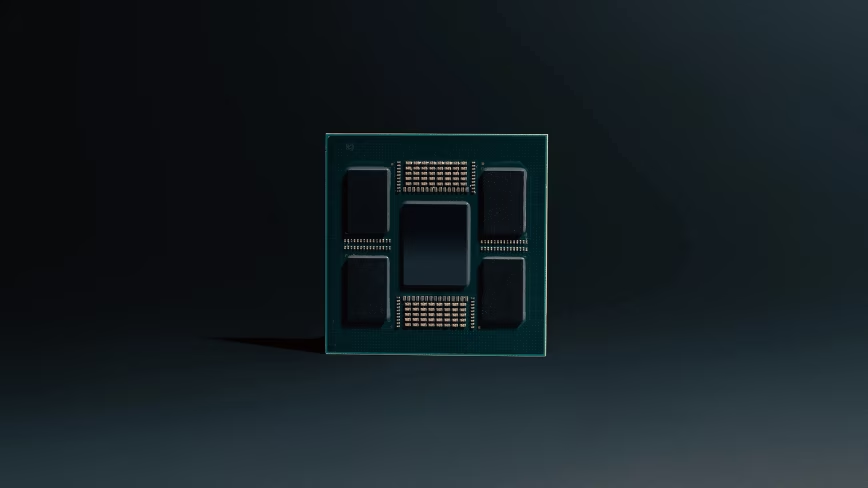
💡See how Waymo is vertically integrating chips and suppliers for scalable autonomous driving.
⚡ 30-Second TL;DR
What Changed
Waymo published the architecture of its robotaxi onboard computer.
Why It Matters
Designing its own silicon could give Waymo more control over compute performance, power consumption, and long-term hardware costs. Publishing the architecture and supplier list also signals greater maturity and transparency in autonomous-driving infrastructure.
What To Do Next
Review Waymo’s published onboard-computing architecture and compare its custom-chip approach with the hardware stack used in your autonomous-driving project.
Key Points
- •Waymo published the architecture of its robotaxi onboard computer.
- •The system includes a custom-designed 5-nanometer chip.
- •Waymo identified seven suppliers involved in building the platform.
🧠 Deep Insight
Background and context from public sources — not the original article. 21 sources cited.
🔑 Enhanced Key Takeaways
- •The custom 5nm chip is an Application-Specific Integrated Circuit (ASIC) specifically designed for front-end processing of raw sensor data, including temporal denoising for improved perception in low light conditions.
- •This ASIC delivers over 1,000 TOPS (trillions of operations per second) of machine learning performance dedicated to this initial data processing.
- •Waymo's overall onboard computing system is described as a "balanced, heterogeneous system" that integrates its custom silicon with third-party CPUs, GPUs, and accelerators from companies like Nvidia and AMD for other computational workloads.
- •The custom 5nm chip is manufactured by Taiwan Semiconductor Manufacturing Co. (TSMC).
- •The development of this custom chip is part of a broader strategy by Waymo and its parent company Alphabet to reduce reliance on external suppliers and manage the increasing costs associated with AI computing infrastructure.
📊 Competitor Analysis▸ Show
| Company | Hardware Strategy | Key Chip/Platform | Sensor Suite (Typical) | Autonomy Level (Claimed/Observed) | Notes |
|---|---|---|---|---|---|
| Waymo | Custom silicon (ASIC for front-end processing) + merchant CPUs/GPUs | Custom 5nm ASIC (1000+ TOPS for front-end), Nvidia, AMD | Lidar, Cameras (13-29), Radar (4-6) | L4 (geofenced robotaxi) | Focus on heterogeneous compute, high sensor redundancy. |
| Tesla | Vision-only, custom silicon | FSD HW4 | Cameras (8) | L2/3 (requires supervision) | Relies heavily on neural networks and vast real-world data. Lower hardware cost (under $5,000 USD for FSD hardware). |
| Cruise (GM) | Custom SoC (past), Nvidia reliance (current) | Custom SoC (halted), likely Nvidia DRIVE | Lidar, Cameras, Radar | L4 (operations suspended in 2024) | Faced operational challenges and suspension of services. |
| Nvidia | Merchant platform supplier | DRIVE Thor (2000 TOPS) | Varies by customer | L4 (platform capability) | Provides powerful, general-purpose platforms to many AV developers. |
🛠️ Technical Deep Dive
- Chip Type: Application-Specific Integrated Circuit (ASIC).
- Process Node: 5-nanometer.
- Primary Function: Front-end processing of raw sensor data streams (lidar, radar, camera), including temporal denoising, before the data reaches the core machine learning inference engine.
- Performance: Over 1,000 TOPS (trillions of operations per second) of machine learning performance dedicated to this front-end processing.
- Overall Compute Architecture: A "balanced, heterogeneous system" that combines Waymo's custom silicon with third-party server-grade CPUs, GPUs, and accelerators from suppliers such as AMD and Nvidia.
- Manufacturing Partner: Taiwan Semiconductor Manufacturing Co. (TSMC).
- Sensor Suite (Fifth-Generation): Included a redesigned 360-degree lidar system with over 300-meter range, high-dynamic range cameras, and an imaging radar system, utilizing 29 cameras and 5 lidars.
- Sensor Suite (Sixth-Generation "Ojai" Platform): Features a reduced sensor count with 13 cameras, 4 lidars, and 6 radars, leading to significantly lower hardware costs (under $20,000 per vehicle).
- Lidar Capabilities: Waymo's lidar system can dynamically adjust laser pulse and beam slew rates to obtain enhanced, higher-resolution scans of specific regions or objects when needed.
🔮 Future ImplicationsAI analysis grounded in cited sources
⏳ Timeline
📎 Sources (21)
Factual claims are grounded in the sources below. Forward-looking analysis is AI-generated interpretation.
Weekly AI Recap
Read this week's curated digest of top AI events →
👉Related Updates




AI-curated news aggregator. All content rights belong to original publishers.
Original source: The Next Web (TNW) ↗
This is a summary, not the original. Read the source, or get the weekly briefing.
Weekly AI briefing
One email a week. Unsubscribe anytime.