Apollo Go Robotaxis Launch on Uber in Dubai
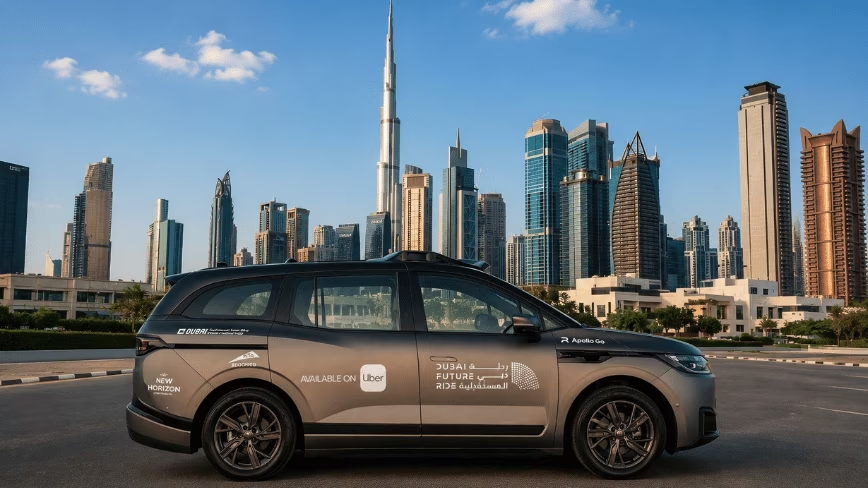
💡Baidu’s driverless fleet is gaining real-world distribution through Uber, not a standalone app.
⚡ 30-Second TL;DR
What Changed
Baidu Apollo Go robotaxis are now available through Uber in Dubai.
Why It Matters
The partnership gives Baidu a consumer-distribution channel beyond its own robotaxi app and lets Uber test autonomous rides within an established marketplace. For AI mobility builders, it demonstrates how autonomous fleets can be integrated into mainstream ride-hailing demand.
What To Do Next
Use the Dubai rollout as a case study and map the required dispatch, rider-consent, and monitoring interfaces for integrating autonomous vehicles into your own mobility app.
Key Points
- •Baidu Apollo Go robotaxis are now available through Uber in Dubai.
- •The vehicles operate without a safety driver onboard.
- •UberX and Uber Comfort bookings may receive an Apollo Go vehicle, while an Autonomous option provides more intentional access.
🧠 Deep Insight
Background and context from public sources — not the original article. 15 sources cited.
🔑 Enhanced Key Takeaways
- •The Baidu Apollo Go robotaxi service is initially available in specific areas of Dubai, namely Umm Suqeim and Jumeirah, with plans for future expansion.
- •The autonomous vehicles deployed are Baidu's sixth-generation RT6 model, which are purpose-built, fully electric robotaxis designed for driverless operations.
- •New Horizon Luxury Transport serves as the local fleet operator managing the Apollo Go vehicles in Dubai.
- •This launch marks Dubai as the first international city where Apollo Go operates under a dual model, offering services both through its proprietary app and via platform partnerships like Uber.
- •The deployment in Dubai is the inaugural step in a multi-year strategic partnership between Uber and Baidu, aiming to scale thousands of Apollo Go vehicles across Uber's global network.
🛠️ Technical Deep Dive
- The robotaxis are Baidu's sixth-generation Apollo RT6, a purpose-built, fully electric vehicle designed for driverless operations.
- Each RT6 vehicle can accommodate up to three passengers.
- The vehicles are equipped with more than 30 sensors for comprehensive environmental perception and real-time onboard data processing.
- The Apollo RT6 is based on Baidu's self-developed "Apollo Galaxy" platform, featuring full driving system redundancy in its architecture, computing unit, and braking system.
- It boasts up to 1,200 TOPS of computing power.
- The design allows for the steering wheel to be removed, enabling the interior to be reconfigured as a dedicated passenger space for fully driverless operations.
- Apollo Go incorporates 10 layers of safety redundancy, covering perception, computing, high-precision positioning, steering, braking, parking, network, thermal management, and 5G connectivity.
- The sensor suite includes 7 types of sensors, totaling 40 units, providing 5x360° environmental perception.
- For high-precision positioning, it utilizes four satellite systems with both star-based and ground-based dual modes, achieving centimeter-level fusion.
🔮 Future ImplicationsAI analysis grounded in cited sources
⏳ Timeline
📎 Sources (15)
Factual claims are grounded in the sources below. Forward-looking analysis is AI-generated interpretation.
Weekly AI Recap
Read this week's curated digest of top AI events →
👉Related Updates



AI-curated news aggregator. All content rights belong to original publishers.
Original source: The Next Web (TNW) ↗
This is a summary, not the original. Read the source, or get the weekly briefing.
Weekly AI briefing
One email a week. Unsubscribe anytime.