Tesla’s Austin Robotaxis Go Fully Driverless
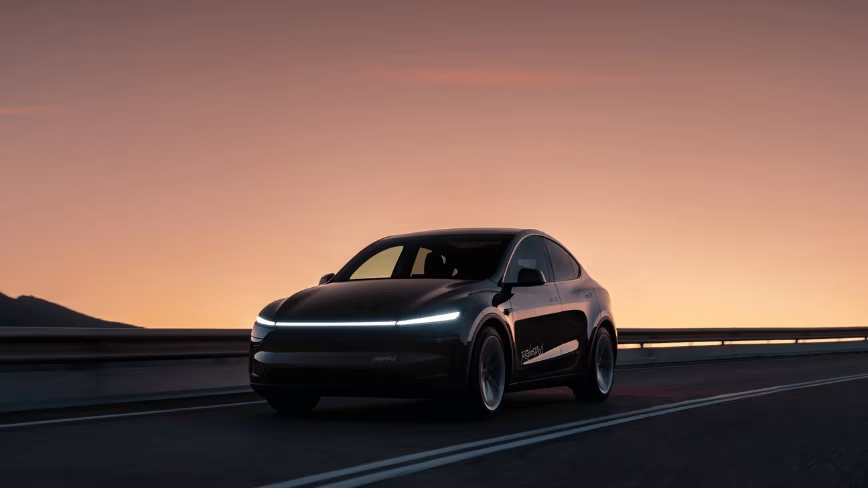
💡Independent tracking suggests Tesla has crossed into fully driverless commercial rides in Austin.
⚡ 30-Second TL;DR
What Changed
All 170 monitored rides reportedly operated without a human safety monitor.
Why It Matters
If sustained, fully driverless operations would represent a significant step toward Tesla’s commercial autonomy ambitions. Independent ride data may also become an important reference for evaluating real-world deployment claims beyond company announcements.
What To Do Next
Track Tesla’s Austin rides alongside intervention and disengagement data before using the deployment as a benchmark for your own autonomous-driving evaluation.
Key Points
- •All 170 monitored rides reportedly operated without a human safety monitor.
- •The rides involved 54 different Tesla robotaxi vehicles in Austin.
- •The result is based on independent tracking over roughly two weeks.
🧠 Deep Insight
Background and context from public sources — not the original article. 32 sources cited.
🔑 Enhanced Key Takeaways
- •Tesla's robotaxi service initially launched in Austin, Texas, on June 22, 2025, operating with human 'safety monitors' in the front passenger seat.
- •Beyond Austin, Tesla's robotaxi service has expanded its unsupervised operations to Dallas, Houston, and Miami, Orlando, and Tampa, Florida.
- •Tesla's Full Self-Driving (FSD) and robotaxi technology primarily relies on a vision-only system using eight cameras, contrasting with competitors like Waymo and Zoox that integrate lidar and radar sensors.
- •New Texas legislation, Senate Bill 2807, which took effect in May 2026, requires commercial automated vehicle operators to obtain state authorization from the Texas Department of Motor Vehicles (TxDMV) and submit emergency response plans.
- •Tesla is developing a purpose-built, two-seater robotaxi called the 'Cybercab,' which features no steering wheel or pedals, with production planned to commence in April 2026.
📊 Competitor Analysis▸ Show
| Company | Approach / Key Features | Operational Areas (Robotaxi) | Autonomy Level | Fleet Size (Robotaxi) | Notes |
|---|---|---|---|---|---|
| Tesla | Vision-only (8 cameras), end-to-end neural network, aims to upgrade existing fleet to full autonomy. Developing purpose-built Cybercab. | Austin, Dallas, Houston, Miami, Orlando, Tampa (unsupervised in many); San Francisco Bay Area (supervised). | FSD (Supervised) is Level 2/3; Robotaxi aims for Level 4/5. | ~227 unsupervised as of Aug 2026; ~135 total in Austin/Bay Area as of Dec 2025. | Cybercab production planned for April 2026. |
| Waymo | Lidar, radar, cameras; extensive real-world and simulation miles. Focus on selling trips. | Phoenix, San Francisco, Los Angeles. Plans for Austin. | Level 4 autonomy in specific conditions. | >1,000 cabs; ~3,871 as of Aug 2026. | Generally considered a leader in the industry. |
| Cruise (GM-backed) | Multi-sensor approach (similar to Waymo). | San Francisco, Phoenix, Austin (limited R&D after 2023 suspension). | Level 4 autonomy in specific conditions. | Surpassed 10 million driverless miles. | Operations suspended in 2023, currently in limited R&D phase. |
| Zoox (Amazon-backed) | Purpose-built vehicle design. | Limited service in Las Vegas and San Francisco. | Level 4/5 autonomy. | ~37 as of Aug 2026. | Focus on experiential, purpose-built robotaxis. |
| Pony.ai | Robotaxis, trucks, and driving systems. | Fremont, Irvine (US); Beijing, Guangzhou (China). | Level 4 autonomy. | N/A | Operates in both US and China. |
| Baidu Apollo Go | N/A | China. | N/A | N/A | Offers heavily subsidized rides during promotional periods in China. |
🛠️ Technical Deep Dive
- FSD Hardware (Onboard Computer):
- Hardware 3 (HW3 / FSD Computer): Custom multiprocessor System-on-a-Chip (SoC) designed for autonomous vehicles, achieving 144 trillion operations per second (TOPS). It includes dual neural network accelerators, ARM CPUs, and dedicated security features. This hardware went into production in late 2018.
- Hardware 4 (HW4 / AI4): Tesla's latest and most powerful chip, reportedly 4-5 times more capable than HW3. It began shipping in January 2023. HW4 features a dual-redundant autonomous driving architecture built around Tesla's AI4 chip, fabricated on a 7-nanometer-class process by Samsung. The dual-SoC system is estimated to provide 100-150 TOPS of INT8 performance.
- Sensors:
- Tesla's current approach is vision-only, utilizing eight cameras. The company stopped installing radar sensors in 2021 and announced it would drop support for ultrasonic sensors in 2022. Newer HW4 Model Y vehicles include an extra camera on the front bumper for improved visibility.
- FSD Software & Training:
- End-to-End Neural Network: The FSD system relies on an end-to-end neural network trained on over 10 billion miles of real-world driving data collected from Tesla's global fleet.
- Dojo Supercomputer: A custom-built, high-performance supercomputer specifically designed to train Tesla's AI systems by processing vast amounts of video data. It uses Tesla's custom-designed D1 chip and went into production in July 2023. Dojo enables the training of geographically adaptive models to improve FSD performance across different regions.
- Single-Stack System (FSD Beta V11): This version innovatively combines highway and city driving algorithms into one cohesive software framework, enhancing efficiency and consistency.
🔮 Future ImplicationsAI analysis grounded in cited sources
⏳ Timeline
📎 Sources (32)
Factual claims are grounded in the sources below. Forward-looking analysis is AI-generated interpretation.
- wikipedia.org
- facebook.com
- fifthlevelconsulting.com
- time.com
- basenor.com
- wikipedia.org
- insideevs.com
- thinkautonomous.ai
- kvue.com
- austintexas.gov
- youtube.com
- patentpc.com
- omahausedcar.com
- reddit.com
- forbes.com
- thedriverlessdigest.com
- nextcurious.com
- landbase.com
- scribd.com
- youtube.com
- teslahubs.com
- substack.com
- shop4tesla.com
- rebellionaire.com
- wikipedia.org
- shop4tesla.com
- teslaacessories.com
- substack.com
- opentools.ai
- wikipedia.org
- dawnproject.com
- reddit.com
Weekly AI Recap
Read this week's curated digest of top AI events →
👉Related Updates

AI-curated news aggregator. All content rights belong to original publishers.
Original source: The Next Web (TNW) ↗
This is a summary, not the original. Read the source, or get the weekly briefing.
Weekly AI briefing
One email a week. Unsubscribe anytime.