vLLM Multi-LoRA Boosts MoE Serving on AWS
💡Serve dozens of fine-tuned MoE models efficiently on AWS with vLLM's new multi-LoRA – scales production inference.
⚡ 30-Second TL;DR
What Changed
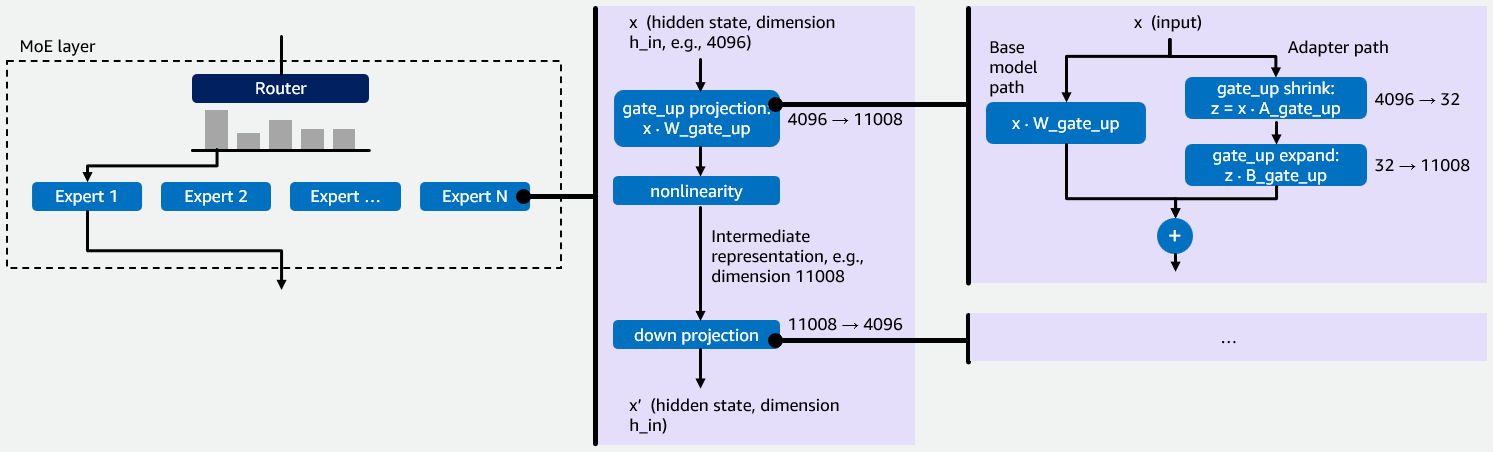
Implemented multi-LoRA inference for MoE models in vLLM
Why It Matters
This feature drastically improves inference scalability for multiple fine-tuned LLMs, reducing costs for production deployments on AWS. AI teams can now handle diverse model variants without proportional resource increases.
What To Do Next
Deploy vLLM on SageMaker to test multi-LoRA inference with your fine-tuned MoE models.
Key Points
- •Implemented multi-LoRA inference for MoE models in vLLM
- •Kernel-level optimizations for improved performance
- •Supports serving dozens of fine-tuned models efficiently
- •Demonstrated using GPT-OSS 20B on SageMaker and Bedrock
🧠 Deep Insight
Background and context from public sources — not the original article. 9 sources cited.
🔑 Enhanced Key Takeaways
- •vLLM's NFS-LoRA replicates full LoRA adapters A and B across devices, while S-LoRA shards them using tensor parallelism to reduce memory but introduces communication overhead via all-gather and all-reduce operations[1].
- •GPT-OSS 20B is a specific open-source MoE model used to demonstrate multi-LoRA serving, alongside other supported MoE models like Mixtral, Deepseek-V2, and Deepseek-V3[3][4][5].
- •Multi-LoRA in vLLM builds on S-LoRA techniques for serving thousands of adapters by replacing matrix computations with XW + XAB and optimizing for transformer-based LLMs[1].
🛠️ Technical Deep Dive
- •In NFS-LoRA (vLLM's default pre-S-LoRA), adapters A and B are fully replicated on each device, avoiding sharding but increasing memory usage[1].
- •S-LoRA shards LoRA matrices A and B across GPUs using tensor parallelism, computing XAB in parallel but requiring all-gather for inputs and all-reduce for outputs, with merged query/key/value projections reducing operations to one larger all-gather[1].
- •vLLM supports MoE models requiring an 'experts' attribute in sparse MoE blocks, compatible with architectures like TransformersForCausalLM, and enables tensor/pipeline/expert parallelism for distributed inference[3][4][6].
🔮 Future ImplicationsAI analysis grounded in cited sources
⏳ Timeline
📎 Sources (9)
Factual claims are grounded in the sources below. Forward-looking analysis is AI-generated interpretation.
Weekly AI Recap
Read this week's curated digest of top AI events →
👉Related Updates

AI-curated news aggregator. All content rights belong to original publishers.
Original source: AWS Machine Learning Blog ↗
This is a summary, not the original. Read the source, or get the weekly briefing.
Weekly AI briefing
One email a week. Unsubscribe anytime.