US Launches First Strategic Lithium Reserve
💡Strategic shift in US mineral policy directly impacts the hardware supply chain for AI and robotics.
⚡ 30-Second TL;DR
What Changed
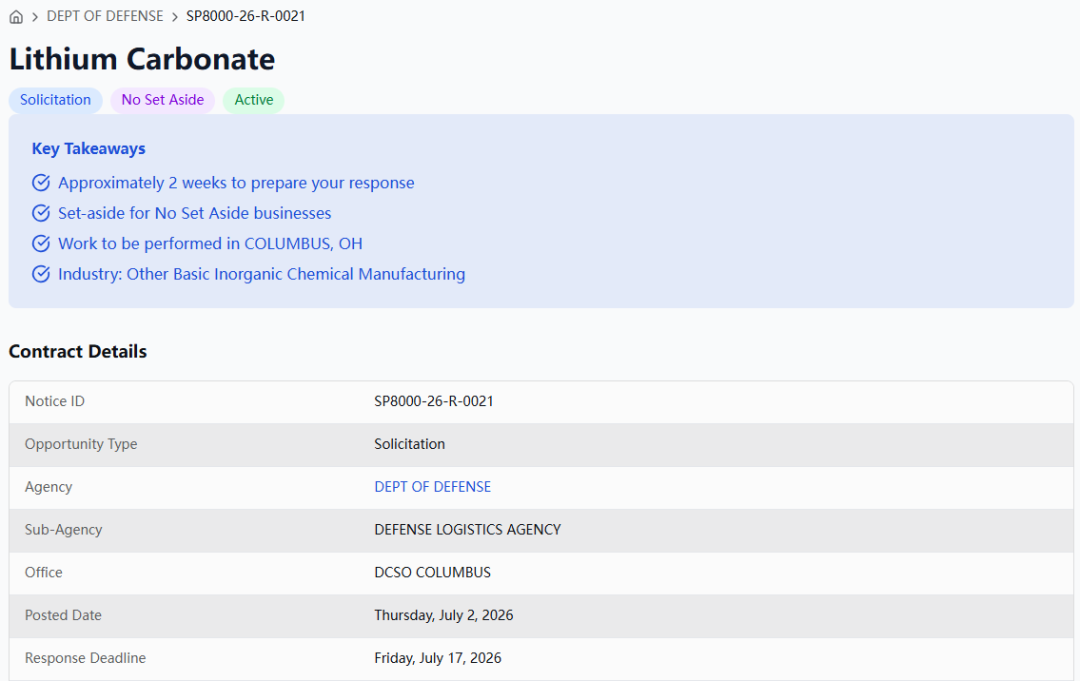
US Department of Defense initiates a 5-year, 16,167-ton lithium carbonate procurement plan.
Why It Matters
This move signals a major shift in US industrial policy, potentially impacting the cost and availability of battery materials for AI-driven hardware and robotics.
What To Do Next
Monitor the supply chain costs for high-density battery components if you are building edge AI hardware or robotics.
Key Points
- •US Department of Defense initiates a 5-year, 16,167-ton lithium carbonate procurement plan.
- •Thacker Pass lithium mine in Nevada is set to begin production by late 2026.
- •US aims to reduce reliance on foreign refining, as 75% of current refining capacity is located in China.
- •The 'Project Vault' initiative establishes a $12 billion strategic mineral reserve.
🧠 Deep Insight
AI-generated analysis for this event — not the original article.
🔑 Enhanced Key Takeaways
- •The procurement initiative is managed by the Defense Logistics Agency (DLA) Strategic Materials division, which oversees the National Defense Stockpile (NDS).
- •Lithium carbonate was specifically chosen for the stockpile due to its versatility as a precursor for both lithium-ion battery cathodes and various high-temperature glass and ceramic applications.
- •The 'Project Vault' initiative is part of a broader legislative effort under the National Defense Authorization Act (NDAA) to secure critical mineral supply chains against geopolitical volatility.
- •The US government is leveraging the Defense Production Act (DPA) Title III authorities to provide financial incentives and loan guarantees to domestic lithium extraction and processing facilities.
- •Environmental and permitting hurdles have historically delayed domestic lithium projects, leading the Department of the Interior to streamline the NEPA review process for sites designated as critical infrastructure.
🛠️ Technical Deep Dive
- The procurement targets battery-grade lithium carbonate with a minimum purity level of 99.5% Li2CO3.
- Impurity thresholds for the stockpile include strict limits on magnetic particles, iron (Fe), sodium (Na), and potassium (K) to ensure compatibility with high-nickel cathode manufacturing.
- Storage protocols require climate-controlled, moisture-resistant facilities to prevent the hygroscopic nature of lithium carbonate from causing clumping or degradation over long-term storage.
- The conversion process from spodumene concentrate or brine to the required carbonate specification involves multi-stage purification, including carbonation and crystallization phases.
🔮 Future ImplicationsAI analysis grounded in cited sources
⏳ Timeline
Weekly AI Recap
Read this week's curated digest of top AI events →
👉Related Updates

AI-curated news aggregator. All content rights belong to original publishers.
Original source: 虎嗅 ↗
This is a summary, not the original. Read the source, or get the weekly briefing.
Weekly AI briefing
One email a week. Unsubscribe anytime.