The Hidden Cost of Free DeepSeek
💡A sharp reminder to examine the total cost behind supposedly free AI models.
⚡ 30-Second TL;DR
What Changed
The headline challenges the idea that DeepSeek access is truly free.
Why It Matters
If the article identifies material operating or infrastructure costs, AI builders may need to reassess the total cost of ownership of supposedly low-cost models. However, the excerpt alone is insufficient to draw conclusions about DeepSeek’s actual economics.
What To Do Next
Before choosing DeepSeek for production, calculate inference, hosting, monitoring, and data-governance costs instead of comparing API prices alone.
Key Points
- •The headline challenges the idea that DeepSeek access is truly free.
- •It points toward hidden costs in AI usage, operation, or distribution.
- •The available excerpt does not establish which costs or pricing mechanisms are involved.
🧠 Deep Insight
Background and context from public sources — not the original article. 19 sources cited.
🔑 Enhanced Key Takeaways
- •DeepSeek offers both open-weight models for self-hosting and a commercial API for its large language models.
- •While the DeepSeek Chat interface (web and mobile app) is free for individual consumer use, its API access is priced on a per-token basis.
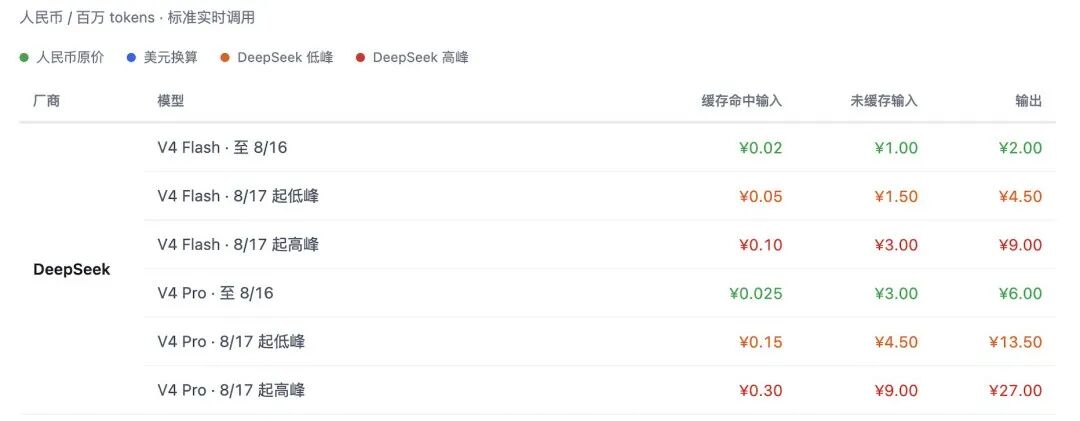
- •DeepSeek's API pricing for its latest V4 models (Flash and Pro) features distinct rates for input (with a significant discount for cache hits) and output tokens.
- •DeepSeek-V4-Flash is positioned as one of the most cost-effective frontier-class APIs available, with per-token rates significantly lower than competitors like OpenAI's GPT-4o.
- •Although some DeepSeek models are released under the permissive MIT License, the overarching 'DeepSeek license' for the models themselves includes use-based restrictions, which means they do not fully align with the definition of open-source by some standards.
📊 Competitor Analysis▸ Show
| Feature/Model | DeepSeek-V4-Flash (API) | DeepSeek-V4-Pro (API) | OpenAI GPT-4o (API) | OpenAI GPT-4o mini (API) | Meta Llama 3/4 (Open-weight) |
|---|---|---|---|---|---|
| Pricing (per 1M tokens) | Input: $0.14 (cache miss) / $0.0028 (cache hit) Output: $0.28 | Input: $0.435 (cache miss) / $0.003625 (cache hit) Output: $0.87 | Input: ~$2.50 Output: ~$10.00 | Input: ~$0.15 Output: ~$0.60 | Self-hostable (no direct API pricing) |
| Context Window | 1M tokens | 1M tokens | Varies by model, generally large | Varies by model, generally large | Up to 10M tokens (Llama 4 Scout) |
| Max Output | 384K tokens | 384K tokens | Varies by model | Varies by model | Varies by model |
| Key Strengths | Cost-efficiency, strong coding, mathematical reasoning, Chinese language capabilities | Higher quality, strong reasoning, cost-efficient compared to top-tier models | Broad general-purpose capabilities, multimodal, large ecosystem | Cost-effective general-purpose, good for lighter tasks | Broad general-purpose, massive ecosystem, strong community, US provenance |
| Licensing | DeepSeek License (open-weight with use restrictions), some MIT License | DeepSeek License (open-weight with use restrictions), some MIT License | Proprietary API | Proprietary API | Open-weight with commercial use restrictions (e.g., 700M MAU threshold for some models) |
🛠️ Technical Deep Dive
- DeepSeek-V2 and subsequent models, including DeepSeek-V4, incorporate a Mixture-of-Experts (MoE) architecture, which contributes to their efficiency.
- DeepSeek-V2 introduced Multi-head Latent Attention (MLA) as a key architectural innovation.
- DeepSeek-V4 models support an extensive 1 million token context window and a maximum output of 384,000 tokens.
- DeepSeek-Coder-V2 is a 236 billion-parameter MoE model, trained on a vast dataset of 10.2 trillion tokens, comprising 60% source code, 10% mathematical corpus, and 30% natural language, covering 338 programming languages.
- The full 671 billion-parameter DeepSeek-R1 model was reportedly trained for approximately $6 million, a significantly lower cost compared to the estimated $100 million for OpenAI's GPT-4.
- Self-hosting larger DeepSeek models, such as the full 671B R1, demands substantial GPU infrastructure, typically requiring a multi-GPU setup like 8x NVIDIA H100 80GB GPUs for INT4 quantization or 8x H200 141GB GPUs for FP8 precision.
- DeepSeek Harness, released as a developer preview, is an open-source execution runtime for AI agents, built upon the Cordis micro-kernel architecture, allowing for modular and interchangeable components.
🔮 Future ImplicationsAI analysis grounded in cited sources
⏳ Timeline
📎 Sources (19)
Factual claims are grounded in the sources below. Forward-looking analysis is AI-generated interpretation.
Weekly AI Recap
Read this week's curated digest of top AI events →
👉Related Updates

AI-curated news aggregator. All content rights belong to original publishers.
Original source: 钛媒体 ↗
This is a summary, not the original. Read the source, or get the weekly briefing.
Weekly AI briefing
One email a week. Unsubscribe anytime.