Six Signals After Unitree's Valuation Frenzy
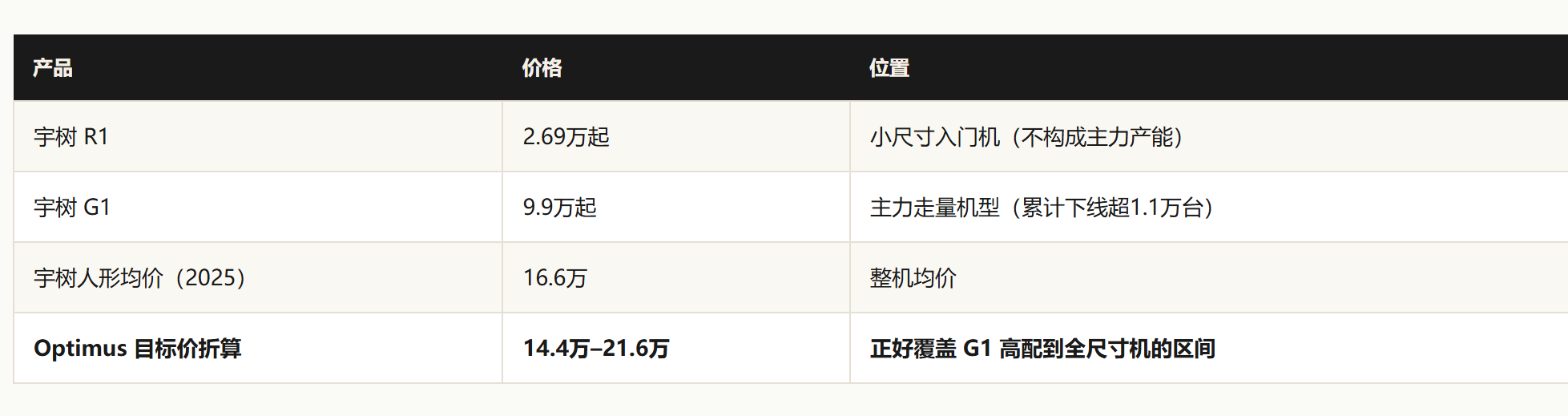
💡Unitree's valuation story needs operating data, not hype—six signals may decide what happens next.
⚡ 30-Second TL;DR
What Changed
Unitree Robotics' reported 440 billion valuation has triggered intense market excitement.
Why It Matters
For robotics founders and builders, the analysis reinforces the importance of validating commercialization, deployment, and operating metrics rather than relying on valuation momentum. Strong valuations can accelerate hiring and funding, but weak underlying signals may quickly reverse expectations.
What To Do Next
Build a Unitree Robotics monitoring sheet that tracks each of the article's six signals alongside deployments, customer adoption, production scale, revenue, and gross margin.
Key Points
- •Unitree Robotics' reported 440 billion valuation has triggered intense market excitement.
- •The company's three-year outlook should be assessed through six verifiable data signals.
- •Each signal could materially alter the assumptions behind the current valuation.
- •Investors and industry observers should prioritize operating data over headline market sentiment.
🧠 Deep Insight
Background and context from public sources — not the original article. 28 sources cited.
🔑 Enhanced Key Takeaways
- •Unitree Robotics officially listed on Shanghai's STAR Market on August 19, 2026, with its stock opening at 1,100 yuan, a 629.44% increase from its IPO price of 150.80 yuan, briefly pushing its market capitalization to approximately 445 billion yuan (US$66 billion).
- •Unlike many humanoid robot companies that are still operating at a loss, Unitree achieved an operating revenue of 1.699 billion yuan in 2025 and a net profit after deducting non-recurring items of 591 million yuan, with its gross profit margin exceeding 60%.
- •In 2025, Unitree's humanoid robot shipments exceeded 5,500 units, making it a world leader in humanoid robot sales, with humanoid robots surpassing quadruped robots to become the company's largest single product category by revenue.
- •Approximately 70% of Unitree's robot sales in 2025 were to universities and research institutions, with less than 10% for commercial deployments, indicating a need to prove operational durability and scalable use cases in industrial settings.
- •The company has raised a total of $252 million across 6 funding rounds, with its largest being a $139 million Series B round in February 2024, and counts Meituan, Source Code Capital, and Shenzhen Capital Group among its investors.
📊 Competitor Analysis▸ Show
| Feature/Company | Unitree (Go1/Go2/B2) | Boston Dynamics (Spot) | ANYbotics (ANYmal X) | DEEP Robotics (X30) |
|---|---|---|---|---|
| Primary Focus | Research, education, light industrial, consumer (quadrupeds); R&D, education (humanoids) | Industrial inspection, hazardous environments | Industrial inspection (oil & gas, chemical) | Industrial inspection, security, emergency response |
| Top Speed (Quadruped) | Go1: 4.7 m/s (17 km/h); B2: up to 3.96 m/s (13 ft/s) | Spot: up to 1.6 m/s (5.76 km/h) | ANYmal X: up to 0.97 m/s (3.2 ft/s) | X30: up to 3.96 m/s (13 ft/s) |
| Payload Capacity | Go1: 3-5 kg; B2: up to 20 kg (44 lbs) | Spot: up to 14 kg | Inspection payload, optional gas sensor payload | X30: up to 20 kg (44 lbs) |
| Battery Life | Go1: 1-2.5 hours (6000mAh); H1: 864Wh, quickly replaceable | Spot: ~90 minutes | ANYmal X: 60-120 minutes (932.4 Wh) | X30: 2.5-4 hours |
| Pricing (Approx.) | Go2 Air: ~$1,600 (consumer); H1: ~$90,000 (R&D, quote anchor) | Spot: $74,500 - $150,000+ | Not publicly listed, likely high-end industrial | Not publicly listed, likely high-end industrial |
| Key Features | Low-cost, agile, open SDK, AI, side-follow system (Go1); World record speed (H1) | Advanced autonomy, rugged, 360° cameras, thermal imaging, terrain adaptability | ATEX certified, nitrogen-pressurized body, inspection payloads, operates in hazardous environments | IP67 rated, high speed, obstacle clearance, operates in harsh conditions |
| Market Share (Quadruped) | 52% in 1H 2026 (down from 75% in 1H 2025) | Significant player, but lower volume than Unitree | N/A | Gaining ground, 10% in 1H 2026 |
🛠️ Technical Deep Dive
- Unitree Go1 EDU Quadruped Robot:
- Dimensions: 588 × 220 × 290 mm.
- Weight: ~12 kg.
- Top Speed: 4.7 m/s (17 km/h).
- Payload Capacity: ~3–5 kg.
- Battery: 6,000 mAh Li-ion, 1–2.5 hours endurance.
- Operating System: Linux (Ubuntu) with ROS support.
- Processors: Built-in AI with 16-core CPU + 384-core GPU (1.5 TFLOPS).
- Sensor Suite: Multiple depth cameras, ultrasonic sensors, foot force sensors, IMU. 5 sets of fisheye binocular depth sensing.
- Joints: 12 degrees of freedom, patented ultra-lightweight, low-noise, long-life power joints. Body/Thigh Joint C1-8 (23.7 N·m MAX), Knee Joint C1-8×1.5 ratio (35.55 N·m MAX). Patented heat pipe-assisted heat dissipation system in knee joint motor.
- Features: Intelligent Side-Follow System (ISS) using patented wireless vector control and positioning technology.
- Unitree H1 Humanoid Robot:
- Height: ~180 cm.
- Weight: 47 kg (with battery).
- Top Speed: 3.3 m/s (world record for full-size humanoid), potential mobility > 5 m/s.
- Degrees of Freedom (DoF): 5 per leg, 4 per arm (total 18-19 actuated joints including torso).
- Battery: 864 Wh (15Ah), quickly replaceable.
- Sensors: 3D LiDAR + Depth Camera (Intel D435i).
- Computing Power: Intel Core i5 (Platform Function), Intel Core i7 (User Development), optional Nvidia Jetson GPU.
- Maximum Joint Torque: 360 N·m (legs), 120 N·m (arms). Peak Torque Density: 189 N·m/Kg.
- Applications: Research, education, innovation, potential for industrial applications, emergency response.
- Unitree H1-2 Humanoid Robot:
- Height: ~178 cm.
- Weight: 70 kg.
- Degrees of Freedom: 6 per leg, 7 per arm (total 27 DoF).
- Payload: 7-21 kg (rated arm load).
- Focus: Manipulation-focused variant, trades sprint speed for manipulation capabilities.
🔮 Future ImplicationsAI analysis grounded in cited sources
⏳ Timeline
📎 Sources (28)
Factual claims are grounded in the sources below. Forward-looking analysis is AI-generated interpretation.
- cnmra.com
- scmp.com
- electronicsforyou.biz
- markets.com
- cryptonews.net
- japantimes.co.jp
- 36kr.com
- therobotreport.com
- seekingalpha.com
- startupfundraising.com
- tracxn.com
- tracxn.com
- maverickdrone.com
- generationrobots.com
- robostore.com
- inrobots.shop
- eweek.com
- unitree.com
- unitree.com
- wevolver.com
- unitree.com
- bybit.com
- robozaps.com
- smartanalyticsglobal.com
- substack.com
- top3dshop.com
- eweek.com
- wikipedia.org
Weekly AI Recap
Read this week's curated digest of top AI events →
👉Related Updates


AI-curated news aggregator. All content rights belong to original publishers.
Original source: 钛媒体 ↗
This is a summary, not the original. Read the source, or get the weekly briefing.
Weekly AI briefing
One email a week. Unsubscribe anytime.