Scientists Create Self-Degrading 'Living Plastic'
💡Sustainable hardware is becoming a key differentiator for AI-integrated consumer devices.
⚡ 30-Second TL;DR
What Changed
Material features an embedded self-destruct mechanism
Why It Matters
Sustainable material science is critical for the future of hardware manufacturing, including the physical components used in AI-powered consumer electronics.
What To Do Next
Evaluate the potential for integrating biodegradable materials into your hardware product roadmap to meet future ESG standards.
Key Points
- •Material features an embedded self-destruct mechanism
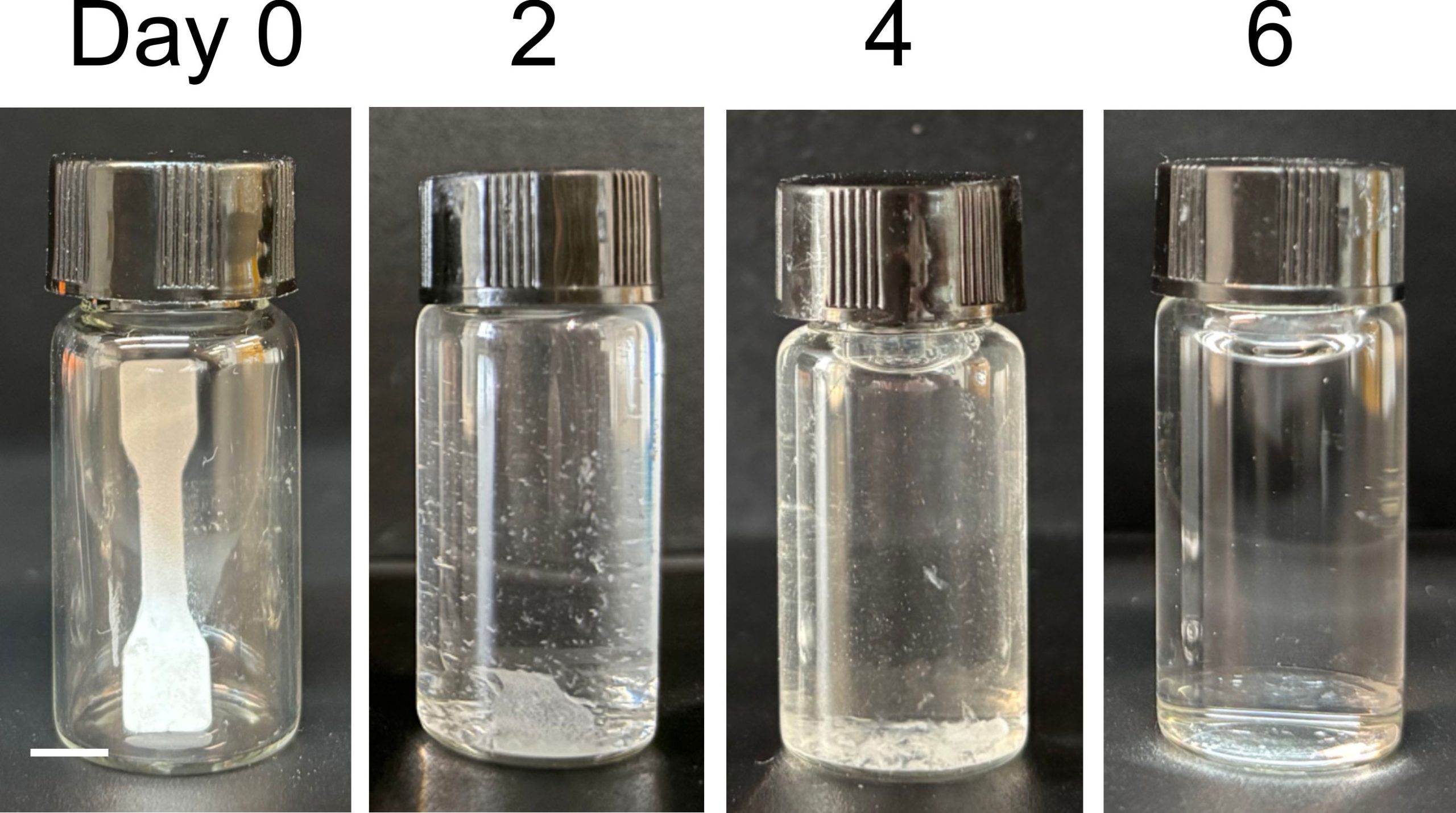
- •Complete degradation achieved within six days
- •Leaves no microplastic residue after decomposition
🧠 Deep Insight
Background and context from public sources — not the original article. 8 sources cited.
🔑 Enhanced Key Takeaways
- •The 'living plastic' is composed of polycaprolactone (PCL), a polymer commonly used in 3D printing and surgical sutures, embedded with dormant spores of engineered Bacillus subtilis bacteria.
- •The self-destruct mechanism is activated by exposing the material to a nutrient broth heated to 50 degrees Celsius (122 degrees Fahrenheit), which triggers the germination of the dormant bacterial spores.
- •The degradation process relies on two cooperative, polymer-degrading enzymes produced by the engineered Bacillus subtilis: one acts as a 'random chopper' to snip long polymer chains, while the other 'chews' these fragments into their monomer building units.
- •This dual-enzyme approach significantly improves degradation efficiency compared to previous attempts that primarily relied on a single enzyme, ensuring complete breakdown without generating microplastics.
- •As a proof-of-concept, a wearable plastic electrode fabricated from this living plastic successfully degraded completely within two weeks, demonstrating its practical applicability.
🛠️ Technical Deep Dive
- Microbial Engineering: Bacillus subtilis bacteria were genetically engineered to produce two distinct polymer-degrading enzymes.
- Enzyme Mechanism: One enzyme functions as a 'random chopper,' breaking long polymer chains into smaller segments. The second enzyme then systematically 'chews' these smaller pieces from their ends, converting them into their basic monomer building blocks.
- Polymer Matrix: The engineered Bacillus subtilis are incorporated in their dormant spore form into a polycaprolactone (PCL) polymer matrix.
- Activation Mechanism: The self-degradation is initiated by exposing the material to a nutrient broth at 50°C (122°F), which triggers the germination and activation of the embedded bacterial spores.
- Degradation Products: The cooperative action of the enzymes ensures the complete breakdown of the plastic into its original monomer units, preventing the formation of microplastic residue.
- Efficiency Improvement: This dual-enzyme system represents an advancement over earlier enzymatic degradation methods that often utilized only a single enzyme, leading to more efficient and complete material breakdown.
🔮 Future ImplicationsAI analysis grounded in cited sources
⏳ Timeline
📎 Sources (8)
Factual claims are grounded in the sources below. Forward-looking analysis is AI-generated interpretation.
Weekly AI Recap
Read this week's curated digest of top AI events →
👉Related Updates
AI-curated news aggregator. All content rights belong to original publishers.
Original source: cnBeta (Full RSS) ↗
This is a summary, not the original. Read the source, or get the weekly briefing.
The weekly digest
One email a week. Unsubscribe anytime.