來源cnBeta (Full RSS)•較早收集於 3h
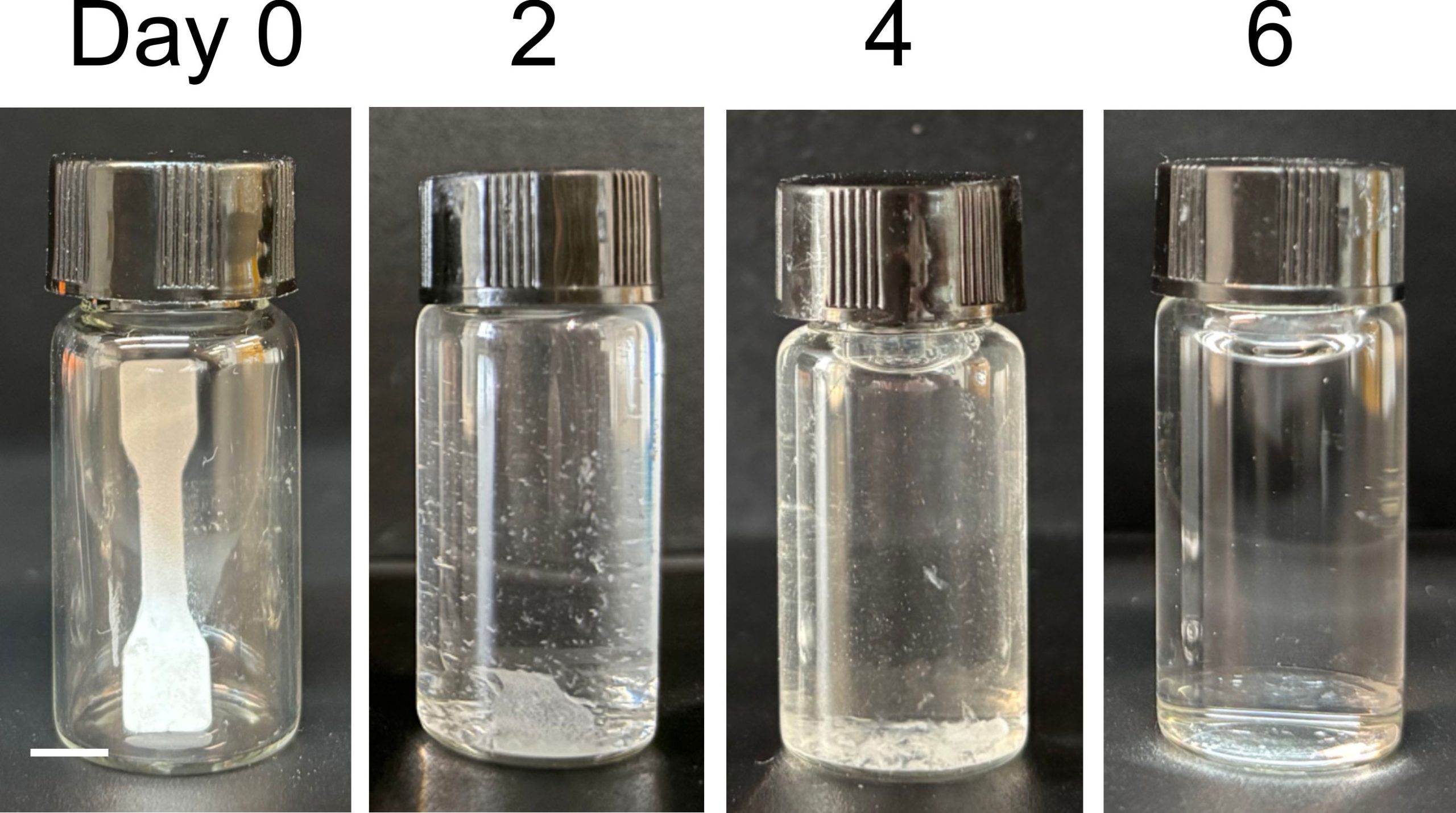
科學家研發可於六天內降解的「活體塑料」
💡永續硬體正成為 AI 整合消費裝置的關鍵差異化因素。
⚡ 30 秒速覽
有什麼變化
材料內嵌自毀機制
為什麼重要
永續材料科學對於硬體製造的未來至關重要,包括 AI 消費電子產品中所使用的實體組件。
下一步行動
評估將可生物降解材料整合至硬體產品藍圖的可能性,以符合未來的 ESG 標準。
誰應關注:Developers & AI Engineers
關鍵要點
- •材料內嵌自毀機制
- •六天內即可完全降解
- •分解後不產生微塑料殘留
🧠 深度解析
背景與延伸:來自公開資料,非原文內容。引用 8 個來源。
🔑 增強重點摘要
- •The 'living plastic' is composed of polycaprolactone (PCL), a polymer commonly used in 3D printing and surgical sutures, embedded with dormant spores of engineered Bacillus subtilis bacteria.
- •The self-destruct mechanism is activated by exposing the material to a nutrient broth heated to 50 degrees Celsius (122 degrees Fahrenheit), which triggers the germination of the dormant bacterial spores.
- •The degradation process relies on two cooperative, polymer-degrading enzymes produced by the engineered Bacillus subtilis: one acts as a 'random chopper' to snip long polymer chains, while the other 'chews' these fragments into their monomer building units.
- •This dual-enzyme approach significantly improves degradation efficiency compared to previous attempts that primarily relied on a single enzyme, ensuring complete breakdown without generating microplastics.
- •As a proof-of-concept, a wearable plastic electrode fabricated from this living plastic successfully degraded completely within two weeks, demonstrating its practical applicability.
🛠️ 技術深入
- Microbial Engineering: Bacillus subtilis bacteria were genetically engineered to produce two distinct polymer-degrading enzymes.
- Enzyme Mechanism: One enzyme functions as a 'random chopper,' breaking long polymer chains into smaller segments. The second enzyme then systematically 'chews' these smaller pieces from their ends, converting them into their basic monomer building blocks.
- Polymer Matrix: The engineered Bacillus subtilis are incorporated in their dormant spore form into a polycaprolactone (PCL) polymer matrix.
- Activation Mechanism: The self-degradation is initiated by exposing the material to a nutrient broth at 50°C (122°F), which triggers the germination and activation of the embedded bacterial spores.
- Degradation Products: The cooperative action of the enzymes ensures the complete breakdown of the plastic into its original monomer units, preventing the formation of microplastic residue.
- Efficiency Improvement: This dual-enzyme system represents an advancement over earlier enzymatic degradation methods that often utilized only a single enzyme, leading to more efficient and complete material breakdown.
🔮 前景展望基於引用來源的 AI 分析
This technology could enable 'programmable durability' for plastics.
By embedding activatable microbes, plastics could be designed to remain stable during their useful life and then self-destruct on command, addressing the environmental issue of long-lasting single-use items.
The approach could be adapted for a wider range of plastic types.
Researchers are optimistic that similar strategies involving engineered microbes and cooperative enzymes could be applied to other common single-use plastics beyond polycaprolactone.
This innovation has the potential to significantly reduce global microplastic pollution.
The highly efficient and complete degradation process, facilitated by the cooperative enzymes, ensures that the plastic breaks down entirely into monomers without leaving behind harmful microplastic particles.
⏳ 時間線
2016
Discovery of plastic-munching bacteria, inspiring research into enzymatic plastic degradation.
2024-08-29
Researchers at the Chinese Academy of Sciences (CAS), including Chenwang Tang, publish work on embedding engineered *Bacillus subtilis* spores producing lipase into polycaprolactone (PCL) plastic, achieving degradation within a week with a second lipase.
2026-04-30
A team including Zhuojun Dai, Jin Geng, and Dianpeng Qi reports in ACS Applied Polymer Materials on an improved 'living plastic' using two cooperative, engineered *Bacillus subtilis* strains to fully degrade polycaprolactone within six days.
📎 來源 (8)
Factual claims are grounded in the sources below. Forward-looking analysis is AI-generated interpretation.
📰
AI 週報
閱讀本週精選 AI 大事摘要 →
👉相關動態
AI 策展新聞聚合。所有內容版權歸原始發布者所有。
原始來源: cnBeta (Full RSS) ↗
每週電子報
每週一封,可隨時退訂。