NVIDIA Pushes 800V DC for AI Factories
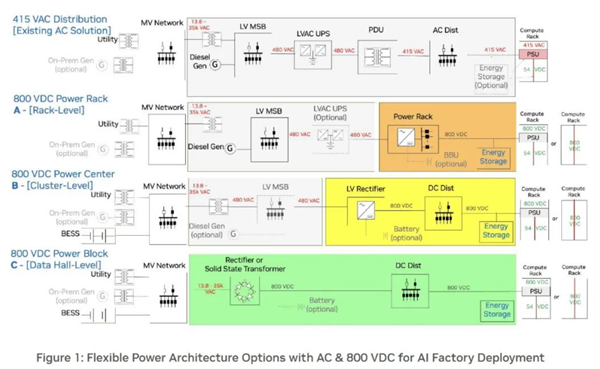
💡800V DC could remove a major power bottleneck in dense GPU data centers.
⚡ 30-Second TL;DR
What Changed
The architecture is designed to replace portions of traditional AC power delivery in AI factories.
Why It Matters
If broadly adopted, 800V DC could lower electrical losses and simplify power delivery for next-generation AI data centers. It may also accelerate a shift in data-center design toward higher-voltage distribution and new rack-level power components.
What To Do Next
Ask your data-center and rack-power suppliers whether their roadmap supports the OCP 800V DC specification, then model conversion losses against your next GPU cluster design.
Key Points
- •The architecture is designed to replace portions of traditional AC power delivery in AI factories.
- •Fewer conversion stages can send more power directly from the grid to GPUs and accelerators.
- •More than 80 equipment vendors are reportedly following the new 800V DC specification.
- •The approach targets power-density and energy-efficiency limits in large-scale AI clusters.
🧠 Deep Insight
AI-generated analysis for this event.
🔑 Enhanced Key Takeaways
- •The 800V DC architecture is specifically designed to mitigate the 'copper tax' by reducing the cross-sectional area of cabling required to deliver massive power loads to high-density GPU racks.
- •This initiative aligns with the Open Compute Project (OCP) 'Advanced Rack' standards, aiming to standardize power shelf designs across hyperscale data centers.
- •By eliminating multiple AC-to-DC and DC-to-DC conversion steps, the architecture targets a reduction in total data center power usage effectiveness (PUE) by approximately 3-5%.
- •The transition to 800V DC is necessitated by the thermal and power constraints of next-generation AI accelerators, which are pushing individual rack power requirements toward the 100kW+ threshold.
- •NVIDIA is collaborating with power supply unit (PSU) manufacturers to integrate wide-bandgap semiconductors, such as Gallium Nitride (GaN) and Silicon Carbide (SiC), to handle the higher voltage switching requirements efficiently.
🛠️ Technical Deep Dive
- Architecture utilizes a centralized power distribution unit (PDU) that converts grid-level AC to 800V DC at the row or rack level.
- Eliminates the traditional intermediate 48V bus conversion stage, moving directly to a higher voltage distribution bus to minimize I2R (resistive) losses.
- Employs advanced busbar designs capable of handling high-voltage DC safely within the rack environment.
- Requires specialized circuit breakers and arc-fault detection systems specifically rated for high-voltage DC to ensure safety compliance.
- Facilitates the use of smaller, lighter power cables, improving airflow and cooling efficiency within the server chassis.
🔮 Future ImplicationsAI analysis grounded in cited sources
⏳ Timeline
Weekly AI Recap
Read this week's curated digest of top AI events →
👉Related Updates

AI-curated news aggregator. All content rights belong to original publishers.
Original source: cnBeta (Full RSS) ↗