Living-Neuron Data Centre Goes Live
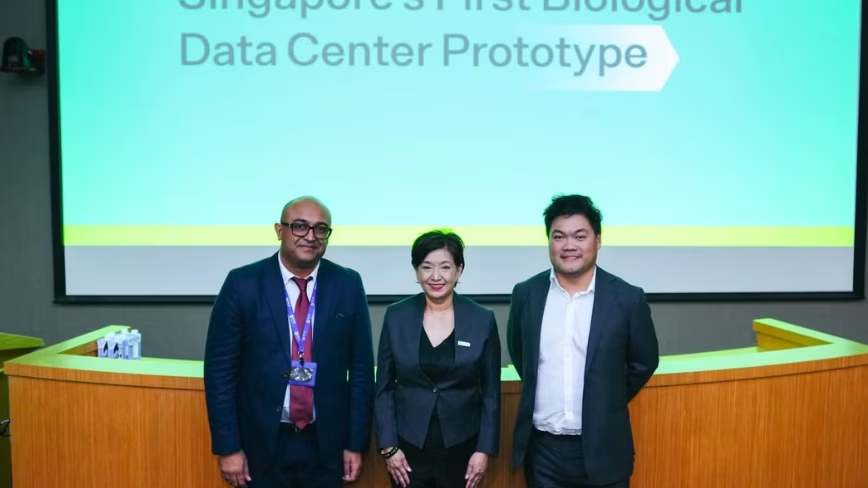
💡A live 20-unit rack tests whether living neurons can become practical computing infrastructure.
⚡ 30-Second TL;DR
What Changed
The prototype is installed in Singapore and operates as a 20-unit rack.
Why It Matters
The project could open a new path for low-power or biologically inspired computing, but its practical value remains uncertain without independent benchmarks. AI researchers should treat the system as an experimental platform rather than a proven alternative to conventional data centre hardware.
What To Do Next
Contact Cortical Labs to request CL1 specifications and benchmark data before evaluating neuron-based computing for an AI workload.
Key Points
- •The prototype is installed in Singapore and operates as a 20-unit rack.
- •It uses Cortical Labs' CL1 computers powered by living human neurons.
- •NUS Medicine, DayOne and Cortical Labs are collaborating on the project.
- •The project has made efficiency claims, but no supporting figures have been published.
🧠 Deep Insight
Background and context from public sources — not the original article. 13 sources cited.
🔑 Enhanced Key Takeaways
- •The prototype in Singapore represents the world's first independently operated biologically integrated server rack, moving biological computing beyond a laboratory setting into a live infrastructure environment.
- •The CL1 units utilize living human neurons derived from induced pluripotent stem cells, which are grown on silicon chips and connected to silicon hardware to process information.
- •This biological data center aims to provide a more adaptable and energy-efficient alternative to traditional silicon-based systems, aligning with Singapore's Green Data Center Roadmap.
- •Cortical Labs has already commercialized a similar biological data center in Melbourne, Australia, which operates 120 CL1 units and serves approximately 20 paying customers, including corporate research arms and universities.
- •The CL1 system can be programmed using Python, and Cortical Labs also offers a cloud-based 'wetware as a service' model called Cortical Cloud, allowing remote access to in-house cultures for a weekly fee.
🛠️ Technical Deep Dive
- Each CL1 unit embeds approximately 800,000 live human neurons onto a high-density microelectrode array.
- The neurons are derived from pluripotent stem cells, often created from donated skin or blood cells.
- The system incorporates a closed-loop life-support module that continuously exchanges fluids, regulates temperature, and filters waste, designed to keep neuron cultures viable for up to six months, with some cells maintained for up to a year.
- The CL1 operates using a proprietary 'Biological Intelligence Operating System (biOS)' which facilitates bidirectional neural stimulation, real-time monitoring, data visualization, and direct programming access to the neurons.
- A 30-unit rack of CL1 computers consumes approximately 850 to 1000 watts of power, significantly less than the multi-megawatt requirements of conventional AI training infrastructure.
- The CL1 boasts a latency of less than a millisecond, an improvement over the 5-millisecond latency observed in earlier 'DishBrain' experiments.
- The CL1 is a hybrid biological-digital system where digital inputs are translated into electrical signals that the neurons respond to, and their outputs are monitored, interpreted, and relayed back to the user.
- The system is built for learning and feedback-driven tasks, demonstrated by its ability to learn to play Pong in under five minutes without explicit programming, by reacting to real-time inputs and adjusting responses through a reward-based feedback loop.
🔮 Future ImplicationsAI analysis grounded in cited sources
⏳ Timeline
📎 Sources (13)
Factual claims are grounded in the sources below. Forward-looking analysis is AI-generated interpretation.
Weekly AI Recap
Read this week's curated digest of top AI events →
👉Related Updates



AI-curated news aggregator. All content rights belong to original publishers.
Original source: The Next Web (TNW) ↗
This is a summary, not the original. Read the source, or get the weekly briefing.
Weekly AI briefing
One email a week. Unsubscribe anytime.