Humanoid Robots Break Bolt's 100m Record
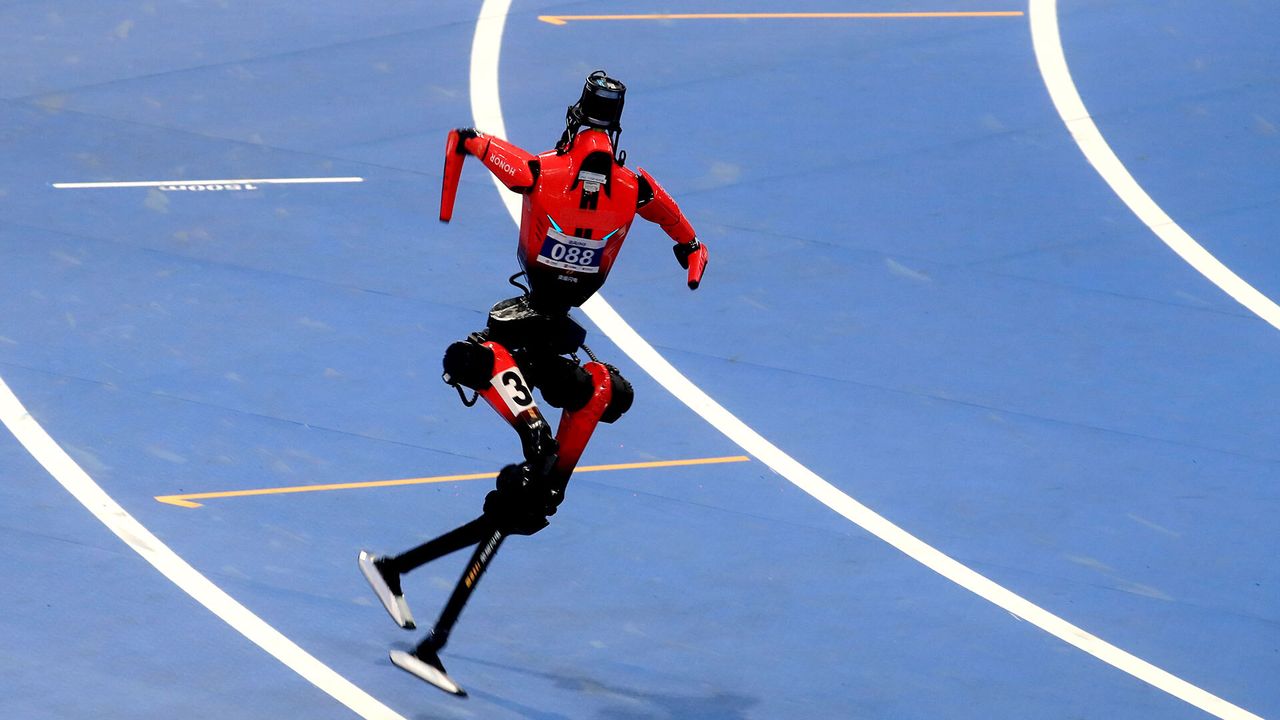
💡A striking embodied-AI benchmark—but the crash raises questions about stability and real-world readiness.
⚡ 30-Second TL;DR
What Changed
Tiangong Ultra reportedly posted a 9.39-second 100-meter sprint.
Why It Matters
The result highlights rapid progress in high-speed humanoid locomotion and embodied AI hardware. However, developers should treat the times as event-specific benchmarks until independent testing confirms repeatability, stability, and energy efficiency.
What To Do Next
Add Tiangong Ultra's 9.39-second result to your humanoid-robot benchmark tracker, but require repeat-run, fall-rate, and energy-per-meter data before using it for deployment decisions.
Key Points
- •Tiangong Ultra reportedly posted a 9.39-second 100-meter sprint.
- •Honor Lightning recorded 9.47 seconds at the same event.
- •Both robots surpassed Usain Bolt's 9.58-second 2009 record, though Tiangong Ultra crashed into padded barriers after finishing.
🧠 Deep Insight
Background and context from public sources — not the original article. 5 sources cited.
🔑 Enhanced Key Takeaways
- •The Honor Lightning robot achieved a faster unofficial time of 9.32 seconds during preparatory trials prior to the main event.
- •The robots reached a peak velocity of 14.5 meters per second (32.4 mph) during their record-breaking sprints.
- •Researchers modified the robots specifically for this competition by extending leg length by 10 cm to a total of 1.05 meters.
- •The event featured over 2,000 humanoid robots competing across 51 distinct athletic categories, including table tennis and soccer.
- •The U.S. Federal Communications Commission (FCC) has implemented a ban on the import of new foreign-made humanoid robots, citing national security concerns.
📊 Competitor Analysis▸ Show
| Feature | Tiangong Ultra | Honor Lightning | Human World Record (Bolt) |
|---|---|---|---|
| 100m Time | 9.39s | 9.32s (prep) / 9.47s | 9.58s |
| Peak Speed | ~14.5 m/s | ~14.5 m/s | 12.4 m/s |
| Leg Length | 1.05m | 1.05m | N/A |
🛠️ Technical Deep Dive
- Leg length optimization: Hardware was modified to 1.05 meters to increase stride length and velocity.
- Braking mechanism: Robots currently lack independent deceleration systems, necessitating the use of padded barriers to stop after high-speed sprints.
- Structural integrity: High-speed performance is currently limited by mechanical volatility, resulting in frequent hardware failure or fragmentation upon impact.
🔮 Future ImplicationsAI analysis grounded in cited sources
⏳ Timeline
📎 Sources (5)
Factual claims are grounded in the sources below. Forward-looking analysis is AI-generated interpretation.
Weekly AI Recap
Read this week's curated digest of top AI events →
👉Related Updates


AI-curated news aggregator. All content rights belong to original publishers.
Original source: Tom's Hardware ↗
This is a summary, not the original. Read the source, or get the weekly briefing.
Weekly AI briefing
One email a week. Unsubscribe anytime.