Honor Lightning Beats Bolt’s 100m Time

💡Honor’s humanoid reportedly ran 100m in 9.32 seconds—an intriguing benchmark for embodied AI.
⚡ 30-Second TL;DR
What Changed
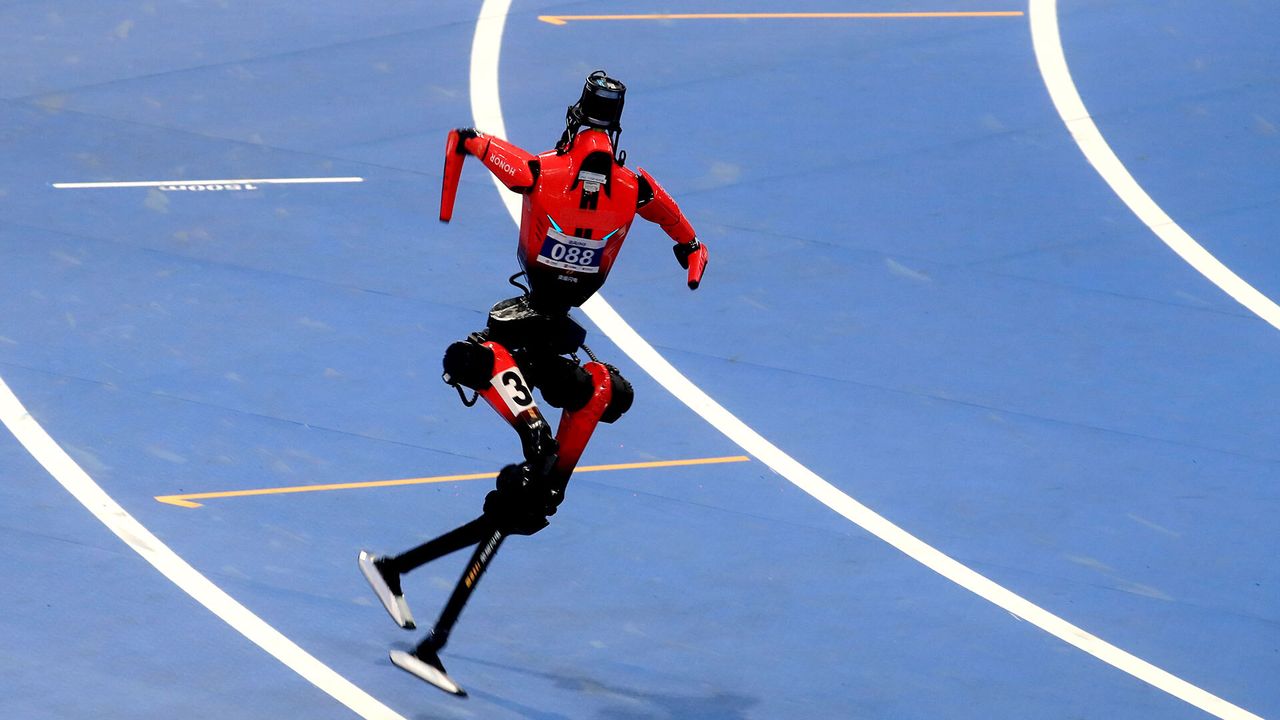
Lightning reportedly ran 100 meters in 9.32 seconds.
Why It Matters
The result showcases progress in high-speed humanoid locomotion and mechanical durability. For robotics developers, it provides a notable reference point, although the article does not include independent verification or detailed test conditions.
What To Do Next
Track Honor Lightning's official race footage and technical disclosures, then compare its speed, stability, and control architecture with your humanoid robotics benchmarks.
Key Points
- •Lightning reportedly ran 100 meters in 9.32 seconds.
- •The reported time is faster than Usain Bolt's cited 9.58-second record.
- •The robot hit the safety wall at full speed without visibly breaking apart or producing sparks.
🧠 Deep Insight
Background and context from public sources — not the original article. 9 sources cited.
🔑 Enhanced Key Takeaways
- •Lightning reached a peak velocity of 14.5 meters per second during its record-setting sprint.
- •The robot's hardware was specifically optimized for the event by lengthening its legs by 10 centimeters to a total of 1.05 meters.
- •The platform previously competed under the name 'Flash' in April 2026, winning a half-marathon in 50 minutes and 26 seconds.
- •The World Humanoid Robot Games featured a highly competitive field, with the 'Tiangong Ultra' robot finishing closely behind at 9.39 seconds.
- •China has officially classified humanoid robotics as a strategic emerging industry, supported by a domestic ecosystem of over 150 startups.
📊 Competitor Analysis▸ Show
| Feature | Honor Lightning | Tiangong Ultra |
|---|---|---|
| 100m Sprint | 9.32s | 9.39s |
| Development Focus | High-speed mobility | High-speed mobility |
| Origin | China | China |
🛠️ Technical Deep Dive
- Leg length: 1.05 meters (increased by 10cm for speed optimization).
- Material composition: Lightweight composite materials utilized to reduce mass and increase stride frequency.
- Stability control: High-speed locomotion systems currently struggle with deceleration, leading to collisions with safety barriers post-sprint.
🔮 Future ImplicationsAI analysis grounded in cited sources
⏳ Timeline
📎 Sources (9)
Factual claims are grounded in the sources below. Forward-looking analysis is AI-generated interpretation.
Weekly AI Recap
Read this week's curated digest of top AI events →
👉Related Updates

AI-curated news aggregator. All content rights belong to original publishers.
Original source: cnBeta (Full RSS) ↗
This is a summary, not the original. Read the source, or get the weekly briefing.
Weekly AI briefing
One email a week. Unsubscribe anytime.