HistoSonics secures Taiwan approval for non-invasive tumour treatment
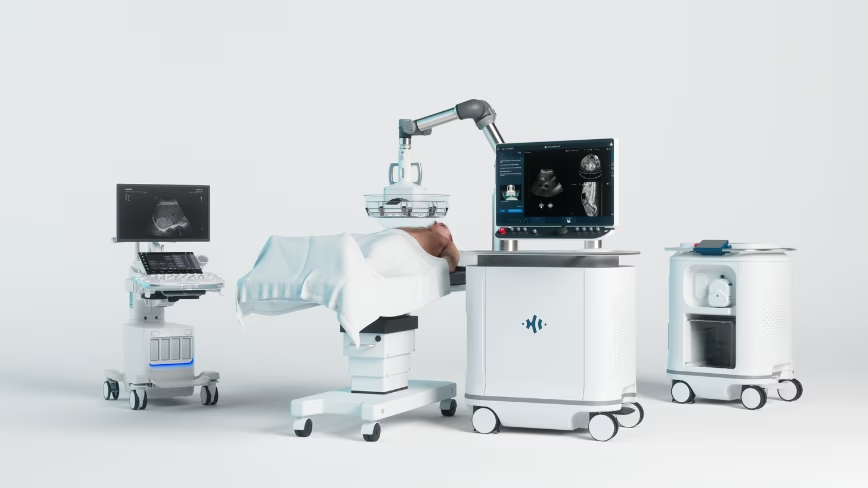
A breakthrough in non-invasive robotic surgery technology expanding into the Asian healthcare market.
30-Second TL;DR
What Changed
Edison Histotripsy System approved for use in Taiwan market
Why It Matters
This approval validates the clinical viability of histotripsy in Asian markets. It sets a precedent for non-invasive, image-guided robotic surgery systems.
What To Do Next
Monitor the integration of image-guided robotic systems in medical AI workflows to identify automation opportunities in surgical planning.
Key Points
- •Edison Histotripsy System approved for use in Taiwan market
- •Non-invasive technology eliminates need for traditional cutting or radiation
- •Strategic expansion into Asia marks a major milestone for HistoSonics
Deep Insight
Background and context from public sources — not the original article. 45 sources cited.
Enhanced Key Takeaways
- •HistoSonics' Edison Histotripsy System received US FDA De Novo clearance in October 2023 for the non-invasive destruction of liver tumors, marking the first time a focused ultrasound mechanism of action other than thermal ablation earned regulatory approval worldwide.
- •The technology operates by using high-amplitude, short-pulse focused ultrasound to generate 'bubble clouds' within targeted tissue, which rapidly expand and collapse to mechanically destroy tumor cells at a cellular and sub-cellular level without using heat or making incisions.
- •Clinical trials, specifically the #HOPE4LIVER trials, demonstrated a high technical success rate of 95.5% and a low complication rate of 6.8% for liver tumors, with some studies suggesting potential immune system activation against tumors not directly targeted (abscopal effect).
- •HistoSonics is actively pursuing additional indications beyond liver tumors, with ongoing clinical trials for kidney tumors (HOPE4KIDNEY Trial) and pancreatic tumors (GANNON Trial), and submitted a de novo application for kidney tumors to the US FDA in May 2026.
- •The company was acquired in August 2025 for $2.25 billion by a consortium of investors including K5 Global, Bezos Expeditions, and Wellington Management, followed by a $250 million financing round in October 2025 to support global expansion and new clinical indications.
Competitor Analysis
- Technology Type
- Histotripsy (Non-thermal Focused Ultrasound)
- Primary Indication (if specified)
- Liver tumors (approved), Kidney, Pancreas (trials)
- Key Differentiator (vs. HistoSonics)
- Mechanical destruction via microbubbles, non-thermal, real-time visualization
- Technology Type
- High-Intensity Focused Ultrasound (HIFU)
- Primary Indication (if specified)
- Benign and malignant tumors (general)
- Key Differentiator (vs. HistoSonics)
- Primarily thermal ablation
- Technology Type
- MRI-guided HIFU
- Primary Indication (if specified)
- Essential tremor, Parkinson's dyskinesia, prostate cancer, uterine fibroids, bone metastases
- Key Differentiator (vs. HistoSonics)
- MRI-guided, primarily thermal ablation
- Technology Type
- HIFU
- Primary Indication (if specified)
- Prostate cancer, urological tumor ablation
- Key Differentiator (vs. HistoSonics)
- Focus on urology, uses both thermal and mechanical ablation
- Technology Type
- HIFU
- Primary Indication (if specified)
- Prostate health, soft tissue treatments
- Key Differentiator (vs. HistoSonics)
- Primarily thermal ablation, focus on prostate
- Technology Type
- HIFU
- Primary Indication (if specified)
- Breast fibroadenomas, thyroid nodules
- Key Differentiator (vs. HistoSonics)
- Primarily thermal ablation
- Technology Type
- HIFU
- Primary Indication (if specified)
- Diagnostic and therapeutic HIFU (general)
- Key Differentiator (vs. HistoSonics)
- Integrates advanced transducer and imaging systems, primarily thermal ablation
| Company | Technology Type | Primary Indication (if specified) | Key Differentiator (vs. HistoSonics) |
|---|---|---|---|
| HistoSonics | Histotripsy (Non-thermal Focused Ultrasound) | Liver tumors (approved), Kidney, Pancreas (trials) | Mechanical destruction via microbubbles, non-thermal, real-time visualization |
| Chongqing Haifu Medical Technology Co., Ltd. | High-Intensity Focused Ultrasound (HIFU) | Benign and malignant tumors (general) | Primarily thermal ablation |
| Insightec Ltd. | MRI-guided HIFU | Essential tremor, Parkinson's dyskinesia, prostate cancer, uterine fibroids, bone metastases | MRI-guided, primarily thermal ablation |
| EDAP TMS S.A. | HIFU | Prostate cancer, urological tumor ablation | Focus on urology, uses both thermal and mechanical ablation |
| SonaCare Medical LLC | HIFU | Prostate health, soft tissue treatments | Primarily thermal ablation, focus on prostate |
| Theraclion S.A. | HIFU | Breast fibroadenomas, thyroid nodules | Primarily thermal ablation |
| Alpinion Medical Systems Co., Ltd. | HIFU | Diagnostic and therapeutic HIFU (general) | Integrates advanced transducer and imaging systems, primarily thermal ablation |
Technical Deep Dive
- Mechanism of Action: Histotripsy utilizes high-amplitude, very short pulses of focused ultrasound to induce controlled acoustic cavitation, creating microscopic 'bubble clouds' within the targeted tissue.
- Tissue Destruction: These microbubbles rapidly expand and collapse, generating powerful mechanical forces that physically break apart and liquefy tumor cells at the cellular and sub-cellular levels.
- Non-thermal and Non-ionizing: The process achieves tissue destruction mechanically, without generating heat or using ionizing radiation, thereby minimizing damage to surrounding healthy tissue.
- Precision and Real-time Monitoring: The Edison System enables physicians to plan, target, treat, and monitor tumor destruction with continuous real-time visualization and control through an integrated ultrasound imaging probe.
- Preservation of Structures: A key advantage is the ability of histotripsy to preserve collagenous vessels and ducts within the treatment area due to its mechanical, non-thermal nature.
- Potential Immune Response: Research suggests that histotripsy may expose tumor antigens, potentially enhancing the body's immune system to recognize and attack cancer cells, including those not directly treated (abscopal effect).
- System Components: The Edison System employs a treatment head housing a concave therapy transducer to generate the localized bubble cloud, and an integrated ultrasound imaging probe for continuous visualization.
Future ImplicationsAI analysis grounded in cited sources
Timeline
- 2005-XXFirst invention report for histotripsy disclosed to University of Michigan's tech transfer office.
- 2009-XXHistoSonics spun out of the University of Michigan.
- 2021-XXEdison System received FDA Breakthrough Device Designation.
- 2023-10US FDA De Novo clearance for the Edison Histotripsy System for liver tumors.
- 2025-08HistoSonics acquired for $2.25 billion by an investor consortium including K5 Global, Bezos Expeditions, and Wellington Management.
- 2025-10HistoSonics raises $250 million in an oversubscribed Series D funding round.
- 2026-05-11HistoSonics submits a de novo application to the US FDA for the Edison Histotripsy System to treat kidney tumors.
- 2026-05-18Taiwan Food and Drug Administration (TFDA) approves HistoSonics' Edison Histotripsy System.
Sources (45)
Factual claims are grounded in the sources below. Forward-looking analysis is AI-generated interpretation.
Weekly AI Recap
Read this week's curated digest of top AI events →
Related Updates



AI-curated news aggregator. All content rights belong to original publishers.
Original source: The Next Web (TNW) ↗
This is a summary, not the original. Read the source, or get the weekly briefing.
The weekly digest
One email a week. Unsubscribe anytime.