Gates Warns: AI’s Turbulent Era Is Here
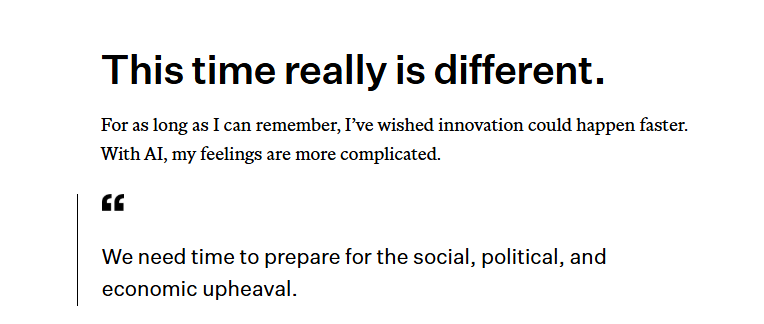
💡Gates outlines concrete risks—from entry-level job loss to cyberattacks—that should shape AI product design now.
⚡ 30-Second TL;DR
What Changed
Gates expects customer service, sales, software engineering, legal assistance, loan review, and medical triage to face early AI disruption.
Why It Matters
The essay reinforces that AI practitioners must treat labor displacement, misuse, child safety, and human oversight as product-design issues rather than external policy concerns. It also signals growing support for restrictions that could affect model deployment, automation economics, and enterprise procurement.
What To Do Next
Add human-review gates, misuse evaluations, and entry-level job impact assessments to your next AI product’s launch checklist.
Key Points
- •Gates expects customer service, sales, software engineering, legal assistance, loan review, and medical triage to face early AI disruption.
- •He is particularly concerned that automation will remove entry-level jobs needed by young people to gain experience and professional networks.
- •AI may lower the barrier to cyberattacks, malware creation, and dangerous biological research.
- •He proposes human-reserved work, AI or robot taxation, and governance mechanisms similar to international aviation or nuclear regulation.
- •Gates still sees major benefits in healthcare, agriculture, government services, and tools that amplify individuals and small businesses.
🧠 Deep Insight
Background and context from public sources — not the original article. 14 sources cited.
🔑 Enhanced Key Takeaways
- •Bill Gates identifies a critical shift in AI's impact, noting that the electricity consumption of AI data centers is currently growing at an annual rate of 43%.
- •The scope of AI disruption is projected to expand from white-collar roles to blue-collar sectors, with direct human-robot competition in construction and hospitality expected by 2030.
- •Gates advocates for the 'Human Reserved' concept, specifically targeting roles requiring emotional connection, such as healthcare, to be protected by policy mandates.
- •The AI industry has shifted its primary competitive focus from raw model capabilities to the development and control of Agent ecosystems, exemplified by recent open-source releases like Codex Harness and DSH.
- •Commercial viability for AI firms is increasingly tied to B2B transaction-based commission models, as C-end subscription services struggle to offset the high costs of inference compute.
🛠️ Technical Deep Dive
- AI infrastructure is now characterized by massive capital expenditure in chip supply chains, wafer fabrication, and dedicated power grid expansion.
- Industry focus has transitioned to Agent-based architectures, moving beyond static LLM inference to autonomous task execution frameworks.
- Inference cost management has become the primary technical bottleneck, forcing a shift toward more efficient model deployment strategies to maintain profitability.
🔮 Future ImplicationsAI analysis grounded in cited sources
⏳ Timeline
📎 Sources (14)
Factual claims are grounded in the sources below. Forward-looking analysis is AI-generated interpretation.
Weekly AI Recap
Read this week's curated digest of top AI events →
👉Related Updates


AI-curated news aggregator. All content rights belong to original publishers.
Original source: 虎嗅 ↗
This is a summary, not the original. Read the source, or get the weekly briefing.
Weekly AI briefing
One email a week. Unsubscribe anytime.