Faraday Future launches industrial robotic arm series FF Faber
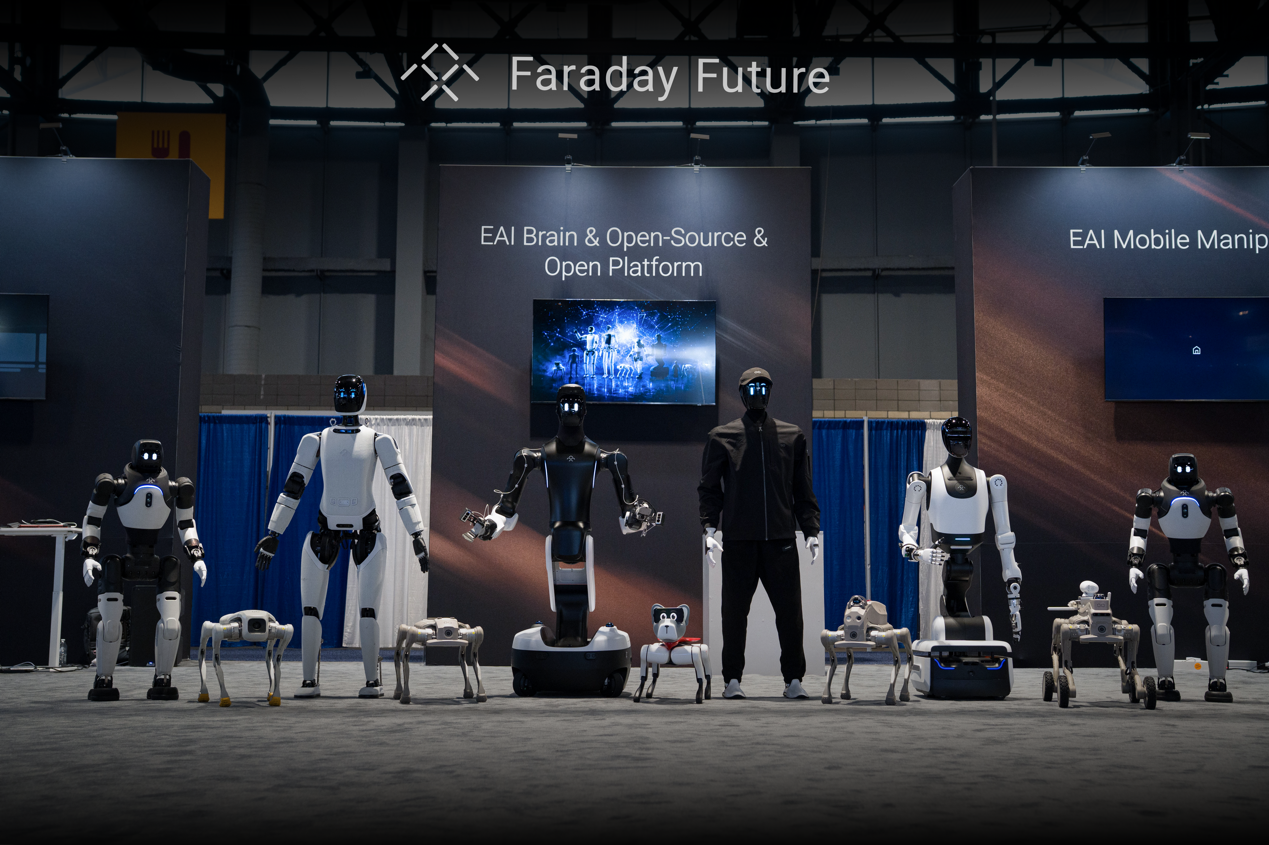
💡Faraday Future enters the embodied AI space with a new industrial robotics line, signaling a major strategic shift.
⚡ 30-Second TL;DR
What Changed
FF Faber industrial robotic arm series unveiled in Chicago
Why It Matters
FF's pivot toward embodied AI and industrial robotics signals a strategic diversification beyond electric vehicles. This move highlights the growing trend of automotive companies leveraging AI for industrial automation.
What To Do Next
Monitor FF's EAI ecosystem documentation to understand how their robotic hardware integrates with AI control software.
Key Points
- •FF Faber industrial robotic arm series unveiled in Chicago
- •Company reveals EAI (Embodied AI) industrial ecosystem strategy
- •Robotics portfolio now spans humanoid, quadruped, and robotic arm categories
🧠 Deep Insight
AI-generated analysis for this event — not the original article.
🔑 Enhanced Key Takeaways
- •FF Faber utilizes a proprietary 'FF-Brain' architecture that integrates real-time sensor fusion with generative AI models to enable autonomous task adaptation without manual reprogramming.
- •The robotic arm series is designed specifically for high-precision EV manufacturing tasks, such as battery module assembly and automated quality inspection, leveraging Faraday Future's existing automotive production data.
- •Faraday Future has established a strategic partnership with NVIDIA to utilize the Jetson Orin platform for the edge computing requirements of the FF Faber series.
- •The FF Faber series features a modular end-effector system, allowing the arms to switch between welding, material handling, and precision assembly tools in under 60 seconds.
- •The company is positioning FF Faber as a 'Software-Defined Robot' (SDR), emphasizing that the hardware is secondary to the over-the-air (OTA) update capabilities that improve robotic efficiency over time.
📊 Competitor Analysis▸ Show
| Feature | FF Faber | FANUC CRX Series | Universal Robots UR Series |
|---|---|---|---|
| Primary Focus | Embodied AI / EV Mfg | General Industrial | Collaborative / SME |
| AI Integration | Native Generative AI | Limited / Add-on | Ecosystem-based |
| Target Market | Automotive / High-Tech | General Manufacturing | SMB / Education |
| Pricing Model | Subscription + Hardware | Capital Expenditure | Capital Expenditure |
🛠️ Technical Deep Dive
- Payload Capacity: Ranges from 5kg to 20kg depending on the specific model variant.
- Degrees of Freedom: 6-axis and 7-axis configurations available for complex spatial maneuvering.
- Connectivity: Integrated 5G and Wi-Fi 7 for low-latency communication with centralized factory management systems.
- AI Architecture: Utilizes a transformer-based model for path planning and obstacle avoidance in dynamic environments.
- Precision: Repeatability of +/- 0.02mm, suitable for high-tolerance automotive assembly.
🔮 Future ImplicationsAI analysis grounded in cited sources
⏳ Timeline
Weekly AI Recap
Read this week's curated digest of top AI events →
👉Related Updates

AI-curated news aggregator. All content rights belong to original publishers.
Original source: cnBeta (Full RSS) ↗
This is a summary, not the original. Read the source, or get the weekly briefing.
Weekly AI briefing
One email a week. Unsubscribe anytime.