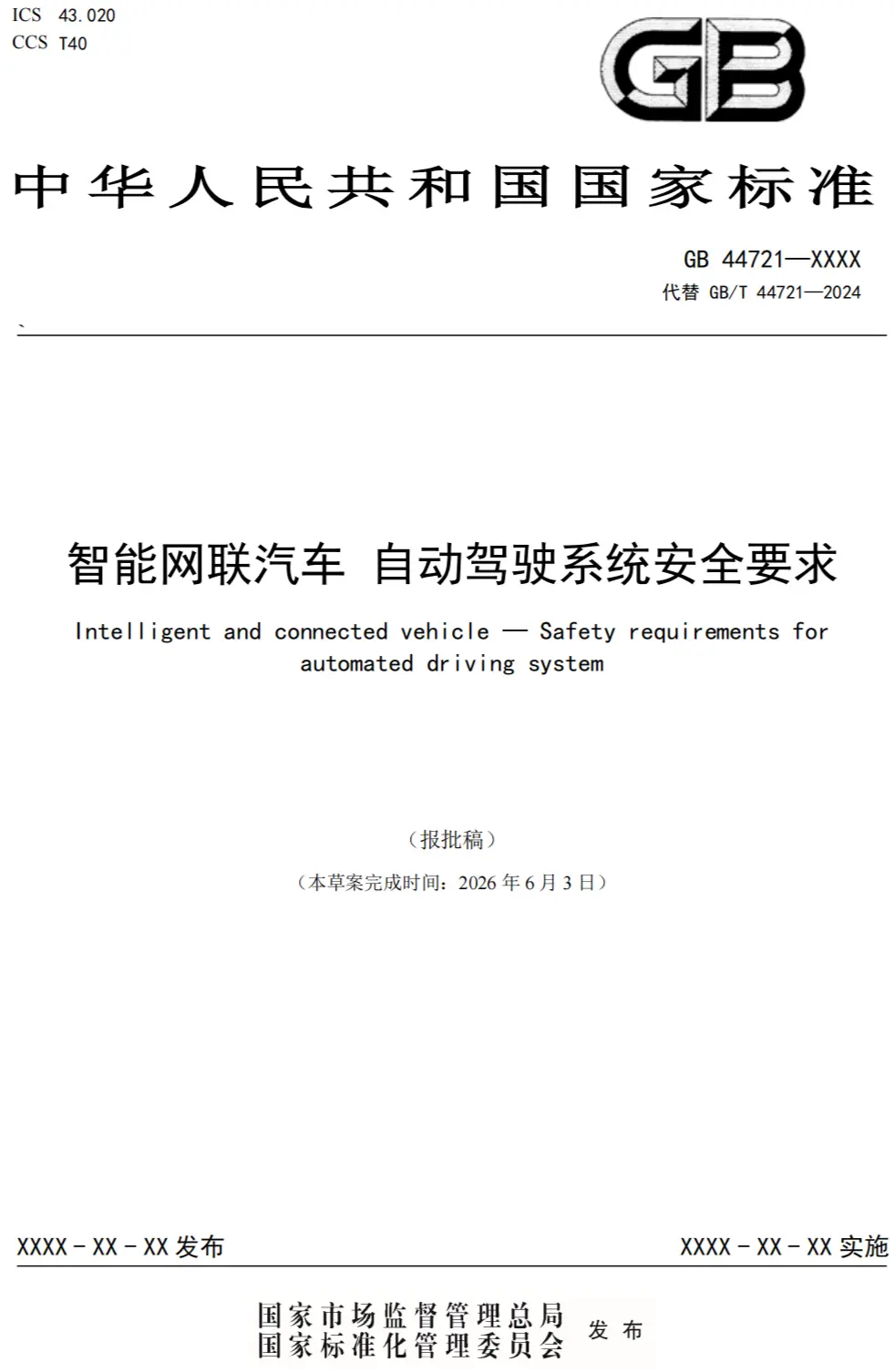
China releases first mandatory autonomous driving safety standards
Essential regulatory update for developers building autonomous systems in the Chinese market.
30-Second TL;DR
What Changed
MIIT introduces the first mandatory national standard for autonomous driving safety
Why It Matters
This regulatory framework will force manufacturers to align their AI safety stacks with national compliance, significantly impacting the development lifecycle of autonomous systems in China.
What To Do Next
Review the MIIT 'Autonomous Driving System Safety Requirements' draft to ensure your perception and planning modules meet new compliance thresholds.
Key Points
- •MIIT introduces the first mandatory national standard for autonomous driving safety
- •Regulations address critical safety protocols, including emergency system behavior
- •Standard aims to standardize safety requirements for L3+ autonomous vehicles
Deep Insight
AI-generated analysis for this event — not the original article.
Enhanced Key Takeaways
- •The standard, designated as GB 44495-2026, specifically targets the functional safety and expected functionality (SOTIF) of vehicles equipped with automated driving systems.
- •It mandates that autonomous systems must be capable of performing a 'Minimal Risk Maneuver' (MRM) to bring the vehicle to a safe stop if the driver fails to respond to a takeover request.
- •The regulations require manufacturers to implement a 'Data Storage System for Automated Driving' (DSSAD) to record critical operational data for accident reconstruction.
- •This mandatory standard applies to all L3 and L4 autonomous vehicles intended for mass production and sale within the Chinese domestic market.
- •The MIIT has established a transition period, requiring all new vehicle models to comply with these safety specifications by January 1, 2027.
Technical Deep Dive
- Defines specific performance metrics for 'Takeover Request' (TOR) latency, requiring the system to provide sufficient lead time for human intervention based on driving context.
- Establishes rigorous testing protocols for 'Object and Event Detection and Response' (OEDR) capabilities under adverse weather and lighting conditions.
- Mandates cybersecurity requirements for over-the-air (OTA) updates to prevent unauthorized access to vehicle control systems.
- Specifies requirements for the 'Human-Machine Interface' (HMI) to ensure clear communication of system status, failure warnings, and transition of control alerts.
Future ImplicationsAI analysis grounded in cited sources
Timeline
- 2021-08MIIT issues guidelines on strengthening the management of intelligent connected vehicle production.
- 2022-08Shenzhen implements the first local regulations for intelligent connected vehicles in China.
- 2023-11MIIT and other departments release a circular on pilot programs for L3/L4 autonomous vehicle road testing.
- 2024-06MIIT announces the first batch of pilot companies for intelligent connected vehicle access and road traffic.
- 2026-06MIIT releases the first mandatory national standard for autonomous driving system safety.
Weekly AI Recap
Read this week's curated digest of top AI events →
Related Updates

AI-curated news aggregator. All content rights belong to original publishers.
Original source: cnBeta (Full RSS) ↗
This is a summary, not the original. Read the source, or get the weekly briefing.
The weekly digest
One email a week. Unsubscribe anytime.