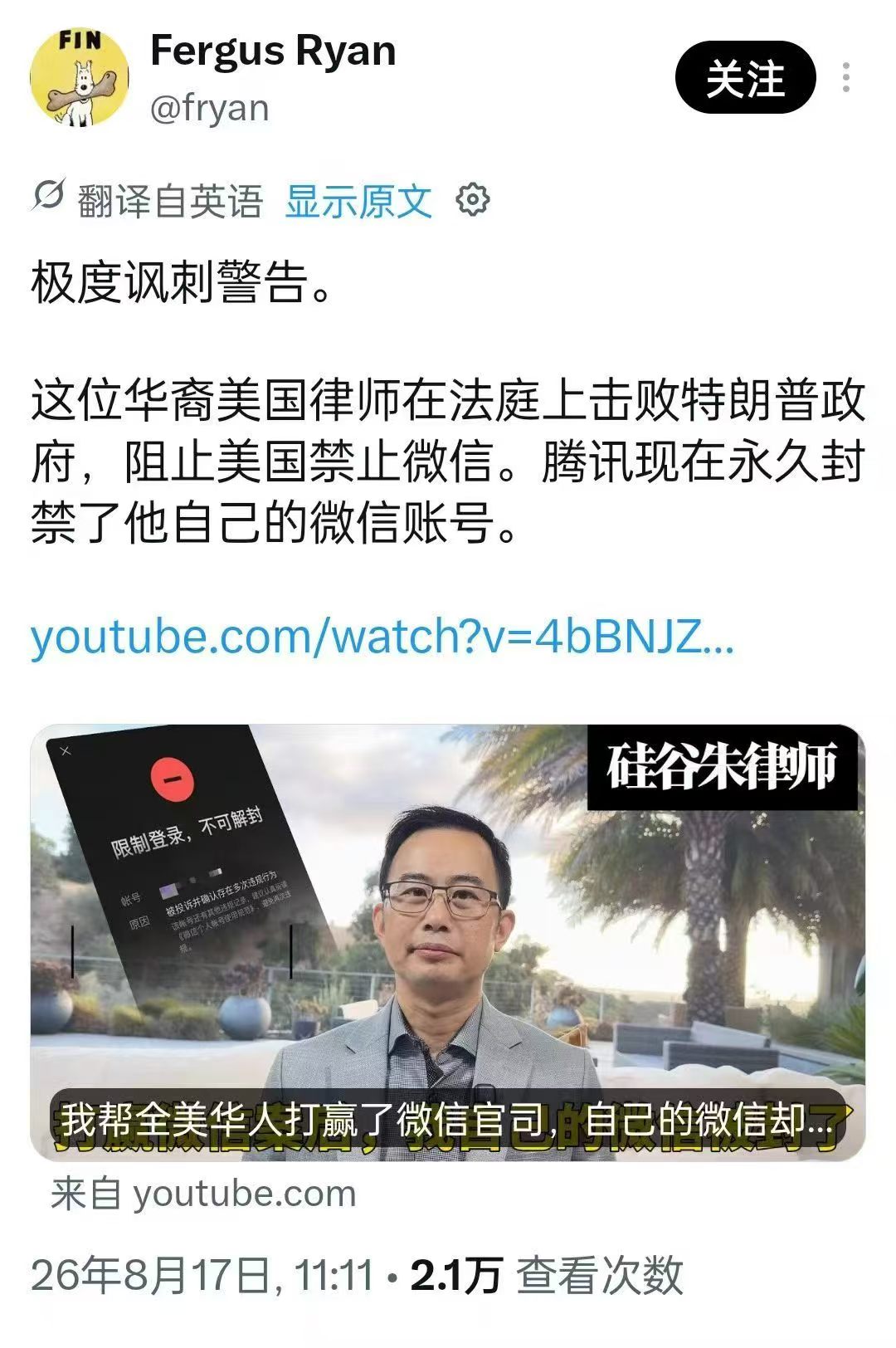
律师微信账号遭腾讯永久封禁
💡A platform-ban case shows why AI teams need resilient communication and account-governance plans.
⚡ 30-Second TL;DR
What Changed
The affected lawyer previously defeated the Trump administration in court over a proposed nationwide WeChat ban.
Why It Matters
The incident highlights the risks of relying on a single platform for professional identity, communication, and client relationships. For technology companies, it also underscores the reputational impact of opaque account-enforcement decisions.
What To Do Next
Audit your team’s dependence on WeChat and configure at least one documented backup channel for client communication and account recovery.
Key Points
- •The affected lawyer previously defeated the Trump administration in court over a proposed nationwide WeChat ban.
- •Tencent reportedly permanently banned the lawyer’s personal WeChat account.
- •The article excerpt does not provide Tencent’s stated reason for the account termination.
🧠 Deep Insight
Background and context from public sources — not the original article. 24 sources cited.
🔑 Enhanced Key Takeaways
- •The affected lawyer is Keliang (Clay) Zhu (朱可亮), a Chinese American lawyer based in Silicon Valley, who was a key member of the U.S. WeChat Users Alliance (USWUA) legal team.
- •Keliang Zhu has filed a lawsuit against Tencent in the Beijing Internet Court, alleging that the permanent ban of his WeChat account violates his rights, including freedom of communication, personal dignity, and property rights.
- •Tencent's stated reason for the account termination in Zhu's case was 'internet related policies and laws and regulations requirements' (互联网相关政策及法律法规要求), a common vague justification for content moderation in China.
- •WeChat employs a 'one app, two systems' approach where censorship is primarily applied to accounts registered with mainland China phone numbers, but surveillance of content (like images and documents) extends to non-China-registered accounts to train censorship algorithms.
- •WeChat's content moderation system utilizes both automated tools, including machine learning models and logic-based rules, and human teams who undergo regular training to identify and action against violating content.
📊 Competitor Analysis▸ Show
While WeChat dominates the Chinese market as an 'all-in-one' super app, other platforms exist, though none offer the same comprehensive functionality and ubiquity within mainland China.
| Feature/Platform | WeChat (Weixin) | Tencent QQ | Douyin (TikTok) | |
|---|---|---|---|---|
| Primary Function | Messaging, social media, payments, services | Instant messaging, file transfer | Short-form video | Microblogging, news |
| User Base (China) | >1.3 billion MAU | ~562 million MAU (popular with under 30s) | Most popular social app, all ages | Significant, similar to X (formerly Twitter) |
| Content Moderation | Extensive, real-time censorship & surveillance | Likely similar to WeChat (Tencent-owned) | Extensive, AIGC disclosure required | Extensive, algorithmic & following feeds |
| File Transfer Limit | Limited (e.g., 200MB) | Up to 10GB | N/A | N/A |
| International Access | Available, but surveillance extends to non-China accounts | Available, less common for international users | International version (TikTok) separate | Available |
| E-commerce/Payments | Integrated (WeChat Pay) | Limited integration | Integrated (e-commerce via videos) | Weibo Wallet |
Note: International alternatives like Facebook Messenger, Google Hangouts, and Skype are generally not accessible or widely used in mainland China due to the Great Firewall.
🛠️ Technical Deep Dive
- Real-time Image Filtering: WeChat implements real-time censorship of images using MD5 hash indexes of known sensitive images. When a user sends an image, its cryptographic hash is calculated and compared against these indexes. If a match is found, the image is censored in real-time.
- Optical Character Recognition (OCR): Images not initially caught by hash indexes are queued for analysis by WeChat's non-real-time OCR censorship system. OCR compares text within images to keywords on a sensitive keyword blacklist.
- Content Surveillance for Algorithm Training: Documents and images shared between non-China-registered accounts are subject to content surveillance. Files deemed politically sensitive are used to invisibly train and build up WeChat's Chinese political censorship system.
- Server-side Censorship: Keyword filtering on WeChat is enabled for users with accounts registered to mainland China phone numbers and persists even if they later link to an international number, indicating server-side content control.
- Hybrid Moderation System: Enforcement of community guidelines involves both a content moderation team that undergoes regular training and automated tools, including machine learning models and logic-based rules, to identify and moderate violating content.
- AI-Generated Content (AIGC) Disclosure: As of June 2024, WeChat requires creators to disclose if a published post was generated using AI technology, displaying a relevant tag at the bottom of the post to combat misinformation.
🔮 Future ImplicationsAI analysis grounded in cited sources
⏳ Timeline
📎 Sources (24)
Factual claims are grounded in the sources below. Forward-looking analysis is AI-generated interpretation.
Weekly AI Recap
Read this week's curated digest of top AI events →
👉Related Updates


AI-curated news aggregator. All content rights belong to original publishers.
Original source: cnBeta (Full RSS) ↗
This is a summary, not the original. Read the source, or get the weekly briefing.
Weekly AI briefing
One email a week. Unsubscribe anytime.