China Mandates L2 Driver Assistance Safety Standards
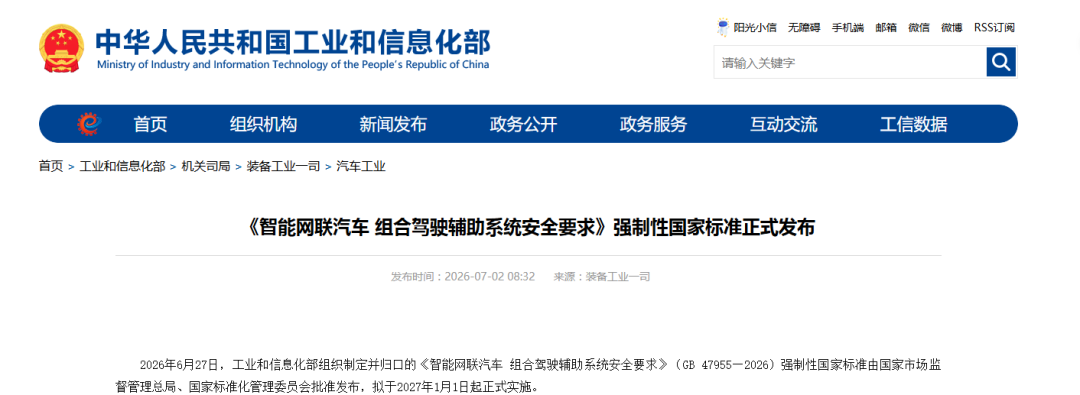
💡Critical regulatory shift for autonomous driving developers in the Chinese market.
⚡ 30-Second TL;DR
What Changed
Standardizes L2 features into three categories: basic single-lane, basic multi-lane, and NOA.
Why It Matters
Ends the 'wild growth' era of autonomous driving marketing in China, forcing manufacturers to prioritize safety and transparency over feature hype.
What To Do Next
If developing ADAS software, ensure your system architecture complies with the new DSSCDA data logging requirements by 2027.
Key Points
- •Standardizes L2 features into three categories: basic single-lane, basic multi-lane, and NOA.
- •Mandates driver monitoring (eye-tracking and steering wheel torque) with strict intervention protocols.
- •Requires mandatory data recording (DSSCDA) for all vehicles to facilitate accident investigation.
- •Prohibits misleading marketing and requires clear ODD (Operational Design Domain) definitions.
🧠 Deep Insight
AI-generated analysis for this event — not the original article.
🔑 Enhanced Key Takeaways
- •The standard GB 47955—2026 was jointly formulated by the Ministry of Industry and Information Technology (MIIT) and the State Administration for Market Regulation to curb the proliferation of 'marketing-first' autonomous driving features.
- •The DSSCDA (Driving Safety System Collection and Data Analysis) requirement mandates a minimum data retention period of 30 seconds prior to a collision and 10 seconds post-collision, with specific encryption standards for data privacy.
- •Manufacturers are now legally required to provide a 'Safety Manual' that explicitly defines the ODD limitations, and failure to comply will result in the revocation of vehicle type-approval certificates.
- •The standard introduces a 'Human-Machine Co-pilot' evaluation metric, requiring systems to demonstrate a specific 'takeover request' latency of under 500 milliseconds during critical system failures.
- •The regulation explicitly bans the use of terms like 'Full Self-Driving' or 'Autopilot' in domestic marketing materials, mandating that all L2 systems be labeled as 'Assisted Driving' to reduce consumer over-reliance.
🛠️ Technical Deep Dive
- DSSCDA Data Architecture: Requires a dedicated black-box module separate from the infotainment system to ensure data integrity during power loss.
- Driver Monitoring System (DMS) Specs: Mandates infrared-based eye-tracking capable of detecting driver distraction even in low-light conditions (below 0.1 lux).
- Steering Torque Sensors: Requires high-fidelity capacitive or resistive sensors capable of detecting 'hands-on' status within 200ms of contact.
- ODD Validation: Systems must undergo standardized simulation testing covering at least 500 distinct edge-case scenarios including extreme weather and sensor occlusion.
🔮 Future ImplicationsAI analysis grounded in cited sources
⏳ Timeline
Weekly AI Recap
Read this week's curated digest of top AI events →
👉Related Updates


AI-curated news aggregator. All content rights belong to original publishers.
Original source: 虎嗅 ↗
This is a summary, not the original. Read the source, or get the weekly briefing.
Weekly AI briefing
One email a week. Unsubscribe anytime.