Codex Closes the Gap With Claude Code
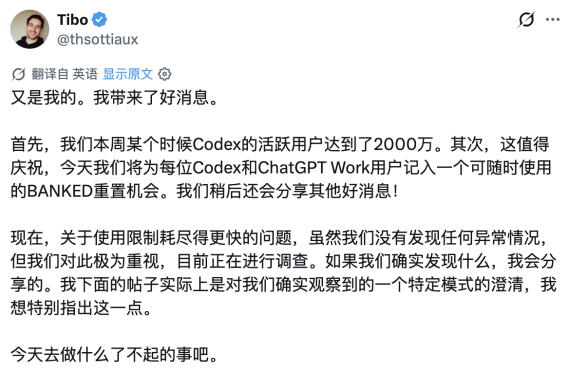
💡Codex hits 20 million users as Claude Code growth cools—an important signal for choosing coding agents.
⚡ 30-Second TL;DR
What Changed
OpenAI Codex reportedly exceeded 20 million weekly active users.
Why It Matters
The coding-agent market is shifting from a single-front-runner race toward broader competition across developers and knowledge workers. Codex’s distribution and cross-functional reach may become as important as raw coding quality, while Claude Code must expand beyond its early developer stronghold.
What To Do Next
Run a two-week evaluation of OpenAI Codex and Claude Code on the same repository, comparing task completion, review effort, latency, and per-developer cost.
Key Points
- •OpenAI Codex reportedly exceeded 20 million weekly active users.
- •TickerTrends estimated four-week growth of 20.8% for Codex versus 5.2% for Claude Code as of August 10.
- •Codex’s user base includes knowledge workers, with non-developers representing about 20% of users.
- •Claude Code still has strong enterprise usage and remained the dominant tool at several tracked companies.
- •OpenAI’s enterprise revenue has reportedly grown about 50% annualized this quarter, faster than its overall 35% growth.
🧠 Deep Insight
Background and context from public sources — not the original article. 10 sources cited.
🔑 Enhanced Key Takeaways
- •Claude Opus 5 currently holds the lead on the SWE-bench Verified benchmark with a 97.0% success rate, highlighting its superiority in complex architectural reasoning.
- •Codex (GPT-5.6 Sol) maintains a performance advantage in system-level tasks, scoring 85.8% on the Terminal-Bench 2.1 benchmark.
- •The architectural design of Codex emphasizes autonomous delegation through parallel subagents in cloud-isolated sandboxes, whereas Claude Code prioritizes a 'Developer-in-the-Loop' workflow.
- •Cost analysis indicates Codex is more token-efficient for specific workflows, averaging $8.39 per DeepSWE task compared to $11.84 for Claude Code.
- •Security implementations differ significantly: Codex utilizes hardware-level OS-kernel sandboxing (e.g., Landlock), while Claude Code relies on application-layer programmable hooks for lifecycle control.
📊 Competitor Analysis▸ Show
| Feature | Codex (GPT-5.6 Sol) | Claude Code (Opus 5) |
|---|---|---|
| Primary Strength | Autonomous task delegation | Deep architectural reasoning |
| Benchmark Lead | Terminal-Bench 2.1 (85.8%) | SWE-bench Verified (97.0%) |
| Cost per Task | ~$8.39 (DeepSWE) | ~$11.84 (DeepSWE) |
| Security Model | Hardware-level OS sandboxing | Application-layer hooks |
🛠️ Technical Deep Dive
- Model Architecture: Codex utilizes the GPT-5.6 family, specifically the Sol tier, optimized for high-throughput terminal operations.
- Context Window: Both platforms have achieved parity with a 1 million token default context window.
- Sandboxing: Codex leverages kernel-level isolation technologies including Apple Seatbelt and Linux Landlock to secure agent-driven execution.
- Agentic Workflow: Codex supports parallel subagent spawning in isolated cloud environments to execute multi-step tasks without human intervention.
🔮 Future ImplicationsAI analysis grounded in cited sources
⏳ Timeline
📎 Sources (10)
Factual claims are grounded in the sources below. Forward-looking analysis is AI-generated interpretation.
Weekly AI Recap
Read this week's curated digest of top AI events →
👉Related Updates


AI-curated news aggregator. All content rights belong to original publishers.
Original source: 虎嗅 ↗
This is a summary, not the original. Read the source, or get the weekly briefing.
Weekly AI briefing
One email a week. Unsubscribe anytime.