BOE Launches China's First Gen 8.6 AMOLED Line
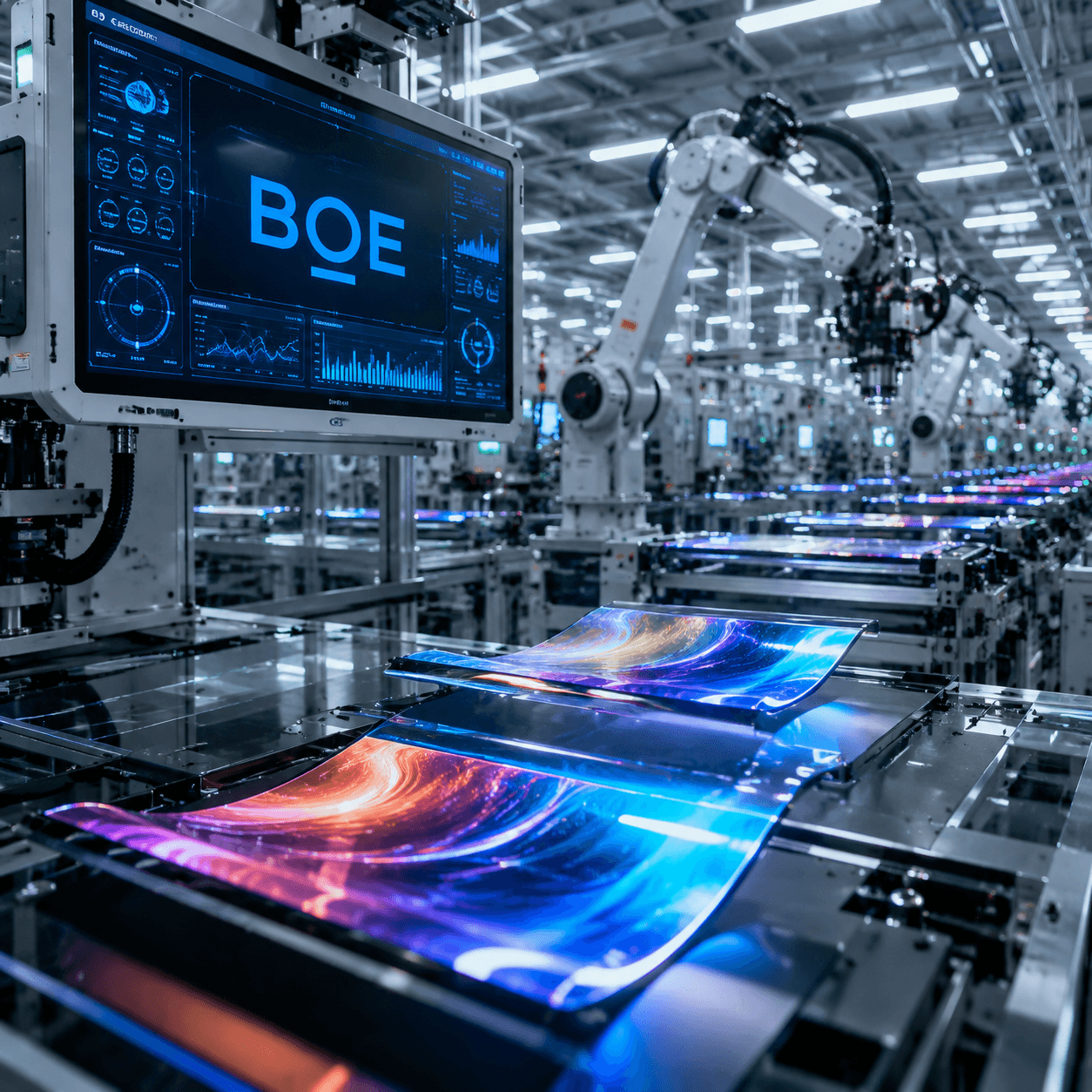
💡Major infrastructure expansion in display tech; critical for the hardware ecosystem supporting AI-ready laptops.
⚡ 30-Second TL;DR
What Changed
China's first Gen 8.6 AMOLED production line
Why It Matters
Increased capacity for high-end OLED displays will lower costs for premium hardware, potentially accelerating the adoption of AI-integrated laptops.
What To Do Next
Evaluate the supply chain impact of increased OLED availability for upcoming AI-PC hardware designs.
Key Points
- •China's first Gen 8.6 AMOLED production line
- •63 billion RMB total investment
- •Focuses on high-end IT displays for laptops and tablets
- •Mass production officially underway in Chengdu
🧠 Deep Insight
Background and context from public sources — not the original article. 23 sources cited.
🔑 Enhanced Key Takeaways
- •The new Gen 8.6 AMOLED facility, known as the B16 plant, has a planned monthly capacity of 32,000 8.6-Gen glass substrates (2290mm x 2620mm), which is more than double the size of previous 6th-generation substrates.
- •BOE's Gen 8.6 line incorporates advanced technologies such as Low-Temperature Polycrystalline Oxide (LTPO) backplanes and a laminated (tandem) electroluminescent device preparation technique, designed to achieve lower power consumption and extend the lifespan of OLED displays.
- •The larger substrate size of the 8.6-generation line significantly enhances production efficiency and cost-effectiveness for mid-sized OLED panels, allowing for the production of approximately 1,000 14-inch panels from a single substrate, compared to around 450 from a 6-Gen line.
- •Initial customers for the 14-inch OLED laptop panels produced at this facility include major brands like Asus and Acer, with products incorporating these displays expected to reach shelves in early 2027.
- •BOE aims to be the first globally to mass produce OLED IT panels on an 8.6-generation line, having commenced glass substrate loading in May 2026, ahead of its original Q4 2026 target and in close competition with Samsung Display.
📊 Competitor Analysis▸ Show
| Feature/Company | BOE (Gen 8.6 AMOLED) | Samsung Display (Gen 8.6 OLED) | LG Display (Gen 8.6 OLED) |
|---|---|---|---|
| Investment | 63 billion RMB (~$9 billion USD) | No definitive investment announced yet | |
| Substrate Size | 2290mm x 2620mm | 2290mm x 2620mm | Not applicable (no line announced) |
| Monthly Capacity (Planned) | 32,000 substrates (full buildout) | 15,000 substrates (Phase 1) | Not applicable (no line announced) |
| Target Products | High-end IT displays (laptops, tablets, monitors), automotive, smartphones | IT devices (laptops, tablets, MacBooks) | IT devices (currently using 6-Gen infrastructure) |
| Key Technologies | LTPO backplanes, tandem architecture, Hybrid OLED (glass base + TFE flexible encapsulation), flexible and rigid OLED compatibility | Two-stack tandem OLED, hybrid substrate (glass + polyimide thin-film), oxide TFTs, All-oxide technology | WOLED for large-area TVs (8.5G), existing 6-Gen for IT OLED |
| Mass Production Target | Mid-2026 (glass loading commenced May 2026) | Q2 2026 (trial operations by end of 2025, mass production June/July 2026) | Cautious stance, waiting for market stabilization |
| Initial Customers | Asus, Acer (14-inch laptop panels) | Apple (MacBook Pro, iPad Pro/Mini) | N/A (no 8.6G line) |
🛠️ Technical Deep Dive
- Substrate Size: The Gen 8.6 line utilizes glass substrates measuring 2290mm x 2620mm, which is more than double the area of 6th-generation substrates (1500mm x 1850mm).
- Backplane Technology: The production line adopts Low-Temperature Polycrystalline Oxide (LTPO) rear panel technology. This enables variable refresh rates and lower power consumption, crucial for high-end IT displays.
- Electroluminescent Device Structure: It employs a laminated electroluminescent device preparation technique, also known as tandem architecture. This involves stacking multiple emissive layers to improve brightness, efficiency, and lifespan.
- Panel Compatibility: The B16 line is designed to produce both flexible OLEDs (using polyimide substrates and thin-film encapsulation) and rigid OLEDs (combining a glass base with thin-film encapsulation, referred to as Hybrid OLED technology).
- Production Efficiency: The larger 8.6-Gen substrates allow for significantly more efficient cutting of mid-sized panels. For instance, a single 8.6-Gen substrate can yield approximately 1,000 14-inch notebook panels, compared to about 450 from a 6-Gen substrate.
- Equipment Suppliers: South Korean equipment manufacturers have secured orders for various components, including polyimide (PI) curing equipment (Wonik IPS), dry etching and plasma surface treatment equipment (ICD), inkjet printing systems (LG Electronics), laser lift-off (LLO) equipment (AP Systems), and deposition machines (Sunic System).
🔮 Future ImplicationsAI analysis grounded in cited sources
⏳ Timeline
📎 Sources (23)
Factual claims are grounded in the sources below. Forward-looking analysis is AI-generated interpretation.
Weekly AI Recap
Read this week's curated digest of top AI events →
👉Related Updates


AI-curated news aggregator. All content rights belong to original publishers.
Original source: Pandaily ↗
This is a summary, not the original. Read the source, or get the weekly briefing.
Weekly AI briefing
One email a week. Unsubscribe anytime.