Amazon Executive Predicts Commercial Quantum Computing in 5-7 Years
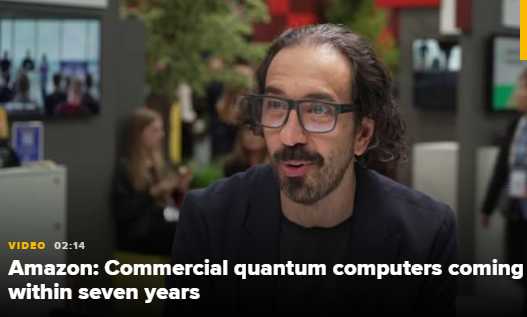
💡Amazon's timeline for commercial quantum computing could redefine the future of AI infrastructure and security.
⚡ 30-Second TL;DR
What Changed
Amazon expects commercial quantum computing to reach maturity in 5-7 years.
Why It Matters
If realized, this timeline suggests a major disruption to current cryptographic standards and optimization algorithms used in AI training.
What To Do Next
Monitor Amazon's Braket service updates to prepare your algorithms for potential quantum-classical hybrid architectures.
Key Points
- •Amazon expects commercial quantum computing to reach maturity in 5-7 years.
- •The development path is compared to the iterative performance scaling of semiconductors.
- •Amazon's new business unit oversees AI models, custom chips, and quantum computing.
🧠 Deep Insight
Background and context from public sources — not the original article. 25 sources cited.
🔑 Enhanced Key Takeaways
- •Amazon has strategically consolidated its quantum computing initiatives, along with expansive AI models (like Nova) and custom silicon development (Graviton, Trainium, Nitro), into a new organization led by Peter DeSantis, aiming for synergistic advancements across these critical technologies.
- •AWS is actively developing its own quantum hardware, specifically superconducting qubits, at the AWS Center for Quantum Computing located at Caltech, with a focus on integrating error correction directly into the chip design using 'cat qubits' in their Ocelot chip.
- •Amazon Braket, AWS's fully managed quantum computing service, provides on-demand access to a diverse range of quantum hardware modalities from multiple providers (including IonQ, Rigetti, IQM, QuEra, and AQT) and various high-performance simulators, offering a unified development environment for researchers and developers.
- •AWS and QuEra Computing Inc. have partnered with a roadmap to deliver the first fault-tolerant quantum computers to the AWS cloud by 2028, targeting a 'megaquop-scale' machine capable of executing one million quantum operations per second over hundreds of logical, error-corrected qubits.
- •Amazon Braket recently introduced 'program sets,' a feature that allows users to bundle up to 100 unique quantum circuits or parametric circuits into a single quantum task, significantly reducing processing overhead and enabling algorithms to run up to 24 times faster on supported devices.
📊 Competitor Analysis▸ Show
| Company/Service | Hardware Modality | Cloud Platform | Key Features/Focus |
|---|---|---|---|
| Amazon (AWS Braket) | Superconducting (own Ocelot 'cat qubits'), Trapped-Ion (IonQ, AQT), Neutral-Atom (QuEra), Superconducting (Rigetti, IQM) | AWS Braket | Unified access to multiple QPUs and simulators, hybrid quantum-classical algorithms, built-in error correction research (Ocelot), program sets for faster execution |
| IBM | Superconducting qubits | IBM Quantum Platform | Qiskit open-source framework, ambitious roadmap targeting 4,000+ qubits by 2025 and 7,500 gates by 2026, quantum-centric supercomputers |
| Google Quantum AI | Superconducting qubits | Google Cloud (via partners) | Focus on breakthrough science and error-corrected quantum computers, achieved 'quantum supremacy' in 2019, deep integration with AI research |
| Microsoft Azure Quantum | Partners with various hardware providers (e.g., IonQ, Quantinuum, Rigetti) | Azure Quantum | Cloud-based ecosystem, provides tools and SDKs (Q#), aims to democratize access to diverse quantum hardware |
| IonQ | Trapped-ion technology | AWS Braket, Azure Quantum, Google Cloud, others | Pure-play quantum computing company, known for high-fidelity qubits and long coherence times |
| D-Wave | Quantum annealing | D-Wave Leap | Specializes in solving optimization problems, focuses on real-world commercial use cases, high system reliability |
🛠️ Technical Deep Dive
- Amazon Braket Service: A fully managed AWS service providing a unified development environment with Jupyter notebooks, pre-installed SDKs (Amazon Braket SDK, Qiskit, PennyLane), and access to various quantum hardware and simulators.
- Quantum Processing Units (QPUs) Access: Braket offers secure, on-demand access to gate-based quantum computers from AQT (trapped-ion), IonQ (trapped-ion), IQM (superconducting), and Rigetti (superconducting), as well as an Analog Hamiltonian Simulator from QuEra (neutral-atom).
- Simulators: Includes fully managed, high-performance quantum circuit simulators like SV1 (state vector), TN1 (tensor network), and DM1 (density matrix) for prototyping and noise studies.
- Hybrid Quantum-Classical Algorithms: Braket supports hybrid algorithms where QPUs act as co-processors for CPUs, facilitating iterative processing between classical and quantum computers, crucial for variational quantum algorithms in chemistry, optimization, and machine learning.
- AWS Center for Quantum Computing: Located at Caltech, this center is dedicated to building Amazon's own quantum computing hardware, specifically focusing on superconducting qubits.
- Ocelot Quantum Chip: Developed by AWS, this new chip utilizes 'cat qubits' and features an architecture with error correction built-in from the ground up, aiming to reduce the costs of implementing quantum error correction by up to 90%.
- Program Sets: A new feature in Amazon Braket that bundles up to 100 unique quantum circuits or parametric circuits into a single quantum task, minimizing overhead and accelerating execution times by 3x-24x on supported devices.
- Fault-Tolerant Target: In partnership with QuEra, AWS aims to launch a 'megaquop-scale' fault-tolerant quantum computer on AWS Braket by 2028, designed to execute one million quantum operations per second over hundreds of logical, error-corrected qubits.
🔮 Future ImplicationsAI analysis grounded in cited sources
⏳ Timeline
📎 Sources (25)
Factual claims are grounded in the sources below. Forward-looking analysis is AI-generated interpretation.
- digitalcommerce360.com
- quantumzeitgeist.com
- aboutamazon.com
- aboutamazon.com
- aboutamazon.com
- youtube.com
- aboutamazon.com
- amazon.com
- amazon.com
- cloudthat.com
- amazon.com
- siliconangle.com
- amazon.com
- amazon.com
- spinquanta.com
- crispidea.com
- marketresearchfuture.com
- wsj.com
- github.io
- amazon.com
- milvus.io
- plainconcepts.com
- elevatetechcommunity.org
- forbes.com
- spinquanta.com
Weekly AI Recap
Read this week's curated digest of top AI events →
👉Related Updates
AI-curated news aggregator. All content rights belong to original publishers.
Original source: cnBeta (Full RSS) ↗
This is a summary, not the original. Read the source, or get the weekly briefing.
Weekly AI briefing
One email a week. Unsubscribe anytime.