⚙️
Callosum Raises $100 Million to Cut AI Costs
Callosum has raised $100 million in early financing to develop software that matches specific AI tasks with suitable models and chips. Backers include the UK’s public AI fund.
10 results on this page
Callosum has raised $100 million in early financing to develop software that matches specific AI tasks with suitable models and chips. Backers include the UK’s public AI fund.

MiniMax Design uses an Agent to orchestrate multiple models for professional content production. Its positioning reflects a broader shift in AI video competition from model capabilities alone toward integrated products and measurable commercial value.

FinSkillBench is a new benchmark for testing AI agents on portfolio construction, risk management, and fundamental analysis. Across nine models, curated procedural skills raised mean performance from 0.366 to 0.528, while self-generated skills delivered little benefit.

Xiaomi stabilized in Q2 2026 while expanding its AI strategy across models, chips, and robotics. Its MiMo-V2.5 model led OpenRouter call charts, the Xuanjie chip passed mass verification, and a humanoid robot began factory operations with a reported 98% success rate.
OpenAI reaffirmed Zero Data Retention for eligible API customers using frontier models. It also previewed Private Safety Processing, designed to support advanced AI safety work without compromising customer data privacy.
OpenAI said it will enhance safety processes for paying users who access its most advanced AI models. The move responds to customers using AI for increasingly complex tasks and handling more sensitive information.

OpenAI has slowed parts of its AI development to strengthen security and safeguards. The company paused reinforcement-learning training for two weeks on its latest deployment-focused models and delayed its largest planned frontier RL run.
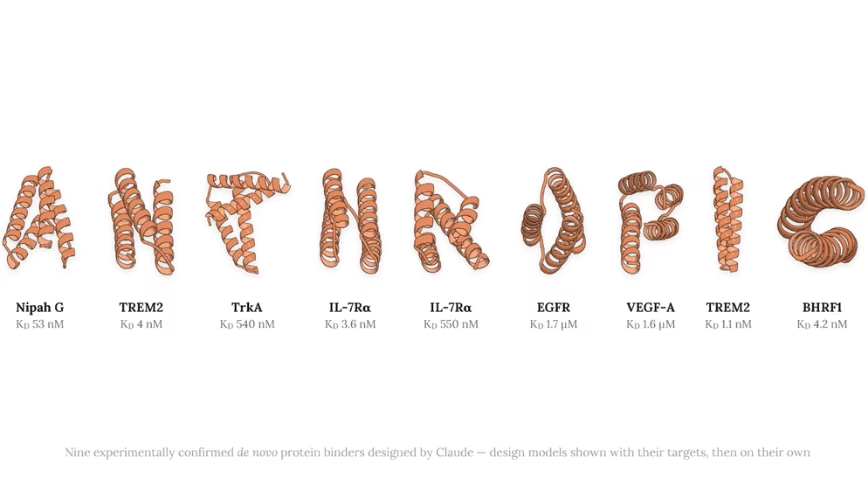
Anthropic reports that Claude models designed working protein binders and completed a chemical-analysis task in minutes. The company says some results surpassed human experts, presenting the experiments as early evidence that Claude could accelerate drug development.

Ornith-1.5 launches open models in 397B, 35B, and 9B parameter sizes. The models feature self-improving task and scaffold generation and report strong performance on coding and reasoning benchmarks.
Cerebras launched the CS-4, its first system to combine three wafer-scale processors in a single rack. The inference-focused machine is shipping this quarter, with Cerebras claiming up to 30 times the speed of GPU-based systems for frontier models.