MiniMax Design Connects Models Through Agents
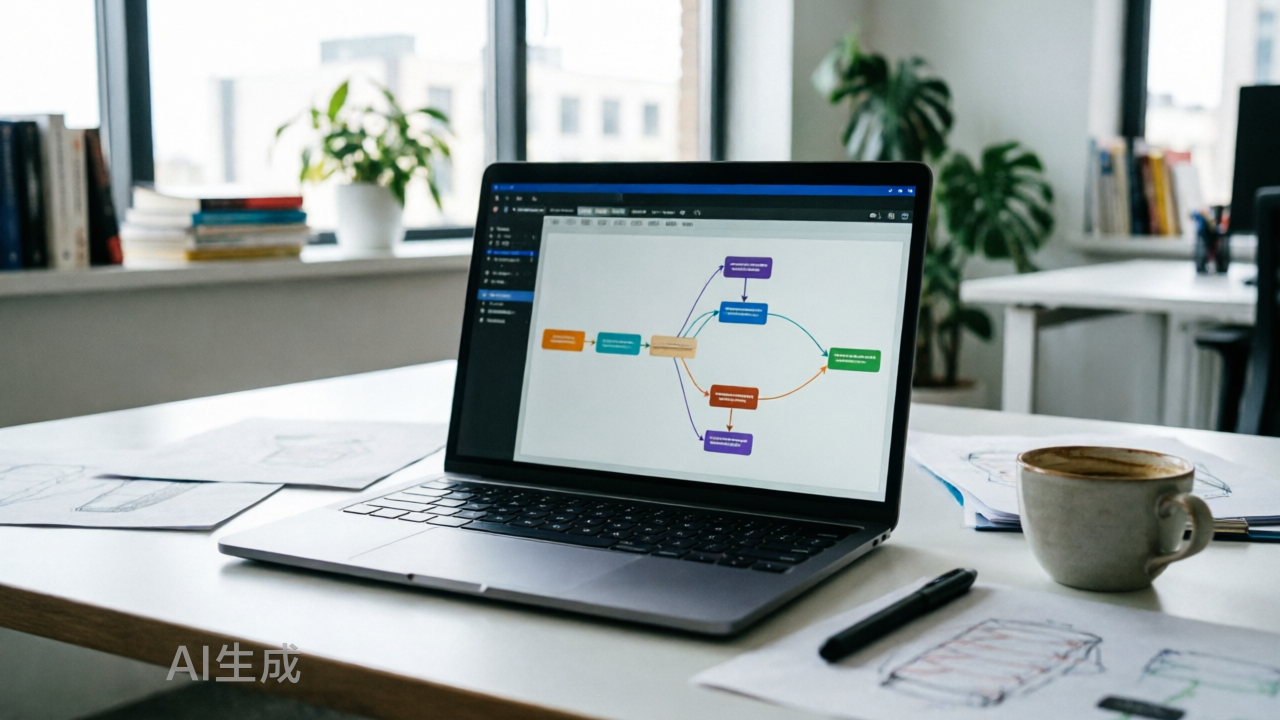
💡See how Agent orchestration may turn multi-model video generation into a professional production workflow.
⚡ 30-Second TL;DR
What Changed
MiniMax Design uses Agent-based orchestration to connect multiple AI models in one workflow.
Why It Matters
Agent-based orchestration could reduce the need for creators to switch between specialized models and tools. For AI startups, the opportunity may move from building one best-in-class model to owning the professional workflow and user entry point.
What To Do Next
Run a pilot workflow in MiniMax Design that measures end-to-end completion time, manual handoffs, and output quality against your current multi-tool video process.
Key Points
- •MiniMax Design uses Agent-based orchestration to connect multiple AI models in one workflow.
- •The product targets professional content production rather than casual, single-prompt generation.
- •AI video competition is increasingly focused on product integration, workflow utility, and monetization.
🧠 Deep Insight
AI-generated analysis for this event.
🔑 Enhanced Key Takeaways
- •MiniMax Design integrates a proprietary 'MoE' (Mixture-of-Experts) architecture specifically optimized for high-fidelity video consistency across multi-shot sequences.
- •The platform incorporates a 'Director Agent' layer that manages temporal coherence and character consistency, addressing a major pain point in long-form AI video generation.
- •MiniMax has shifted its commercial strategy toward a 'B2B-first' model, offering API-based workflow integration for advertising agencies and film production houses.
- •The system utilizes a closed-loop feedback mechanism where the Agent evaluates output quality against user-defined style guides and automatically triggers re-generation for specific segments.
- •MiniMax Design supports multi-modal input processing, allowing users to upload reference assets (storyboards, character sheets) that the Agent uses to constrain the generative process.
📊 Competitor Analysis▸ Show
| Feature | MiniMax Design | Runway Gen-3 Alpha | Kling AI |
|---|---|---|---|
| Core Focus | Agent-orchestrated workflows | Creative suite/Director tools | High-fidelity generation |
| Model Architecture | Multi-model Agentic | Unified Video Model | Diffusion-Transformer |
| Target User | Professional Production | Prosumer/Creative | General/Prosumer |
| Pricing Model | Enterprise/Usage-based | Subscription/Credits | Subscription/Credits |
🛠️ Technical Deep Dive
- Employs a hierarchical Agentic framework where a central orchestrator decomposes complex video prompts into sub-tasks (scripting, asset generation, scene assembly).
- Utilizes a latent space consistency module that maintains character identity across disparate model outputs by sharing embedding constraints.
- Implements a temporal attention mechanism that allows the Agent to reference previous frames in a sequence to prevent 'flickering' or identity drift.
- Supports asynchronous model execution, allowing the Agent to parallelize background and foreground generation tasks to reduce total render time.
🔮 Future ImplicationsAI analysis grounded in cited sources
⏳ Timeline
Weekly AI Recap
Read this week's curated digest of top AI events →
👉Related Updates

AI-curated news aggregator. All content rights belong to original publishers.
Original source: 钛媒体 ↗