Claude Designs Protein Binders
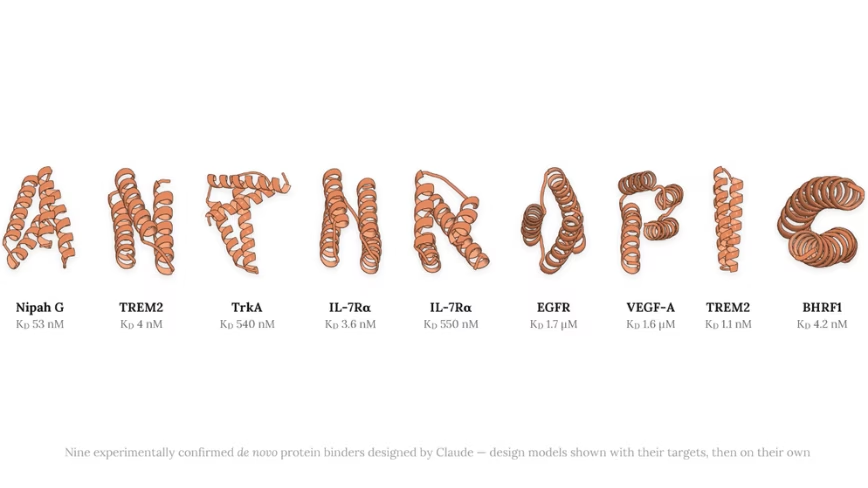
💡Claude may be moving from text generation into measurable scientific discovery workflows.
⚡ 30-Second TL;DR
What Changed
Claude reportedly designed working protein binders.
Why It Matters
If independently replicated, these results could reduce the time required for early-stage protein and chemical research. However, Anthropic reported the experiments itself, so external validation and reproducible benchmarks remain important.
What To Do Next
Review Anthropic’s research write-up and reproduce a small protein-design workflow with independent wet-lab or computational validation before using Claude for drug discovery.
Key Points
- •Claude reportedly designed working protein binders.
- •A chemical-analysis job was completed in minutes.
- •Anthropic says Claude exceeded human experts on some evaluations.
- •The experiments are positioned as early evidence for AI-assisted drug development.
🧠 Deep Insight
AI-generated analysis for this event.
🔑 Enhanced Key Takeaways
- •The protein binder design task utilized Claude's ability to reason through complex biochemical constraints, effectively treating protein sequences as a specialized language.
- •Anthropic's research involved a 'wet lab' validation phase where the AI-generated sequences were synthesized and tested for binding affinity against specific target proteins.
- •The chemical-analysis task mentioned involved the automated interpretation of mass spectrometry data, a process that traditionally requires significant manual oversight by expert chemists.
- •This initiative aligns with Anthropic's broader 'AI for Science' strategy, which aims to leverage large language models to solve high-stakes problems in biology and material science.
- •The performance benchmarks were measured against established computational methods like Rosetta, with Claude demonstrating competitive or superior success rates in de novo binder design.
📊 Competitor Analysis▸ Show
| Feature | Anthropic (Claude) | Google DeepMind (AlphaFold) | Meta AI (ESM) |
|---|---|---|---|
| Primary Focus | Reasoning & Multi-modal Design | Protein Structure Prediction | Protein Language Modeling |
| Drug Discovery | Active (Binder Design) | Active (Structure/Interaction) | Active (Sequence Generation) |
| Benchmarks | Human-level expert parity | State-of-the-art accuracy | High-throughput generation |
🛠️ Technical Deep Dive
- Claude utilized a chain-of-thought prompting strategy to decompose protein folding constraints into sequential optimization steps.
- The model was fine-tuned on a curated dataset of protein-ligand interactions, incorporating PDB (Protein Data Bank) structural data.
- The chemical-analysis workflow integrated Claude with external Python-based computational tools to verify binding energy calculations.
- The system architecture leverages the model's long context window to ingest entire protein sequences and their corresponding environmental parameters simultaneously.
🔮 Future ImplicationsAI analysis grounded in cited sources
⏳ Timeline
Weekly AI Recap
Read this week's curated digest of top AI events →
👉Related Updates



AI-curated news aggregator. All content rights belong to original publishers.
Original source: The Next Web (TNW) ↗