🐼Pandaily•Freshcollected in 77m
Xiaomi Robots Deploy to SU7 Car Production Line
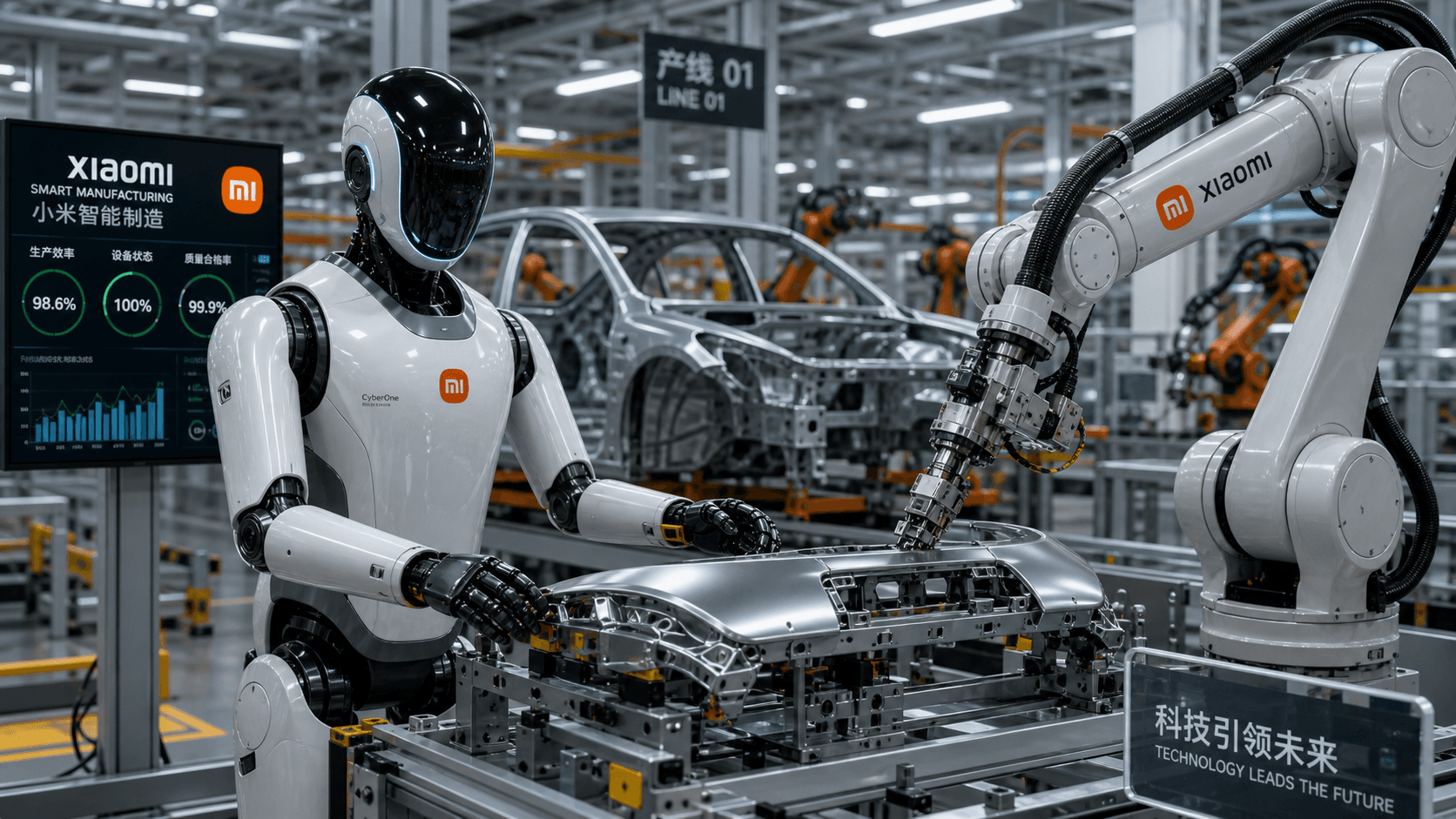
💡Xiaomi's robots hit 90% success in real factory tasks—a major win for embodied AI in manufacturing.
⚡ 30-Second TL;DR
What Changed
Robots are now performing complex flexible workpiece operations rather than just screw-tightening.
Why It Matters
This milestone validates the viability of humanoid robots in high-precision manufacturing, potentially lowering labor costs for complex assembly tasks.
What To Do Next
Review the training methodologies used for Xiaomi's robots to understand how to improve success rates in your own robotics simulation environments.
Who should care:Developers & AI Engineers
Key Points
- •Robots are now performing complex flexible workpiece operations rather than just screw-tightening.
- •Achieved a 90%+ success rate in real-world manufacturing environments.
- •Demonstrates rapid progress in embodied AI training within a high-stakes automotive production setting.
🧠 Deep Insight
AI-generated analysis for this event.
🔑 Enhanced Key Takeaways
- •Xiaomi's humanoid robot, known as CyberOne, serves as the foundational research platform for the embodied AI systems currently being refined in the SU7 factory environment.
- •The integration utilizes a proprietary 'End-to-End' large model architecture that allows robots to process visual and tactile feedback in real-time without relying on pre-programmed paths.
- •Xiaomi has established a dedicated 'Robot Lab' within its Beijing manufacturing hub to accelerate the iteration cycle between simulation (digital twin) and physical deployment.
- •The deployment utilizes advanced force-control sensors developed in-house, enabling the robots to handle delicate automotive components that previously required human dexterity.
- •Xiaomi's strategy involves a 'dual-track' approach, simultaneously developing humanoid robots for industrial manufacturing and consumer-facing service roles.
📊 Competitor Analysis▸ Show
| Feature | Xiaomi (CyberOne/Industrial) | Tesla (Optimus) | Figure AI (Figure 02) |
|---|---|---|---|
| Primary Focus | Automotive Manufacturing | General Purpose/Factory | Logistics/Manufacturing |
| Integration | Deeply tied to SU7 ecosystem | Tied to GigaFactory operations | Platform-agnostic/Partnerships |
| Key Advantage | Rapid iteration in-house | Massive data collection scale | Advanced neural network speed |
🛠️ Technical Deep Dive
- Architecture: Employs a transformer-based embodied AI model that maps visual inputs directly to motor control commands.
- Sensing: Utilizes a combination of Mi-Sense depth vision modules and high-frequency force/torque sensors at the end-effectors.
- Training: Leverages a digital twin environment where robots undergo millions of simulated cycles before physical deployment to the SU7 line.
- Control: Implements a hierarchical control system where high-level task planning is separated from low-level joint torque control for stability.
🔮 Future ImplicationsAI analysis grounded in cited sources
Xiaomi will launch a commercialized industrial humanoid robot by 2027.
The successful 90%+ success rate in a high-stakes automotive environment provides the necessary validation data to move toward external enterprise sales.
Humanoid robot density in Xiaomi's factories will increase by 300% within two years.
The transition from basic tasks to complex workpiece handling proves the scalability of the current embodied AI model across different assembly stations.
⏳ Timeline
2022-08
Xiaomi officially unveils its first full-size humanoid robot, CyberOne.
2023-08
Xiaomi showcases the second generation CyberOne with improved motion control and sensing capabilities.
2024-03
Xiaomi SU7 officially launches, establishing the high-tech manufacturing base for future robot integration.
2026-01
Xiaomi initiates intensive six-month factory training program for humanoid robots on the SU7 line.
📰
Weekly AI Recap
Read this week's curated digest of top AI events →
👉Related Updates

AI-curated news aggregator. All content rights belong to original publishers.
Original source: Pandaily ↗