🇨🇳cnBeta (Full RSS)•Stalecollected in 2h
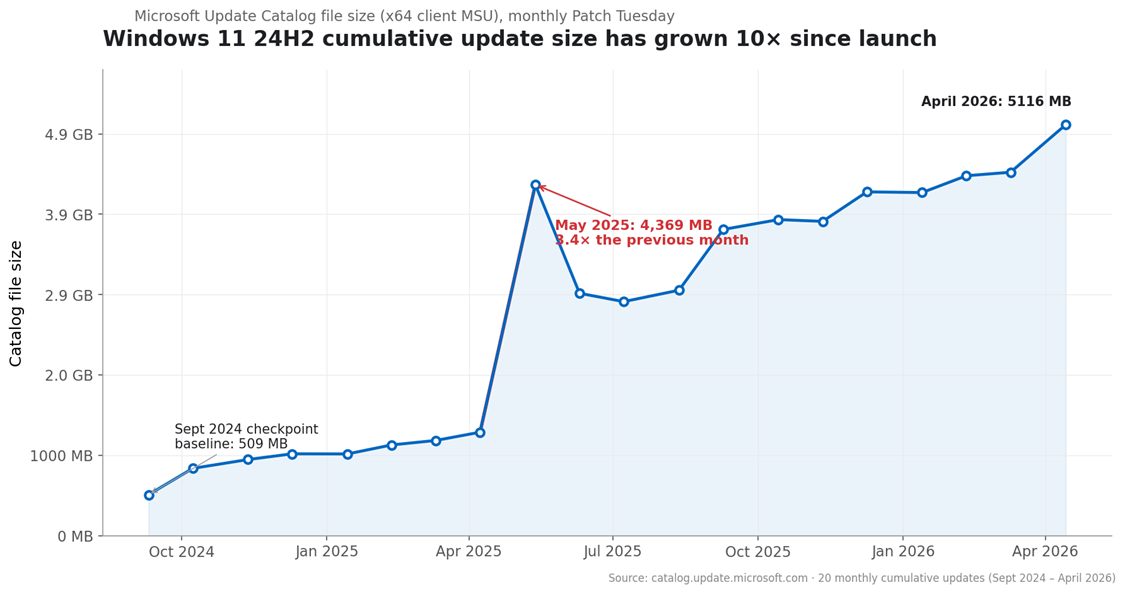
Windows 11 Updates Bloat to 5GB in 2 Years
💡Windows 11 patches now 5GB—AI devs on Windows, plan for massive downloads!
⚡ 30-Second TL;DR
What Changed
Update size grew 16x from 300MB to 5GB over two years
Why It Matters
Larger updates increase bandwidth strain and deployment time for enterprises running Windows-based AI workflows. Devs may need to optimize patching schedules.
What To Do Next
Review WSUS policies to defer non-critical Windows 11 updates in AI compute clusters.
Who should care:Enterprise & Security Teams
Key Points
- •Update size grew 16x from 300MB to 5GB over two years
- •Uncompressed size nears 9GB
- •AI features add some bulk, but mechanism is primary cause
🧠 Deep Insight
AI-generated analysis for this event.
🔑 Enhanced Key Takeaways
- •Microsoft's transition to the 'Checkpoint Cumulative Update' (CCU) architecture in 2025 was intended to reduce bandwidth usage by only downloading changed files, yet the cumulative base size continues to balloon due to the inclusion of legacy component support and redundant binaries.
- •The integration of 'Windows Intelligence' (the rebranded AI-driven OS layer) requires frequent, large-scale model weight updates and localized vector database synchronization, which are bundled directly into the monthly patch cycle rather than being delivered via separate app-store updates.
- •Enterprise IT departments are increasingly adopting 'Update Orchestration' tools to bypass standard Windows Update channels, as the 5GB+ payload size is causing significant network congestion and storage exhaustion on thin-client devices with limited eMMC storage.
📊 Competitor Analysis▸ Show
| Feature | Windows 11 (2026) | macOS (Sequoia/Post) | ChromeOS (Flex) |
|---|---|---|---|
| Update Delivery | Cumulative (Large) | Delta/Differential (Small) | A/B Partition (Seamless) |
| AI Integration | OS-Level (Heavy) | Hybrid (Cloud/Local) | Cloud-First (Light) |
| Storage Footprint | High (Bloat-prone) | Moderate | Low (Optimized) |
🛠️ Technical Deep Dive
- •Checkpoint Cumulative Update (CCU) architecture: Implements a base-plus-delta model, but the 'base' is frequently re-baselined to include all previous updates, preventing effective long-term size reduction.
- •Component Store (WinSxS) growth: The directory continues to accumulate superseded versions of system files to support 'Rollback' functionality, which is now mandatory for AI-integrated kernel stability.
- •AI Model Weight Bundling: Windows 11 now includes pre-compiled neural network weights for local inference, which are updated monthly to maintain compatibility with the latest Windows Intelligence API versions.
- •Payload Compression: While Microsoft utilizes LZMS compression, the entropy of the new AI-related binary blobs is high, resulting in diminishing returns for compression ratios compared to traditional system files.
🔮 Future ImplicationsAI analysis grounded in cited sources
Microsoft will introduce 'Modular Updates' by Q4 2026.
The current cumulative update size is unsustainable for low-end hardware and enterprise network infrastructure, forcing a shift toward componentized delivery.
Minimum storage requirements for Windows 11 will increase to 128GB.
The rapid expansion of the WinSxS directory and AI model caches necessitates larger baseline storage to prevent OS-level performance degradation.
⏳ Timeline
2021-10
Windows 11 official release with initial update architecture.
2023-09
Introduction of Windows Copilot, marking the start of AI-integrated OS updates.
2025-03
Microsoft rolls out Checkpoint Cumulative Updates (CCU) to manage update size.
2026-01
Windows 11 cumulative update size officially crosses the 4GB threshold.
📰
Weekly AI Recap
Read this week's curated digest of top AI events →
👉Related Updates
Same topic
Explore #update-bloat
Same product
More on windows-11
Same source
Latest from cnBeta (Full RSS)

PACA: Open-source tool for ancient fossil coordinate mapping
cnBeta (Full RSS)•Jul 28

First atmosphere detected on habitable-zone exoplanet
cnBeta (Full RSS)•Jul 25

Samsung Secures $200B Broadcom AI Infrastructure Deal
cnBeta (Full RSS)•Jul 25

How AMD's 2006 ATI Acquisition Built Today's AI Empire
cnBeta (Full RSS)•Jul 25
AI-curated news aggregator. All content rights belong to original publishers.
Original source: cnBeta (Full RSS) ↗