How AMD's 2006 ATI Acquisition Built Today's AI Empire
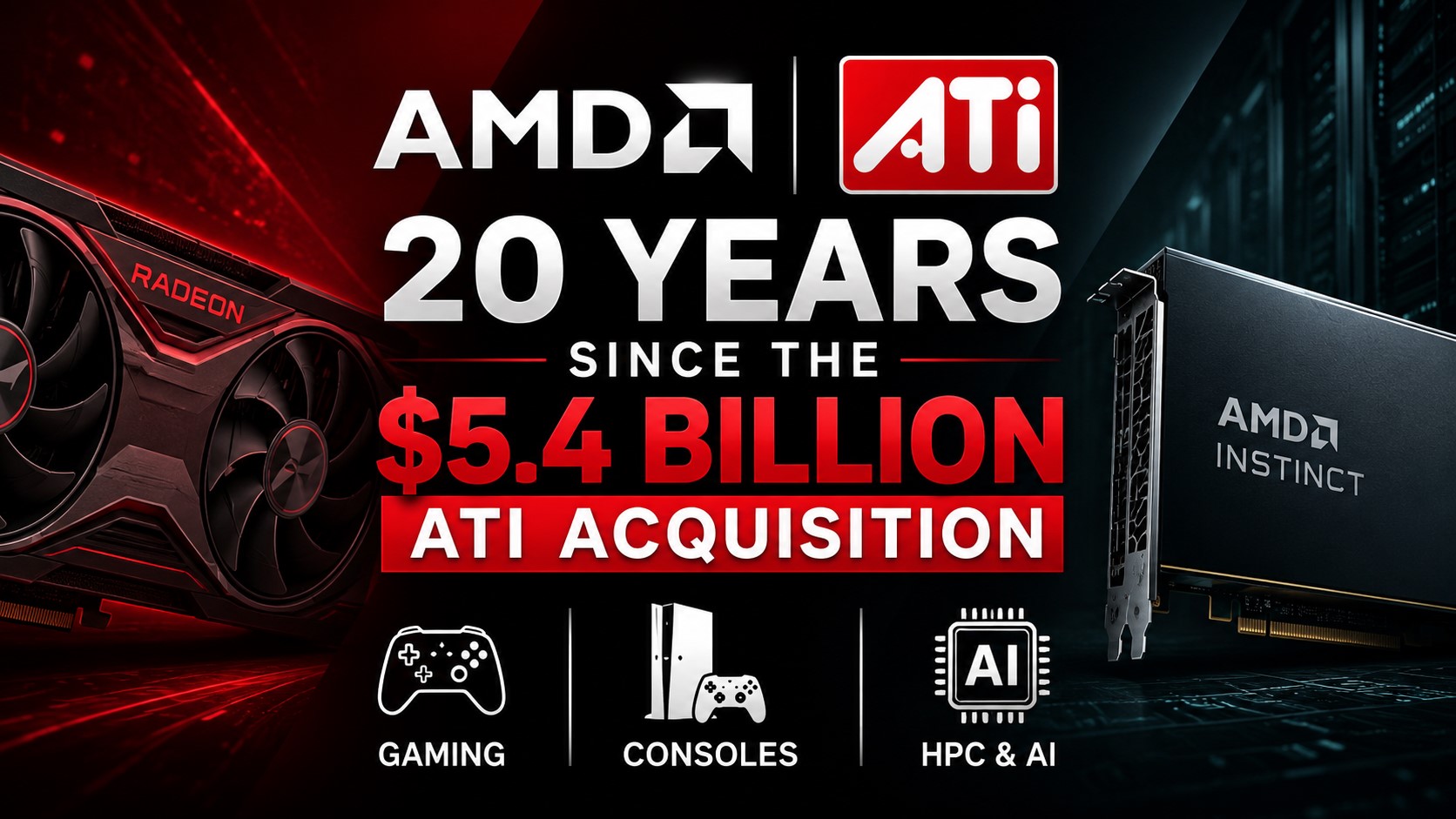
💡Understand how a 20-year-old hardware bet became the foundation for today's AI compute power.
⚡ 30-Second TL;DR
What Changed
The 2006 ATI acquisition was a pivotal moment that transformed AMD's long-term trajectory.
Why It Matters
The historical success of this acquisition highlights the importance of vertical integration in hardware for AI. It serves as a case study for how legacy tech companies can pivot to become leaders in the AI era.
What To Do Next
Analyze your company's hardware stack to identify if strategic acquisitions or partnerships could fill critical gaps in your AI compute infrastructure.
Key Points
- •The 2006 ATI acquisition was a pivotal moment that transformed AMD's long-term trajectory.
- •Integrating GPU technology allowed AMD to compete directly with Intel and Nvidia.
- •Strategic hardware acquisitions are essential for long-term dominance in the AI compute era.
🧠 Deep Insight
AI-generated analysis for this event — not the original article.
🔑 Enhanced Key Takeaways
- •The 2006 acquisition was primarily driven by AMD's desire to create the 'Fusion' platform, which aimed to integrate CPU and GPU cores on a single die, a concept that eventually materialized as the Accelerated Processing Unit (APU).
- •Before the acquisition, ATI was a dominant force in the discrete graphics market, holding significant intellectual property in shader architecture that AMD leveraged to pivot into high-performance computing (HPC).
- •The merger faced severe initial criticism due to AMD's heavy debt load and the cultural clash between the CPU-focused AMD engineering teams and the graphics-centric ATI teams.
- •AMD's acquisition of ATI provided the foundational IP for the semi-custom business unit, which secured long-term contracts to power gaming consoles like the PlayStation 4, PlayStation 5, and Xbox Series X/S, providing steady revenue to fund R&D.
- •The integration of ATI's technology was critical for the development of the ROCm (Radeon Open Compute) software stack, which is AMD's current primary answer to Nvidia's CUDA ecosystem in the AI training and inference market.
📊 Competitor Analysis▸ Show
| Feature | AMD (ATI-derived) | Nvidia | Intel |
|---|---|---|---|
| Primary AI Strategy | ROCm / Open Ecosystem | CUDA / Proprietary Stack | OneAPI / Open Standards |
| Hardware Focus | Instinct Accelerators | Blackwell/Hopper GPUs | Gaudi Accelerators |
| Market Position | Challenger / Value-Oriented | Market Leader / Premium | Emerging / Integrated |
| Software Maturity | Improving (Open Source) | Industry Standard | Developing |
🛠️ Technical Deep Dive
- The Fusion architecture pioneered the Heterogeneous System Architecture (HSA), allowing CPU and GPU to share memory address spaces.
- Modern AMD Instinct MI300 series utilizes a chiplet-based design, combining 5nm and 6nm process nodes to integrate CDNA 3 architecture with HBM3 memory.
- The CDNA architecture, derived from the original GCN (Graphics Core Next) lineage, was specifically bifurcated from gaming graphics (RDNA) to optimize for FP64 and matrix math performance required for AI workloads.
- Infinity Fabric serves as the high-bandwidth, low-latency interconnect that allows CPU and GPU chiplets to communicate as a unified system, a direct evolution of the early integration efforts.
🔮 Future ImplicationsAI analysis grounded in cited sources
⏳ Timeline
Weekly AI Recap
Read this week's curated digest of top AI events →
👉Related Updates
AI-curated news aggregator. All content rights belong to original publishers.
Original source: cnBeta (Full RSS) ↗
This is a summary, not the original. Read the source, or get the weekly briefing.
The weekly digest
One email a week. Unsubscribe anytime.