Why Long-Form Video Resists Full AI
💡Long-form video reveals where AI cuts costs—and where quality failures, rework, and rendering bottlenecks erase the gain
⚡ 30-Second TL;DR
What Changed
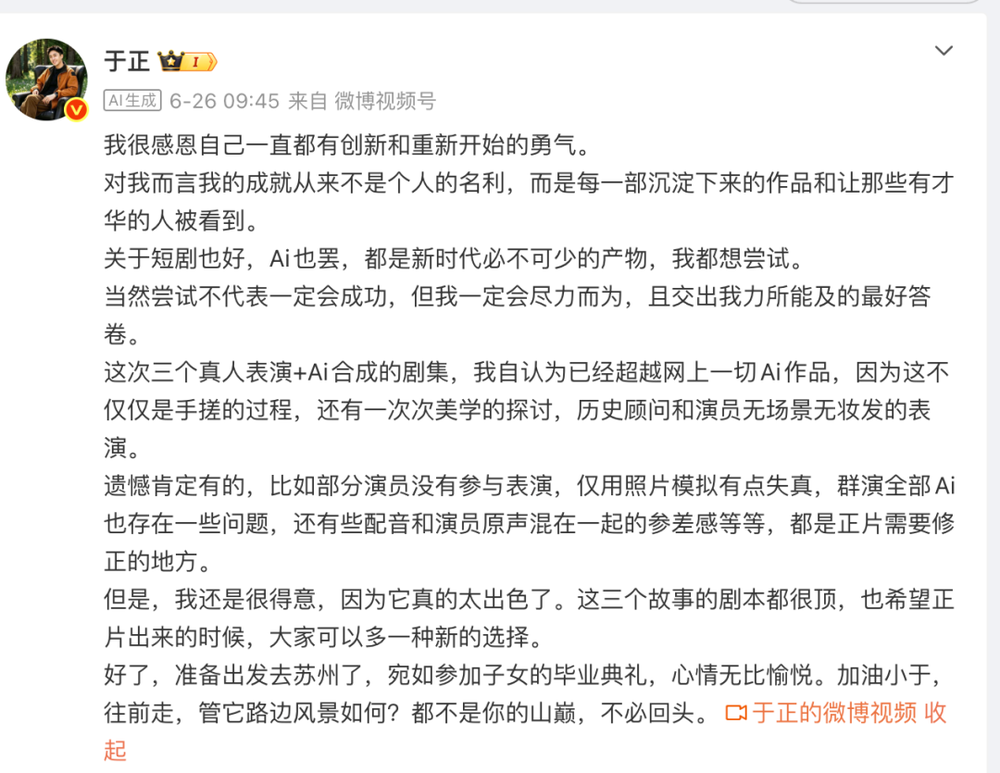
AI-generated long-form productions such as 桃花潭記 and 奇譚 received limited audience response, while 這一秒過火 faced criticism for its cheap visual style.
Why It Matters
For AI video founders and production teams, the article suggests that quality and controllability matter more than maximizing AI-generated footage. Vendors that provide reliable workflow integration, review tools, provenance, and human-in-the-loop editing may create more durable value than fully automated video generators.
What To Do Next
Prototype a human-in-the-loop pipeline with Kling AI for previsualization or effects, then measure revision time, rendering latency, defect rate, and per-shot cost against a manual baseline.
Key Points
- •AI-generated long-form productions such as 桃花潭記 and 奇譚 received limited audience response, while 這一秒過火 faced criticism for its cheap visual style.
- •華策影視 used Kling AI for virtual environments and effects on 太平年, reducing a traditional two-month ocean-fluid effect process to roughly two weeks.
- •歡娛影視 reported that AI-assisted production cut per-episode funding costs by about one-third, but increased rendering queues, iteration, and rework.
- •柠萌影视 limited AI in 十日終焉 to 3D storyboards, continuity fixes, green-screen replacement, and neural-network-assisted quality inspection.
- •The emerging industry model is human-led production with AI concentrated in tasks that are difficult or uneconomical to perform manually.
🧠 Deep Insight
Background and context from public sources — not the original article. 23 sources cited.
🔑 Enhanced Key Takeaways
- •AI in post-production workflows extends beyond visual effects to include asset organization (ingest), editing, audio enhancement (noise reduction, dialogue enhancement, automatic mixing), and content delivery (export and distribution).
- •AI tools can significantly reduce green screen editing time by up to 65% compared to manual methods, with some AI algorithms achieving 98% accurate edge detection even with complex elements like hair or transparent objects.
- •Huace Film & TV has partnered with U.S.-based Utopai Studios to deploy its PAI cinematic AI system as a core engine for long-form narrative creation, indicating a strategic shift towards integrated AI production workflows rather than just standalone tools.
- •Studios are increasingly leveraging AI-driven predictive analytics to forecast audience preferences and optimize marketing strategies, aiming to improve box office performance.
- •AI short films have been produced with total costs ranging from $750 to $5,000, and per-minute costs between $315 and $750, potentially reducing production expenses by up to 99.7% compared to traditional shoots of the same scale.
🛠️ Technical Deep Dive
- Kling AI: Utilizes 3.0, O1, and 2.6 model hierarchies, described as the world's first unified multimodal AI video engine. Its capabilities include semantic prompt engineering, motion brush precision, multimodal input, pixel-level reconstruction, and native audio synchronization, powered by Omni One architecture for physics-aware motion.
- General AI in Post-Production: Employs machine learning technologies to analyze content contextually, recognizing scenes, detecting objects, understanding dialogue, and predicting motion across various stages like ingest, editing, VFX, audio, and delivery.
- AI for Green Screen/Background Removal: Advanced AI algorithms can achieve up to 98% accurate edge detection, adapting to lighting changes and enabling background replacement without the need for a physical green screen.
- AI for Audio Enhancement: AI-powered machine learning algorithms perform noise reduction, dialogue enhancement, and automatic mixing. Neural models can separate audio stems, recreate missing ambience, and synthesize Foley effects.
- AI for Quality Control (QC): AI-based video analysis systems learn the 'normal' or target condition through model training, allowing them to recognize deviations and identify novel or previously unknown error patterns without explicit pre-programming.
- Generative AI in Film: Leverages techniques such as text-to-image and image-to-video diffusion, neural radiance fields (NeRF), avatar generation, and 3D synthesis for content creation.
🔮 Future ImplicationsAI analysis grounded in cited sources
⏳ Timeline
📎 Sources (23)
Factual claims are grounded in the sources below. Forward-looking analysis is AI-generated interpretation.
Weekly AI Recap
Read this week's curated digest of top AI events →
👉Related Updates

AI-curated news aggregator. All content rights belong to original publishers.
Original source: 虎嗅 ↗
This is a summary, not the original. Read the source, or get the weekly briefing.
Weekly AI briefing
One email a week. Unsubscribe anytime.