Why Goldman Bets on Nearly Double HBM Prices
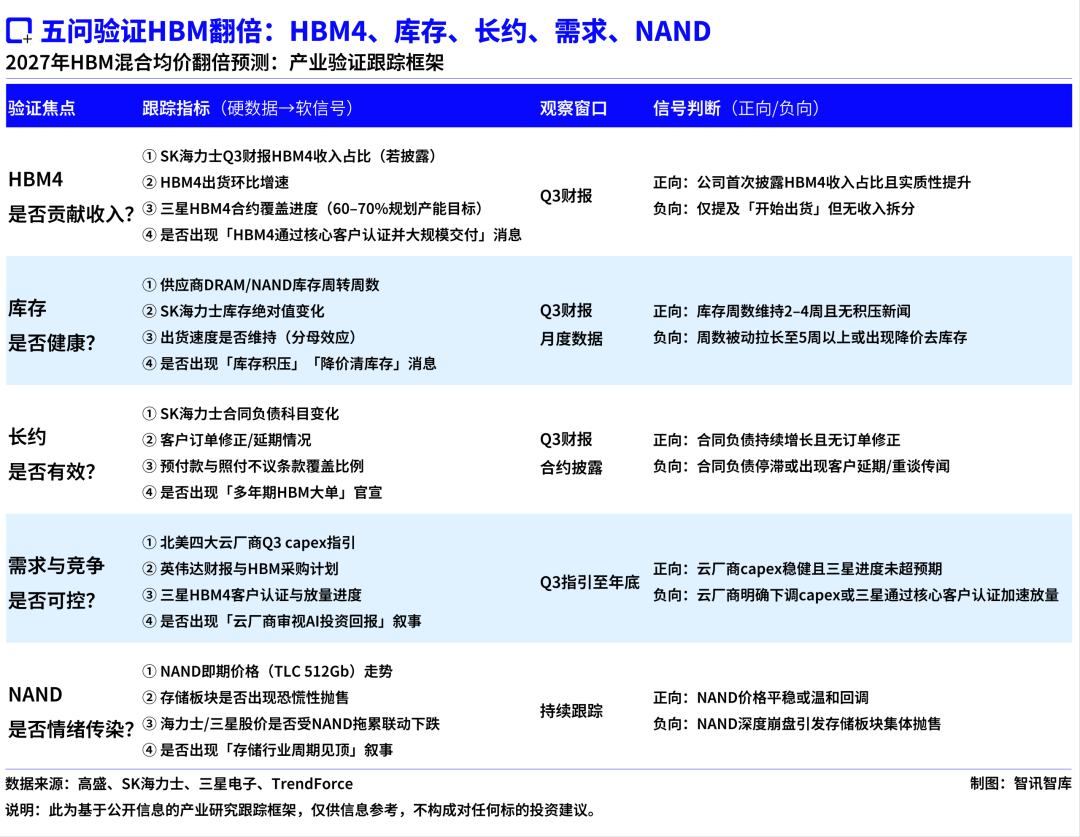
HBM prices could nearly double, reshaping AI hardware costs—but the key assumptions are still unproven.
30-Second TL;DR
What Changed
Goldman forecasts 2027 HBM blended ASP at about $2.9 per Gb, versus roughly $2.3 per Gb in Visible Alpha consensus estimates.
Why It Matters
HBM pricing will directly affect the cost structure and capacity planning of AI accelerator and data-center projects. AI infrastructure buyers should avoid treating Goldman’s forecast as a confirmed trend, because HBM4 yields, supplier competition, contract terms, and AI capital spending still need quarterly validation.
What To Do Next
Add HBM4 yield, supplier allocation, and contract-ASP scenarios to your GPU cost model, then refresh the assumptions when Samsung or SK hynix reports Q3 results.
Key Points
- •Goldman forecasts 2027 HBM blended ASP at about $2.9 per Gb, versus roughly $2.3 per Gb in Visible Alpha consensus estimates.
- •The expected price increase relies on the HBM supply deficit widening from 5.4% in 2026 to 6.0% in 2027.
- •General-purpose DRAM prices may reach about $2.0 per Gb by the end of 2026, creating an anchor for HBM contract repricing.
- •Around 40% of the forecast improvement depends on product-mix gains and HBM4 volume, whose execution remains uncertain.
- •The main downside risk is not necessarily an AI demand collapse, but faster supply growth, stronger competition, and reduced capital expenditure occurring together.
Deep Insight
AI-generated analysis for this event — not the original article.
Enhanced Key Takeaways
- •Goldman Sachs' bullish outlook is partially predicated on the transition to HBM4, which utilizes a 2048-bit interface compared to HBM3E's 1024-bit, significantly increasing manufacturing complexity and cost.
- •The supply-demand imbalance is exacerbated by the 'die size penalty' associated with advanced HBM nodes, where larger die sizes reduce the number of chips per wafer, effectively tightening supply even if wafer starts remain constant.
- •SK hynix has reportedly secured a dominant share of the HBM3E market for NVIDIA's Blackwell platform, creating a high barrier to entry for competitors attempting to capture margin through volume.
- •Samsung Electronics is aggressively pursuing the 'Custom HBM' strategy, aiming to integrate logic dies directly into the HBM stack to differentiate from standard commodity HBM offerings.
- •Market analysts note that the 'blended ASP' calculation is highly sensitive to the yield rates of 12-high and 16-high stacks, which currently face significant thermal and stacking challenges in mass production.
Competitor Analysis
- SK Hynix (HBM3E/4)
- Current Leader
- Samsung (HBM3E/4)
- Aggressive Challenger
- Micron (HBM3E)
- Niche/Fast Follower
- SK Hynix (HBM3E/4)
- High Yield/NVIDIA Partnership
- Samsung (HBM3E/4)
- Logic Integration/Foundry Synergy
- Micron (HBM3E)
- Power Efficiency
- SK Hynix (HBM3E/4)
- Development Phase
- Samsung (HBM3E/4)
- Development Phase
- Micron (HBM3E)
- Sampling Phase
| Feature | SK Hynix (HBM3E/4) | Samsung (HBM3E/4) | Micron (HBM3E) |
|---|---|---|---|
| Market Position | Current Leader | Aggressive Challenger | Niche/Fast Follower |
| Key Advantage | High Yield/NVIDIA Partnership | Logic Integration/Foundry Synergy | Power Efficiency |
| HBM4 Status | Development Phase | Development Phase | Sampling Phase |
Technical Deep Dive
- HBM4 architecture shifts to a 2048-bit wide interface, doubling the bandwidth per stack compared to HBM3E.
- Implementation of 16-high stacking requires advanced MR-MUF (Mass Reflow Molded Underfill) or hybrid bonding techniques to manage thermal dissipation and vertical interconnect density.
- Logic die integration in HBM4 allows for custom base dies, enabling memory-side processing capabilities that reduce latency for AI inference workloads.
- Thermal management in 2026-era HBM relies on improved thermal conductivity materials (TC-NCF) to prevent localized hotspots during high-bandwidth operations.
Future ImplicationsAI analysis grounded in cited sources
Timeline
- 2023-10SK hynix announces mass production of HBM3E, setting the industry standard for high-capacity AI memory.
- 2024-02Samsung Electronics unveils its 36GB HBM3E 12-high stack, focusing on high-density capacity for large language models.
- 2025-05Industry-wide shift toward HBM4 development begins as AI accelerator requirements exceed HBM3E bandwidth limits.
- 2026-03Samsung and SK hynix report record-high capital expenditure allocations specifically for HBM-dedicated TSV (Through-Silicon Via) capacity.
Weekly AI Recap
Read this week's curated digest of top AI events →
Related Updates
AI-curated news aggregator. All content rights belong to original publishers.
Original source: 虎嗅 ↗
This is a summary, not the original. Read the source, or get the weekly briefing.
The weekly digest
One email a week. Unsubscribe anytime.