Waymo and Uber end robotaxi partnership in Phoenix
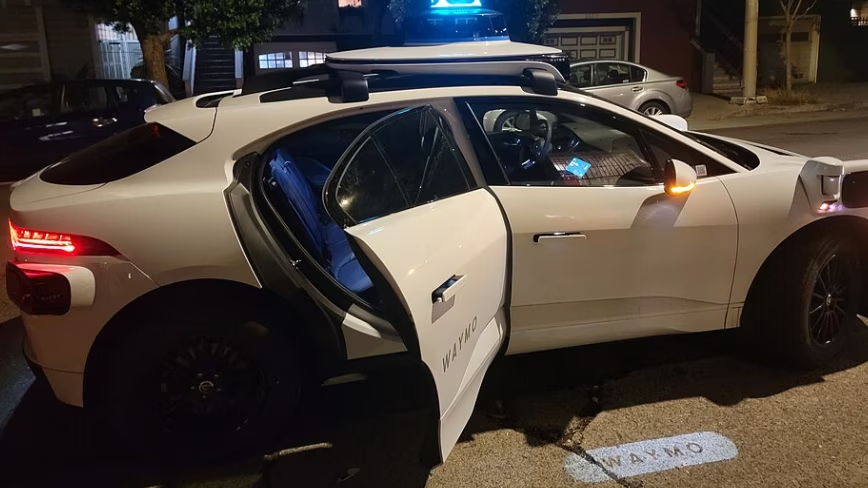
💡A significant shift in the autonomous ride-hailing market as Waymo moves away from third-party distribution.
⚡ 30-Second TL;DR
What Changed
Partnership in Phoenix officially concluded after three years
Why It Matters
This split suggests that autonomous vehicle providers may prioritize owning the end-user experience and data loop over third-party platform integration.
What To Do Next
If building for autonomous platforms, prioritize developing proprietary user interfaces to maintain control over customer data and feedback cycles.
Key Points
- •Partnership in Phoenix officially concluded after three years
- •Waymo moves to direct-to-consumer model via its own app
- •Collaboration was a key test for autonomous ride-hailing integration
- •Signals potential shift in Waymo's platform distribution strategy
🧠 Deep Insight
AI-generated analysis for this event — not the original article.
🔑 Enhanced Key Takeaways
- •The partnership termination follows Waymo's recent expansion of its operational design domain (ODD) to include more complex weather conditions and higher-speed highway driving in the Phoenix metropolitan area.
- •Internal data suggests Waymo's proprietary app has achieved higher user retention rates and better customer feedback loops compared to the Uber-integrated booking flow.
- •The shift aligns with Waymo's broader strategy to capture 100% of the transaction margin, moving away from the revenue-sharing model inherent in third-party ride-hailing integrations.
- •Waymo is reportedly preparing to launch a new 'Waymo One' subscription tier that incentivizes frequent riders, a feature that was technically difficult to implement while relying on Uber's platform infrastructure.
- •Regulatory filings indicate that Waymo's transition to a standalone model is intended to streamline safety data reporting and liability management by centralizing all ride telemetry within its own ecosystem.
📊 Competitor Analysis▸ Show
| Feature | Waymo | Zoox | Cruise | Tesla (Cybercab) |
|---|---|---|---|---|
| Model | Direct-to-Consumer | Direct-to-Consumer | Direct-to-Consumer | Direct-to-Consumer |
| Vehicle Type | Purpose-built SUV | Purpose-built Carriage | Retrofitted/Custom | Purpose-built Robotaxi |
| Market Focus | Urban/Suburban | Dense Urban | Urban | Mass Market/Private |
| Platform | Proprietary App | Proprietary App | Proprietary App | Tesla App |
🛠️ Technical Deep Dive
- Waymo utilizes a multi-modal sensor suite consisting of high-resolution LiDAR, radar, and cameras to achieve 360-degree perception.
- The vehicle software stack employs a transformer-based architecture for motion prediction, allowing the system to anticipate pedestrian and cyclist behavior in real-time.
- Waymo's fleet management system uses a centralized 'Fleet Response' platform that allows remote human operators to provide high-level guidance, though the vehicle remains fully autonomous.
- The transition to a standalone app allows Waymo to integrate deeper telemetry data, such as real-time cabin environmental controls and personalized route preferences, directly into the vehicle's onboard compute unit.
🔮 Future ImplicationsAI analysis grounded in cited sources
⏳ Timeline
📰 Event Coverage
Weekly AI Recap
Read this week's curated digest of top AI events →
👉Related Updates

AI-curated news aggregator. All content rights belong to original publishers.
Original source: The Next Web (TNW) ↗
This is a summary, not the original. Read the source, or get the weekly briefing.
Weekly AI briefing
One email a week. Unsubscribe anytime.