US and China AI competition risks in nuclear age
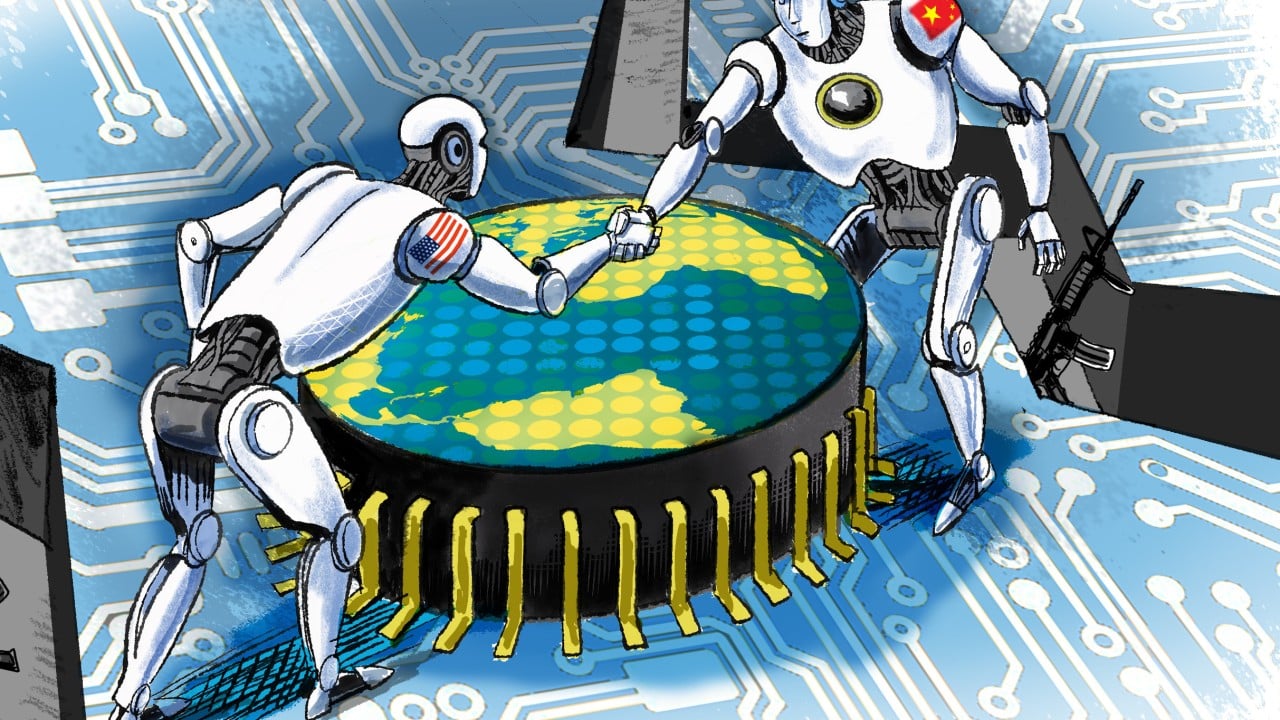
Understand how US-China AI rivalry will shape global tech policy, export controls, and your future compliance strategy.
30-Second TL;DR
What Changed
AI supremacy is now a central pillar of US-China relations, surpassing traditional trade and geopolitical issues.
Why It Matters
The geopolitical tension surrounding AI development may lead to increased export controls, fragmented research ecosystems, and stricter compliance requirements for AI companies operating internationally.
What To Do Next
Review your company's supply chain and data residency policies to ensure compliance with evolving cross-border AI technology export regulations.
Key Points
- •AI supremacy is now a central pillar of US-China relations, surpassing traditional trade and geopolitical issues.
- •The intersection of AI and nuclear-age security creates unprecedented risks for global stability.
- •Diplomatic communication is essential to prevent AI-driven escalation in military and strategic domains.
Deep Insight
Background and context from public sources — not the original article. 24 sources cited.
Enhanced Key Takeaways
- •The United States and China employ diverging strategies for military AI development; the US prioritizes 'decision superiority' and an ethics-centered approach, while China focuses on 'intelligentization' of the People's Liberation Army (PLA) through a military-civil fusion doctrine.
- •A key US strategy to manage AI competition involves imposing export controls on advanced computing chips and chip-making equipment to limit China's access to crucial AI inputs, a policy sustained by the Biden administration.
- •Despite intense competition, both the US and China have reached a consensus that decisions regarding the use of nuclear weapons must always remain under human control, not AI systems.
- •China's 'Military-Civil Fusion Development' doctrine mandates the integration of civilian and military AI advancements, enabling the government to direct technological innovations from the commercial sector to military applications.
- •The US military faces challenges in rapidly adopting AI capabilities due to internal bureaucratic blockers and resistance from major tech companies regarding military-relevant AI work, contrasting with China's more integrated approach.
Technical Deep Dive
- The US Department of Defense (DoD) is developing the Joint All-Domain Command and Control (JADC2) system, which leverages AI to consolidate data across land, sea, air, space, and cyber domains to enhance battlefield awareness and accelerate decision-making.
- China's military AI applications include the development of unmanned intelligent combat systems, enhancement of battlefield situational awareness and decision-making, multi-domain operations, and advanced training and simulation.
- Chinese military researchers have reportedly utilized an early version of Meta's open-source Llama model, dubbed 'ChatBIT,' for intelligence gathering and decision-making recommendations, circumventing the company's terms of service.
- AI is being integrated into autonomous systems for threat detection and tracking, exemplified by Anduril's 'Lattice' AI software used by the US military.
- China is enhancing naval assets, such as guided-missile frigates, with AI algorithms to improve air defense capabilities and illuminate blind spots.
- AI plays a role in managing complex orbital operations in space and in planning and executing cyber operations against critical information infrastructure.
Future ImplicationsAI analysis grounded in cited sources
Timeline
- 2017-07China issues its 'New Generation Artificial Intelligence Development Plan,' aiming for global AI leadership by 2030.
- 2018The US establishes the National Security Commission on Artificial Intelligence (NSCAI) to address AI's impact on national security.
- 2021-03The NSCAI releases its final report, warning that the US is not adequately prepared to compete with China in the AI era.
- 2022-10The Biden administration implements export controls on advanced semiconductors and chip-making equipment to China, aiming to limit its AI development.
- 2024-05The US and China hold their first inter-governmental dialogue on AI in Geneva, followed by a consensus in November 2024 between Presidents Xi and Biden on maintaining human control over nuclear weapons.
- 2026-05China agrees to formal discussions on AI safety with the US during President Trump's visit, with a focus on preventing non-state actors from acquiring dangerous models.
Sources (24)
Factual claims are grounded in the sources below. Forward-looking analysis is AI-generated interpretation.
Weekly AI Recap
Read this week's curated digest of top AI events →
Related Updates


AI-curated news aggregator. All content rights belong to original publishers.
Original source: SCMP Technology ↗
This is a summary, not the original. Read the source, or get the weekly briefing.
The weekly digest
One email a week. Unsubscribe anytime.