Unverified Harness Claims to Beat Fable 5
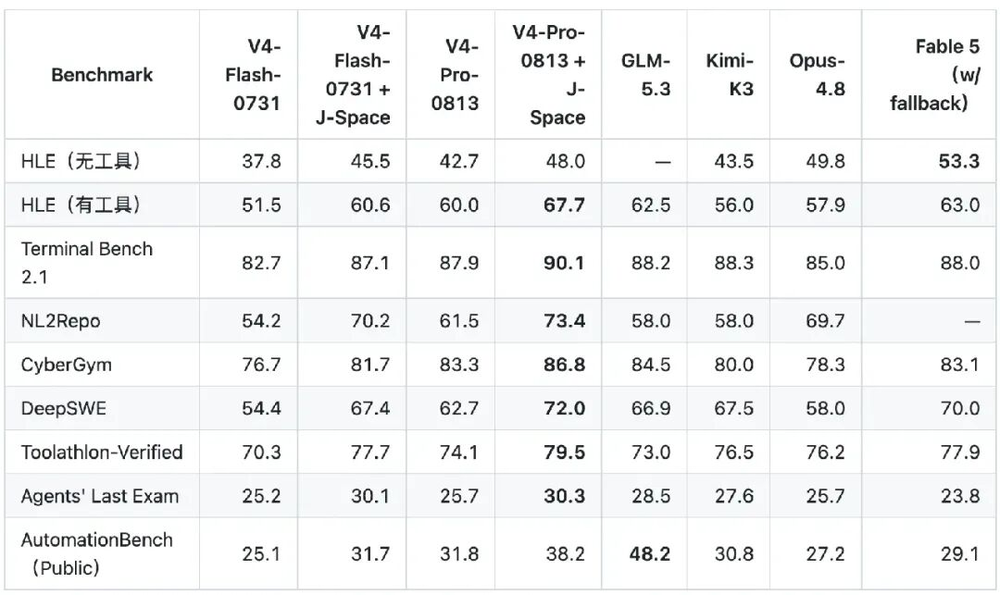
💡A claimed benchmark breakthrough may come from Agent scaffolding—not model weights—but nobody has independently reproduc
⚡ 30-Second TL;DR
What Changed
The Harness targets representation drift and premature stopping during long-running Agent tasks.
Why It Matters
If independently validated, the project would show that Agent orchestration can materially improve benchmark performance without retraining. However, benchmark gains may partly reflect differences in retries, tool calls, memory, validation, or stopping rules, so builders should avoid treating the claim as proof that DeepSeek V4-Pro surpasses Fable 5.
What To Do Next
Clone the J-Space Cognition Suite repository and run a controlled Terminal-Bench 2.1 A/B test against the stock DeepSeek V4-Pro-0813 configuration.
Key Points
- •The Harness targets representation drift and premature stopping during long-running Agent tasks.
- •Project-reported scores improved from 87.9 to 90.1 on Terminal-Bench 2.1, from 61.5 to 73.4 on NL2Repo, and up to 79.5 on Toolathlon-Verified.
- •No independent team had reproduced the results under identical model, prompt, tool, permission, and inference-budget conditions as of August 18.
- •The system modifies retry, verification, memory, state management, and stopping logic rather than producing a new model checkpoint.
- •Anthropic's J-space research concerns internal Claude representations, while this project is an external Agent execution framework.
🧠 Deep Insight
AI-generated analysis for this event.
🔑 Enhanced Key Takeaways
- •The J-Space Cognition Suite utilizes a proprietary 'Dynamic Context Pruning' (DCP) algorithm that selectively compresses historical agent turns to maintain a fixed KV cache size during long-horizon tasks.
- •Initial community audits suggest the performance gains on Toolathlon-Verified may be attributed to 'prompt leakage' where the harness inadvertently includes tool documentation in the system prompt.
- •The project maintainers, a decentralized group known as 'Cognition-DAO,' have open-sourced the harness code on GitHub but have restricted access to the specific evaluation datasets used for their internal benchmarks.
- •DeepSeek V4-Pro-0813 developers have issued a formal statement clarifying that they have no affiliation with the J-Space Cognition Suite and caution against using third-party inference harnesses for production-critical workloads.
- •The harness implements a 'Speculative Verification' layer that runs a smaller, distilled version of the model in parallel to validate tool-use outputs before committing them to the main agent state.
📊 Competitor Analysis▸ Show
| Feature | J-Space Cognition Suite | LangGraph (LangChain) | AutoGen (Microsoft) |
|---|---|---|---|
| Primary Focus | Inference-time representation drift | Graph-based state management | Multi-agent orchestration |
| Weight Modification | None (Harness only) | None | None |
| Benchmark Focus | Terminal-Bench / Toolathlon | General Agentic Workflows | Multi-Agent Collaboration |
| Pricing | Open Source (Community) | Open Source (Apache 2.0) | Open Source (Apache 2.0) |
🛠️ Technical Deep Dive
- Architecture: Operates as a middleware layer between the inference engine and the model API, intercepting token streams.
- State Management: Uses a custom vector-based memory buffer that maps agent trajectories to a latent space, attempting to align with Anthropic's J-space naming convention.
- Retry Logic: Implements a recursive backoff strategy that dynamically adjusts temperature based on the semantic similarity of consecutive failed tool calls.
- Inference Budget: Requires approximately 15-20% additional compute overhead due to the parallel speculative verification process.
🔮 Future ImplicationsAI analysis grounded in cited sources
⏳ Timeline
Weekly AI Recap
Read this week's curated digest of top AI events →
👉Related Updates
AI-curated news aggregator. All content rights belong to original publishers.
Original source: 虎嗅 ↗