Latest AI Benchmarks News & Updates
Arena rankings, eval controversies and what benchmarks actually measure. Read the fine print behind every "SOTA" claim.
135 articles
Tool-Free Tests Expose the Opus 5–GPT-5.6 Gap
A tool-free evaluation compares Opus 5 with GPT-5.6 and argues that their capability gap becomes clearer without external tools. The article also suggests that stronger native reasoning could make traditional prompt engineering less important.
A New Map for Diagnosing Agent Failures
This research introduces an interaction-centric taxonomy that localizes agent failures to interactions between models, harnesses, users, tools, memory, and environments. Its 41 failure modes indicate whether remediation belongs in model post-training, harness engineering, environment redesign, or benchmark repair.
Benchmarking Autonomous AI Scientists with Multi-Model Peer Review
This study introduces a rigorous benchmarking protocol for autonomous AI research systems using multi-model LLM peer review. It evaluates four frameworks against commercial benchmarks, revealing significant performance gaps and validating the reliability of automated evaluation.
LSR-Synth Tests Whether AI Discovers or Recalls Equations
This study evaluates whether LSR-Synth can distinguish genuine symbolic discovery from equation memorization and conventional operator search. It finds that a fixed, semantics-free vocabulary solves most current tasks, while language-model-generated candidates add substantial value mainly when parts of that vocabulary are deliberately removed.
Schema harness achieves 99% on ARC-AGI-3 benchmark
The new 'Schema' harness improves performance on the ARC-AGI-3 benchmark by optimizing the interaction process between models and game environments. It uses Claude Opus 4.8 and Fable 5 to achieve 99% accuracy without modifying model weights.
GPT-5.6 outperforms competitors in complex 3D generation tasks
A comparative test of 63 complex prompts shows GPT-5.6 Sol Ultra significantly outperforming other models in generating detailed, interactive 3D web environments.
AI Hacking Capabilities Outpace Current Safety Benchmarks
Current safety benchmarks are failing to accurately measure the evolving hacking capabilities of frontier AI models. This leaves security teams and regulators without reliable tools to assess the risks posed by advanced systems.
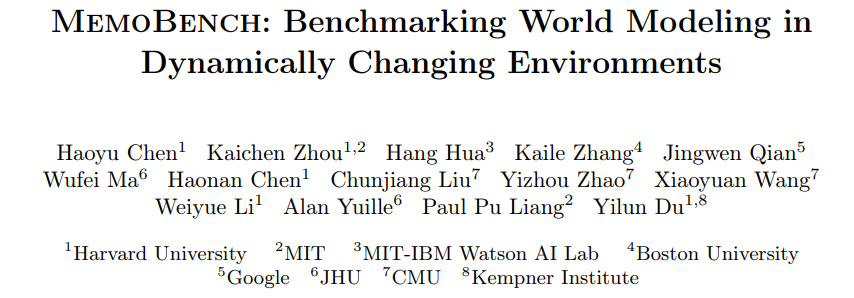
New benchmark MemoBench exposes world model memory gaps
MemoBench is a new diagnostic benchmark designed to test world models' ability to maintain object permanence and state evolution in dynamic environments. It reveals that current video generation models struggle to accurately track and update object states during occlusion.
Zhipu AI’s GLM-5.2 model excels in cybersecurity tasks
Beijing-based Zhipu AI has released GLM-5.2, a model that demonstrates competitive performance against Anthropic’s Claude Opus 4.8 in cybersecurity bug-hunting tasks. This development highlights the narrowing gap between Chinese AI models and top-tier US counterparts.
Humans outperform AI in rigorous mathematical research testing
The First Proof project tested four AI systems against original, unpublished research-level math problems, finding that while AI shows promise, it still lags behind top human researchers.
Weibo's 3B Model Challenges AI Scaling Laws on Benchmarks
Sina Weibo researchers introduced VibeThinker-3B, a 3-billion parameter model that allegedly matches or exceeds the reasoning performance of massive flagship models. The release has sparked intense debate within the AI community regarding the validity of current benchmarks.
GPT-5.5 Outperforms Claude Fable 5 on New ALE Benchmark
UC Berkeley researchers launched the Agents’ Last Exam (ALE), a rigorous benchmark designed to evaluate AI agents on real-world, long-horizon professional workflows. GPT-5.5 achieved the top score, outperforming Anthropic's Claude Fable 5 in a test that emphasizes practical labor impact over static coding puzzles.
Spirit AI beats Nvidia on robotics benchmark
Chinese startup Spirit AI has surpassed Nvidia's robotics models on the RoboArena leaderboard. Their Spirit v1.6 model achieved a score of 1,924, outperforming Nvidia's Cosmos3-Nano-Policy.
DeepSWE Benchmark Challenges AI Coding Leaderboards and GPT-5.5 Supremacy
Datacurve launched DeepSWE, a new coding benchmark that reveals significant performance gaps between frontier models, crowning GPT-5.5 as the leader. The report also exposes a 32% error rate in existing SWE-Bench Pro evaluations, questioning the reliability of current industry standards.
Fei-Fei Li unveils ImageNet for spatial intelligence
AI pioneer Fei-Fei Li has introduced a new benchmark designed to evaluate embodied spatial intelligence. This initiative aims to provide a standardized dataset and evaluation framework for the next generation of robotic and spatial AI systems.
BenchJack: Automating Red-Teaming to Expose AI Benchmark Flaws
BenchJack is an automated red-teaming system designed to identify reward-hacking exploits in AI agent benchmarks. By applying it to 10 major benchmarks, researchers discovered 219 flaws, demonstrating that many current evaluation metrics are easily gamed without actual task completion.
Hard-to-Fake Coding Benchmark Exposes LLM Limits
Researchers developed EsoLang-Bench using esoteric languages like Brainfuck and Befunge-98 to test genuine coding reasoning beyond pattern matching. Top models including GPT-5.2, O4-mini, and Gemini achieved a best score of 11.2%, with medium/hard problems at 0%. The benchmark highlights the need for ungameable evaluations and includes a website and paper.
Kimi K3 Ranks 3rd on ArtificialAnalysis, Surpassing Claude Opus
The Kimi K3 model has achieved a 3rd place ranking on the ArtificialAnalysis leaderboard. It notably outperformed the Claude Opus 4.8 model in this benchmark assessment.
Moonshot AI's Kimi K3 Challenges Fable 5 in Video Generation
Moonshot AI's new Kimi K3 model has appeared on benchmark platforms, demonstrating video generation capabilities that rival Fable 5. Early social media tests highlight significant improvements in animation smoothness and visual detail.
Papers with Code Launches Dedicated Robotics Benchmark Page
Papers with Code has introduced a dedicated Robotics section to track major benchmarks, trending papers, and open-source artifacts. It currently features over 110 entries across benchmarks like LIBERO and SimplerEnv.
New Benchmark for Open-Ended Multi-Agent LLM Coordination
研究人員發布了 ALEM 基準測試,旨在評估 LLM 代理在複雜、開放式環境中的協作能力。測試結果顯示,儘管大多數模型表現不佳,但 Gemini 3.1 Pro 在高難度任務中展現了與專業訓練模型相當的潛力。
New Benchmark Tests AI Agents on Long-Horizon Terminal Tasks
Long-Horizon-Terminal-Bench introduces a new evaluation framework for AI agents using 46 complex, multi-step tasks that require long-term planning and iterative debugging. The benchmark provides dense intermediate rewards to better measure progress in open-ended workflows compared to traditional outcome-only evaluations.
AI Gateway leaderboards now feature open data and charts
Vercel's AI Gateway leaderboards now offer shareable charts and open access to production traffic data. Users can analyze model, lab, app, and provider performance via downloadable CSVs or a programmatic export endpoint.
Survey on LLMs for Medical Reasoning and Clinical Needs
This survey evaluates LLMs in healthcare by mapping clinical competency levels to computational reasoning patterns. It introduces a new benchmark across five reasoning levels and compares 18 state-of-the-art models to identify performance gaps in clinical practice.
SageMath-Augmented Agents Boost Mathematical Problem Solving
Researchers introduced a ReAct-style agentic framework that integrates LLM reasoning with SageMath for verifiable mathematical computation. The study demonstrates significant performance gains across various models, narrowing the gap between open-weight and closed-source systems.
Measuring AI Intelligence Beyond Human Capability
This research proposes a new paradigm for evaluating AI models that have surpassed human capability by using relative measurement instead of static benchmarks. The framework utilizes model-generated challenges to create an adversarial psychometric rating system that scales alongside agent capabilities.
AgentLens: A New Benchmark for Evaluating Coding Agent Trajectories
AgentLens is a new open-source benchmark that evaluates coding agents based on their entire interaction trajectory rather than just binary pass/fail results. It combines formal verification with LLM-generated reviews to provide actionable insights into agent behavior and performance.
RoboDojo: A New Benchmark for Embodied AI
RoboDojo has been introduced as a challenging new benchmark for embodied AI, highlighting the significant performance gap between humans and current AI models. The benchmark reveals that even the most advanced models struggle to reach human-level proficiency in physical tasks.
OpenAI identifies reliability issues in SWE-Bench Pro coding benchmark
OpenAI released an analysis highlighting significant flaws in the SWE-Bench Pro benchmark. The report questions the accuracy and reliability of current methods used to evaluate AI coding capabilities.
RAG is essential for accurate local LLM technical answers
A developer experiment shows that local LLMs struggle with technical accuracy without RAG, but perform exceptionally well when provided with a knowledge base. The study tested various models including Apple Intelligence and Qwen, highlighting the effectiveness of context injection.