Unitree Unveils Pilotable Mecha and Files for IPO
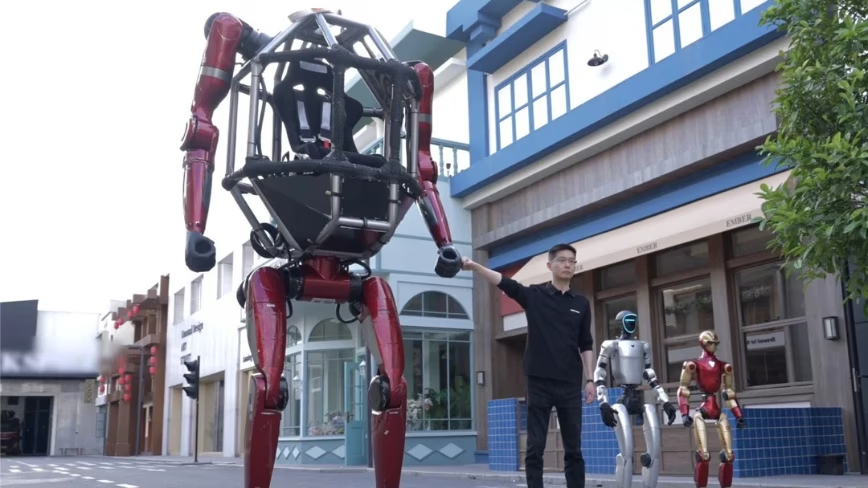
A major player in humanoid robotics is going public and building giant mechas—see the future of embodied AI.
30-Second TL;DR
What Changed
The GD01 mecha can switch between bipedal and quadruped configurations.
Why It Matters
Unitree's move into pilotable mecha represents a new frontier in human-robot interaction. The IPO filing highlights the massive investor appetite for embodied AI and advanced robotics hardware.
What To Do Next
Monitor Unitree's technical whitepapers on their balance control algorithms to understand how they handle high-payload robotics.
Key Points
- •The GD01 mecha can switch between bipedal and quadruped configurations.
- •The unit weighs 500kg and is priced starting at approximately $650,000.
- •Unitree is pursuing a $7 billion IPO to scale its robotics operations.
Deep Insight
Background and context from public sources — not the original article. 25 sources cited.
Enhanced Key Takeaways
- •The GD01 is explicitly marketed as the world's first mass-produced human-carrying transforming mecha for civilian use, with potential applications in tourism displays, special-purpose work scenarios, and high-end private mobility.
- •Unitree Robotics holds approximately 60-70% of the global quadruped robot market and shipped over 5,500 humanoid robots in 2025, demonstrating significant market leadership in legged robotics.
- •The company's IPO on Shanghai's STAR Market aims to raise approximately $610 million (4.2 billion yuan) and targets a valuation of up to $7 billion, with proceeds intended for robot body development, AI models, manufacturing facilities, and R&D.
- •Unitree has been profitable every year since 2020, with revenue reaching 1.71 billion yuan (approximately $248 million) in 2025 and gross margins for humanoid and quadruped segments around 60%.
- •The GD01's transformation process, which involves the mecha bending backward and pivoting nearly 90 degrees at the hips, has raised questions regarding operator orientation and cockpit ergonomics, which appear cramped and lack significant weather protection.
Competitor Analysis
- Unitree Go2 (Quadruped)
- From $1,600 (Air) to $2,800 (Pro)
- Boston Dynamics Spot (Quadruped)
- $74,500
- Xiaomi CyberDog 2 (Quadruped)
- Under $2,000
- Unitree H1 (Humanoid)
- ~$90,000
- Tesla Optimus (Humanoid)
- Not yet commercially available; consumer availability targets late 2027
- Unitree Go2 (Quadruped)
- 33 lbs (Go2)
- Boston Dynamics Spot (Quadruped)
- Not specified in snippets
- Xiaomi CyberDog 2 (Quadruped)
- Not specified in snippets
- Unitree H1 (Humanoid)
- 180 cm (5 ft 11 in), 47 kg (104 lbs)
- Tesla Optimus (Humanoid)
- Not specified in snippets
- Unitree Go2 (Quadruped)
- 4.7 m/s (Go1, similar for Go2)
- Boston Dynamics Spot (Quadruped)
- Not specified in snippets
- Xiaomi CyberDog 2 (Quadruped)
- Not specified in snippets
- Unitree H1 (Humanoid)
- 3.3 m/s (world record at launch)
- Tesla Optimus (Humanoid)
- Not specified in snippets
- Unitree Go2 (Quadruped)
- Intelligent Side-Follow System, 4D Ultra-wide LiDAR, AI, affordable
- Boston Dynamics Spot (Quadruped)
- Industrial inspection, advanced mobility
- Xiaomi CyberDog 2 (Quadruped)
- Affordable AI-vision research, 19-sensor fusion stack, open-source SDK
- Unitree H1 (Humanoid)
- World-record running speed, 360 N·m knee torque, ROS2 support
- Tesla Optimus (Humanoid)
- Vertical integration for cost advantages, R&D phase, data collection
- Unitree Go2 (Quadruped)
- Consumer, education, light-industrial, research
- Boston Dynamics Spot (Quadruped)
- Industrial, utilities, public safety
- Xiaomi CyberDog 2 (Quadruped)
- Research, STEM, hobbyists
- Unitree H1 (Humanoid)
- Research labs, universities, R&D teams
- Tesla Optimus (Humanoid)
- Manufacturing, general-purpose tasks
| Feature/Product | Unitree Go2 (Quadruped) | Boston Dynamics Spot (Quadruped) | Xiaomi CyberDog 2 (Quadruped) | Unitree H1 (Humanoid) | Tesla Optimus (Humanoid) |
|---|---|---|---|---|---|
| Price | From $1,600 (Air) to $2,800 (Pro) | $74,500 | Under $2,000 | ~$90,000 | Not yet commercially available; consumer availability targets late 2027 |
| Height/Weight | 33 lbs (Go2) | Not specified in snippets | Not specified in snippets | 180 cm (5 ft 11 in), 47 kg (104 lbs) | Not specified in snippets |
| Speed | 4.7 m/s (Go1, similar for Go2) | Not specified in snippets | Not specified in snippets | 3.3 m/s (world record at launch) | Not specified in snippets |
| Key Features | Intelligent Side-Follow System, 4D Ultra-wide LiDAR, AI, affordable | Industrial inspection, advanced mobility | Affordable AI-vision research, 19-sensor fusion stack, open-source SDK | World-record running speed, 360 N·m knee torque, ROS2 support | Vertical integration for cost advantages, R&D phase, data collection |
| Market Focus | Consumer, education, light-industrial, research | Industrial, utilities, public safety | Research, STEM, hobbyists | Research labs, universities, R&D teams | Manufacturing, general-purpose tasks |
Technical Deep Dive
- Degrees of Freedom (DOF): The GD01 boasts 23 joint degrees of freedom (6 per leg, 5 per arm), offering an extensive range of motion.
- Processing Unit: Powered by an 8-core high-performance CPU.
- Sensors: Equipped with a depth camera and 3D LiDAR for smart interaction and connectivity.
- Connectivity: Supports Wi-Fi 6.
- Transformation Mechanism: The mecha can pivot nearly 90 degrees at the hips to switch between bipedal and quadrupedal modes.
- Structural Material: Constructed with high-strength alloy.
- Component Development: Unitree independently develops core components including motors, reducers, controllers, and some sensors for its robots.
Future ImplicationsAI analysis grounded in cited sources
Timeline
- 2016-08Unitree Robotics officially founded by Wang Xingxing.
- 2017-09Unitree releases its first commercial quadruped robot, Laikago.
- 2021-06Unitree releases the Go1, a budget-friendly quadruped robot that gained significant recognition.
- 2024-04Unitree releases a video showcasing its humanoid robot H1, marking its entry into the humanoid market.
- 2025-06Unitree completes Series C+ funding round, valuing the company at $1.7 billion.
- 2026-03Unitree Robotics files for an IPO on Shanghai's STAR Market, aiming to raise approximately $610 million.
Sources (25)
Factual claims are grounded in the sources below. Forward-looking analysis is AI-generated interpretation.
Weekly AI Recap
Read this week's curated digest of top AI events →
Related Updates


AI-curated news aggregator. All content rights belong to original publishers.
Original source: The Next Web (TNW) ↗
This is a summary, not the original. Read the source, or get the weekly briefing.
The weekly digest
One email a week. Unsubscribe anytime.