TranscEngram Secures Funding for Robot Memory Systems
💡A new approach to embodied AI using memory-based architectures to solve the 'hallucination' and generalization issues.
⚡ 30-Second TL;DR
What Changed
Raised hundreds of millions in angel funding from institutional and industry investors.
Why It Matters
The shift from static VLA models to memory-based architectures could significantly reduce the reliance on massive labeled datasets for robot training.
What To Do Next
Evaluate whether your current robot control stack can incorporate a 'memory' layer to improve task generalization without retraining.
Key Points
- •Raised hundreds of millions in angel funding from institutional and industry investors.
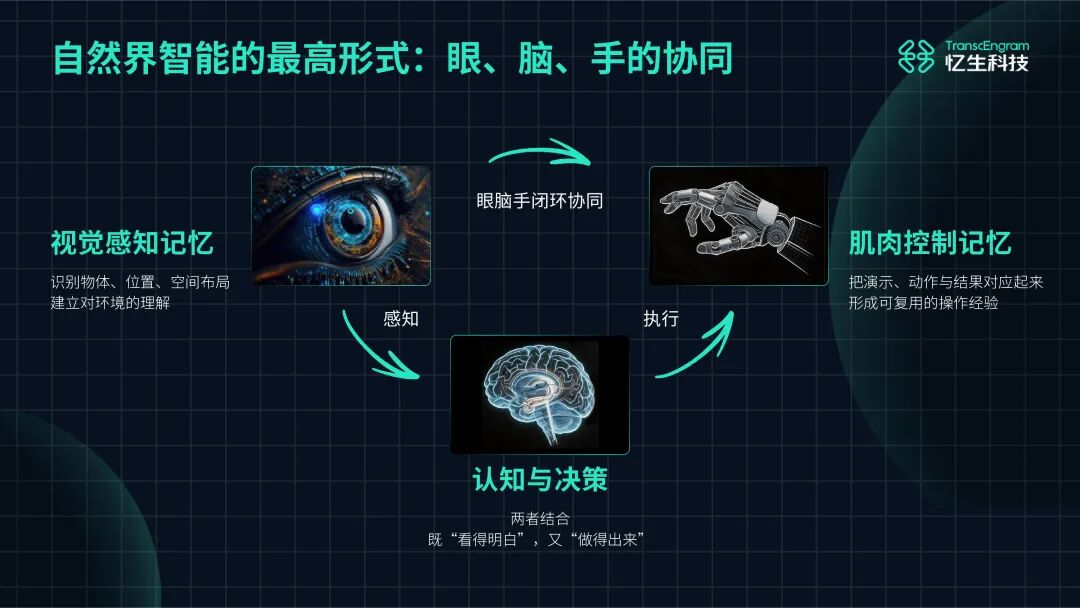
- •Developed a 'brain + cerebellum' architecture to mimic human visual and muscle memory.
- •Claims 3x performance improvement over traditional VLA models in multi-task scenarios.
- •Focusing on high-end hotel services and flexible manufacturing assembly.
🧠 Deep Insight
AI-generated analysis for this event — not the original article.
🔑 Enhanced Key Takeaways
- •TranscEngram's founding team includes researchers from the University of Hong Kong (HKU) with deep expertise in neuro-symbolic AI and embodied cognition.
- •The 'brain + cerebellum' architecture utilizes a hierarchical memory mechanism that separates high-level semantic reasoning from low-level motor control loops.
- •The company is actively collaborating with major domestic robotics OEMs in China to integrate their memory modules into existing humanoid hardware platforms.
- •The angel funding round was led by prominent deep-tech venture capital firms specializing in the 'Embodied AI' sector in the Greater Bay Area.
- •The system's 'perception-prediction-interaction' loop is designed to reduce latency in real-time decision-making by caching frequently used motor primitives in the 'cerebellum' layer.
📊 Competitor Analysis▸ Show
| Feature | TranscEngram | Physical Intelligence (Pi) | Figure AI |
|---|---|---|---|
| Architecture | Brain + Cerebellum (Hierarchical) | General Purpose Foundation Model | End-to-End VLA |
| Primary Focus | Memory-centric Embodied AI | Universal Robot Brain | Humanoid Hardware/Software |
| Performance | 3x vs VLA (Multi-task) | High generalization | High dexterity |
| Target Market | Hotel/Manufacturing | Industrial/Logistics | General Purpose/Service |
🛠️ Technical Deep Dive
- Brain Layer: Employs a large-scale transformer-based architecture for semantic understanding, planning, and long-horizon task decomposition.
- Cerebellum Layer: Implements a high-frequency reactive control system that handles proprioceptive feedback and motor execution, bypassing the main brain for millisecond-level adjustments.
- Memory Mechanism: Uses a dynamic 'Engram' storage system that allows the robot to store and retrieve successful motor trajectories, preventing catastrophic forgetting in multi-task environments.
- VLA Integration: The system acts as a middleware or enhancement layer that sits on top of standard Vision-Language-Action (VLA) models to provide persistent memory and predictive stability.
🔮 Future ImplicationsAI analysis grounded in cited sources
⏳ Timeline
Weekly AI Recap
Read this week's curated digest of top AI events →
👉Related Updates

AI-curated news aggregator. All content rights belong to original publishers.
Original source: 36氪 ↗
This is a summary, not the original. Read the source, or get the weekly briefing.
Weekly AI briefing
One email a week. Unsubscribe anytime.