Toyota, Suzuki Adopt Chinese AI Chips
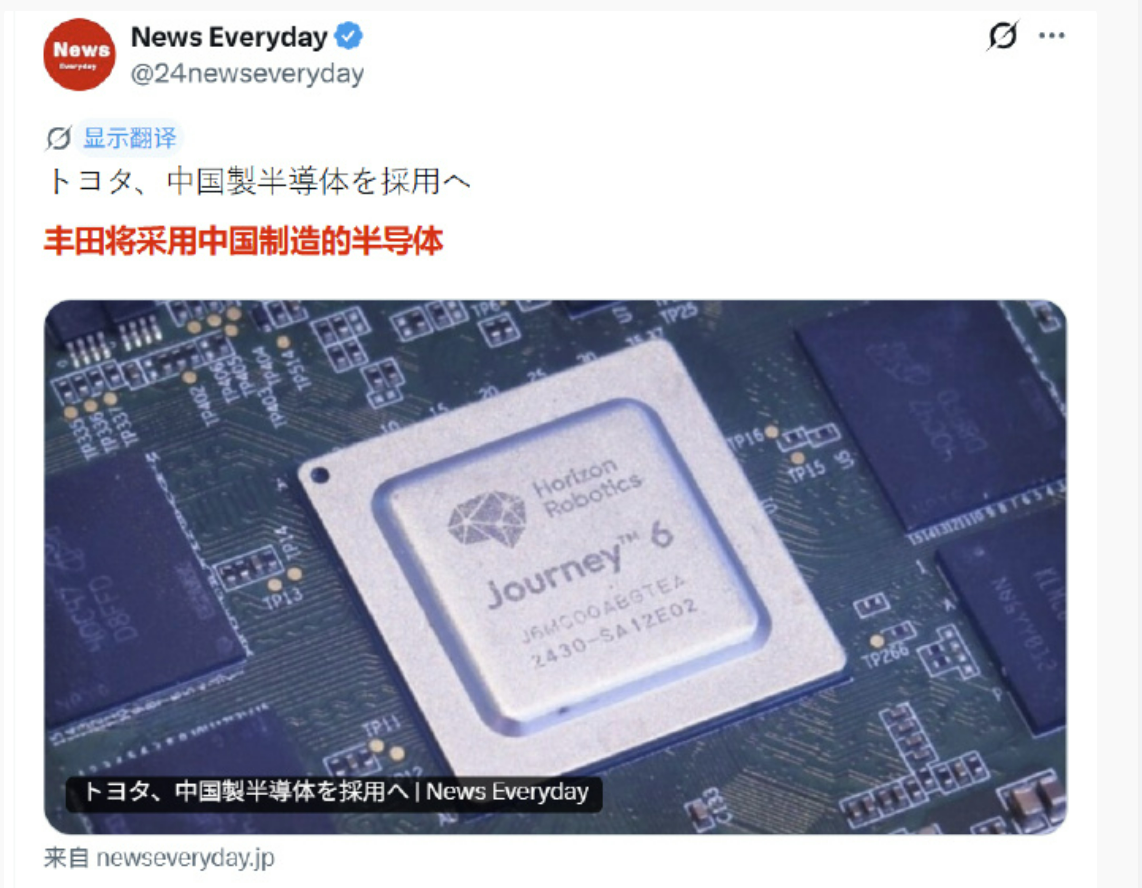
💡Toyota validates Chinese AI chips for cars—signals supply chain shift for edge AI hardware
⚡ 30-Second TL;DR
What Changed
Toyota and Suzuki to integrate Horizon Robotics SoC in global vehicles
Why It Matters
Boosts Chinese AI chipmakers' global presence, potentially disrupting automotive supply chains and reducing reliance on Western semiconductors for ADAS.
What To Do Next
Benchmark Horizon Robotics Journey SoCs vs Nvidia Jetson for automotive AI inference.
Key Points
- •Toyota and Suzuki to integrate Horizon Robotics SoC in global vehicles
- •Horizon Robotics is emerging Chinese automotive AI chip developer
- •Chips quality matches European and American standards
- •Reported by Japanese media on adoption trend
🧠 Deep Insight
Background and context from public sources — not the original article. 6 sources cited.
🔑 Enhanced Key Takeaways
- •Toyota and other Japanese automakers are addressing semiconductor supply risks by sharing chip data via a blockchain-based system led by JAMA, indicating broader supply chain resilience efforts amid geopolitical tensions[1].
- •Horizon Robotics' adoption by Toyota and Suzuki for global vehicles highlights growing acceptance of Chinese AI chips, with quality reportedly matching Western standards as per Japanese media[article].
- •Chinese firms like BYD demonstrate vertical integration success by producing their own automotive microchips, helping navigate supply chain disruptions unlike Western competitors[2].
- •Toyota partnerships extend to other Chinese tech like ECARX, with expected program launches and revenue ramps in late 2026, particularly in China[3].
- •Japanese auto industry faces chip supply challenges, prompting collaborative data sharing among Toyota and peers to mitigate shortages[1].
🔮 Future ImplicationsAI analysis grounded in cited sources
This adoption signals increasing global reliance on Chinese automotive semiconductors, potentially reducing dependence on Western suppliers while raising supply chain resilience concerns amid geopolitical tensions and tariffs[1][article].
📎 Sources (6)
Factual claims are grounded in the sources below. Forward-looking analysis is AI-generated interpretation.
Weekly AI Recap
Read this week's curated digest of top AI events →
👉Related Updates
AI-curated news aggregator. All content rights belong to original publishers.
Original source: cnBeta (Full RSS) ↗
This is a summary, not the original. Read the source, or get the weekly briefing.
Weekly AI briefing
One email a week. Unsubscribe anytime.