The Embodied AI Data Bottleneck and Emerging Solutions
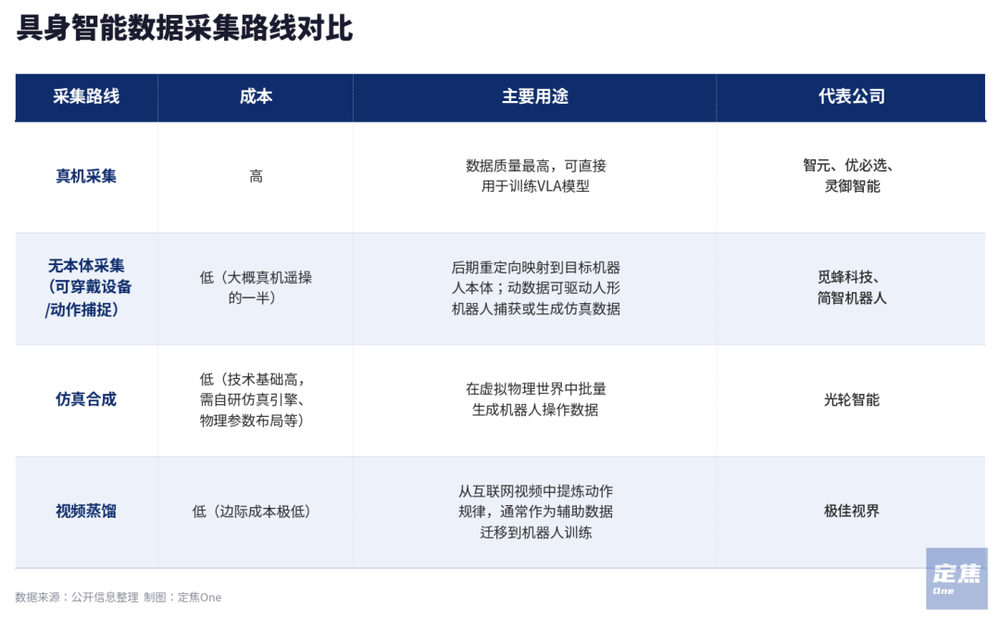
💡Understand the four key data acquisition strategies currently defining the multi-billion dollar embodied AI market.
⚡ 30-Second TL;DR
What Changed
Embodied AI data is currently the primary bottleneck, with publicly available operational data lagging far behind LLM and autonomous driving datasets.
Why It Matters
The shift toward specialized embodied data providers will lower the barrier to entry for robotics startups but will force a consolidation of data standards across the industry.
What To Do Next
Evaluate the feasibility of integrating video distillation pipelines into your training workflow to augment sparse real-world robot interaction data.
Key Points
- •Embodied AI data is currently the primary bottleneck, with publicly available operational data lagging far behind LLM and autonomous driving datasets.
- •Four distinct data acquisition routes are emerging: real-machine teleoperation (high quality, high cost), non-embodied capture (lower cost, lower fidelity), simulation synthesis (scalable but reality-gap issues), and video distillation (low marginal cost).
- •Capital is flowing rapidly into third-party data companies like Lightwheel AI and Extreme Vision, signaling a shift toward specialized data services.
- •Industry trends show a convergence where companies are blending these four routes to balance cost, scale, and data quality.
🧠 Deep Insight
AI-generated analysis for this event.
🔑 Enhanced Key Takeaways
- •The 'Sim-to-Real' gap is increasingly being addressed by Foundation Pose and foundation models that utilize cross-embodiment learning, allowing robots to transfer skills across different hardware morphologies.
- •Data flywheel architectures are becoming the industry standard, where robots deployed in the field continuously collect edge cases to retrain models, reducing the reliance on static datasets.
- •Standardization efforts, such as the Open X-Embodiment dataset, have become critical for benchmarking, though proprietary data moats remain the primary differentiator for top-tier AI robotics firms.
- •Synthetic data generation is shifting from simple physics-based rendering to generative world models that simulate complex, non-deterministic human environments to improve generalization.
- •Regulatory and safety frameworks are beginning to influence data collection practices, with companies now prioritizing 'privacy-by-design' when capturing human teleoperation data in domestic settings.
📊 Competitor Analysis▸ Show
| Feature | Lightwheel AI | Extreme Vision | Traditional Robotics Integrators |
|---|---|---|---|
| Primary Focus | Embodied Data Pipelines | Computer Vision/Perception | Hardware Deployment |
| Data Strategy | Teleop-to-Model Flywheel | Large-scale Video Distillation | Manual Programming |
| Pricing Model | Usage-based/Subscription | Project-based/Licensing | CapEx/Service Contracts |
| Benchmarking | High (Task Success Rate) | High (Detection Accuracy) | Low (Generalization) |
🛠️ Technical Deep Dive
- Cross-Embodiment Transformers: Models utilize transformer architectures that treat robot joint states and sensor inputs as tokens, enabling policy learning across heterogeneous robot platforms.
- Video Distillation Pipelines: Implementation involves using pre-trained Vision-Language Models (VLMs) to annotate massive unlabeled video corpora, which are then used to train smaller, real-time robot policies via knowledge distillation.
- World Model Integration: Advanced systems incorporate latent dynamics models that predict future states, allowing robots to perform 'imagination-based' planning before executing physical actions.
- Teleoperation Haptic Feedback: High-fidelity data acquisition now includes force-torque sensor logging, which is essential for training robots in delicate manipulation tasks.
🔮 Future ImplicationsAI analysis grounded in cited sources
⏳ Timeline
Weekly AI Recap
Read this week's curated digest of top AI events →
👉Related Updates
Same topic
Explore #robotics
Same product
More on embodied-ai-data-infrastructure
Same source
Latest from 虎嗅

Pongbot launches multi-sport AI coach robot Aura
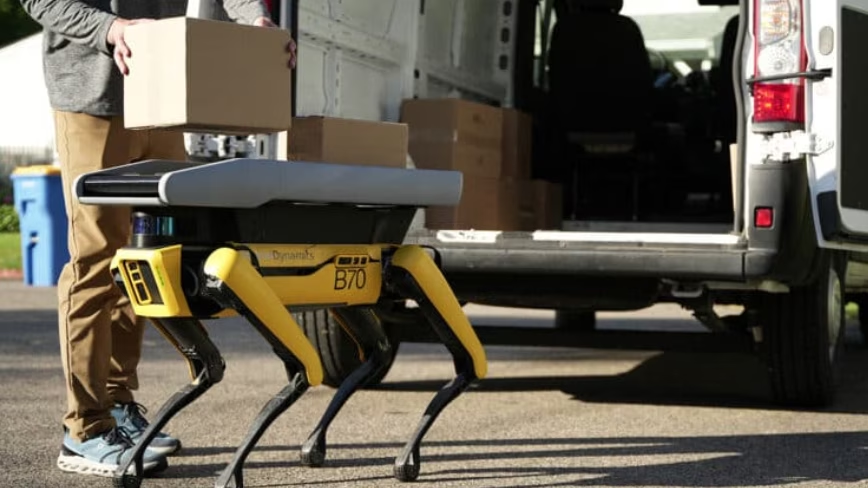
Boston Dynamics tests Spot as autonomous delivery robot
Nvidia Expands Toyota Partnership for Smart Cities and Factories
NVIDIA expands Jetson Thor lineup with T3000 and T2000
AI-curated news aggregator. All content rights belong to original publishers.
Original source: 虎嗅 ↗