來源虎嗅•較早收集於 11m
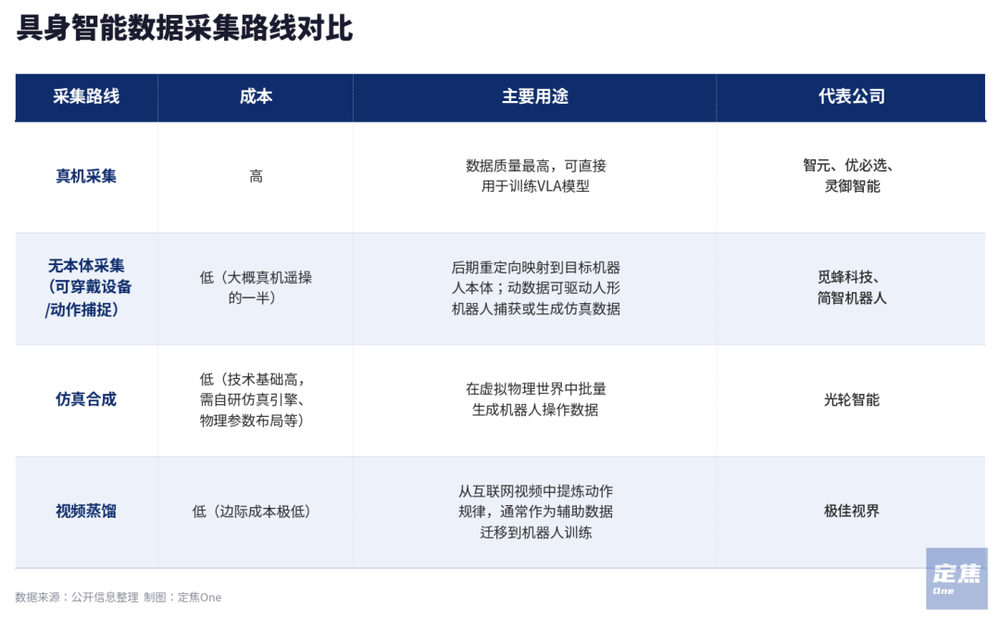
具身智能的數據瓶頸與四大生產路線

#robotics#embodied-ai#data-engineeringembodied-ai-data-infrastructurelightwheel aiextreme visiontesla optimusumi
深入了解定義當前數十億美元具身智能市場的四大數據採集策略。
30 秒速覽
有什麼變化
具身智能數據目前是產業最大瓶頸,公開操作數據量遠落後於LLM與自動駕駛數據。
為什麼重要
轉向專業具身數據供應商將降低機器人新創公司的進入門檻,但也將迫使產業內部的數據標準進行整合。
下一步行動
評估將視頻蒸餾流程整合至訓練工作流的可行性,以增強稀缺的真實世界機器人交互數據。
誰應關注:Developers & AI Engineers
關鍵要點
- •具身智能數據目前是產業最大瓶頸,公開操作數據量遠落後於LLM與自動駕駛數據。
- •四大數據採集路線成形:真機遙操(高品質高成本)、無本體採集(低成本低保真)、仿真合成(可擴展但有現實差距)、視頻蒸餾(邊際成本極低)。
- •資本正快速湧入第三方數據公司如光輪智能與極佳視界,顯示產業正轉向專業化數據服務。
- •產業趨勢顯示各家正融合多種路線,以平衡成本、規模與數據品質。
深度解析
本篇為 AI 生成分析,非原文內容。
增強重點摘要
- •The 'Sim-to-Real' gap is increasingly being addressed by Foundation Pose and foundation models that utilize cross-embodiment learning, allowing robots to transfer skills across different hardware morphologies.
- •Data flywheel architectures are becoming the industry standard, where robots deployed in the field continuously collect edge cases to retrain models, reducing the reliance on static datasets.
- •Standardization efforts, such as the Open X-Embodiment dataset, have become critical for benchmarking, though proprietary data moats remain the primary differentiator for top-tier AI robotics firms.
- •Synthetic data generation is shifting from simple physics-based rendering to generative world models that simulate complex, non-deterministic human environments to improve generalization.
- •Regulatory and safety frameworks are beginning to influence data collection practices, with companies now prioritizing 'privacy-by-design' when capturing human teleoperation data in domestic settings.
競品分析
Primary Focus
- Lightwheel AI
- Embodied Data Pipelines
- Extreme Vision
- Computer Vision/Perception
- Traditional Robotics Integrators
- Hardware Deployment
Data Strategy
- Lightwheel AI
- Teleop-to-Model Flywheel
- Extreme Vision
- Large-scale Video Distillation
- Traditional Robotics Integrators
- Manual Programming
Pricing Model
- Lightwheel AI
- Usage-based/Subscription
- Extreme Vision
- Project-based/Licensing
- Traditional Robotics Integrators
- CapEx/Service Contracts
Benchmarking
- Lightwheel AI
- High (Task Success Rate)
- Extreme Vision
- High (Detection Accuracy)
- Traditional Robotics Integrators
- Low (Generalization)
| Feature | Lightwheel AI | Extreme Vision | Traditional Robotics Integrators |
|---|---|---|---|
| Primary Focus | Embodied Data Pipelines | Computer Vision/Perception | Hardware Deployment |
| Data Strategy | Teleop-to-Model Flywheel | Large-scale Video Distillation | Manual Programming |
| Pricing Model | Usage-based/Subscription | Project-based/Licensing | CapEx/Service Contracts |
| Benchmarking | High (Task Success Rate) | High (Detection Accuracy) | Low (Generalization) |
技術深入
- Cross-Embodiment Transformers: Models utilize transformer architectures that treat robot joint states and sensor inputs as tokens, enabling policy learning across heterogeneous robot platforms.
- Video Distillation Pipelines: Implementation involves using pre-trained Vision-Language Models (VLMs) to annotate massive unlabeled video corpora, which are then used to train smaller, real-time robot policies via knowledge distillation.
- World Model Integration: Advanced systems incorporate latent dynamics models that predict future states, allowing robots to perform 'imagination-based' planning before executing physical actions.
- Teleoperation Haptic Feedback: High-fidelity data acquisition now includes force-torque sensor logging, which is essential for training robots in delicate manipulation tasks.
前景展望基於引用來源的 AI 分析
Data-as-a-Service (DaaS) will become the dominant business model for Embodied AI startups by 2027.
The high cost of proprietary data acquisition will force smaller hardware manufacturers to outsource their training data needs to specialized infrastructure providers.
Synthetic data will surpass real-world data in training volume for foundation models by late 2026.
The rapid advancement of generative world models allows for the creation of infinite, diverse training scenarios that are cheaper and faster to produce than physical teleoperation.
時間線
2023-10
Release of the Open X-Embodiment dataset, establishing a baseline for cross-robot learning.
2024-05
Emergence of large-scale video-to-robot policy distillation techniques in academic research.
2025-02
Increased venture capital allocation toward specialized embodied data infrastructure companies.
2026-01
Industry-wide shift toward integrating generative world models for synthetic data generation.
- 2023-10Release of the Open X-Embodiment dataset, establishing a baseline for cross-robot learning.
- 2024-05Emergence of large-scale video-to-robot policy distillation techniques in academic research.
- 2025-02Increased venture capital allocation toward specialized embodied data infrastructure companies.
- 2026-01Industry-wide shift toward integrating generative world models for synthetic data generation.
AI 週報
閱讀本週精選 AI 大事摘要 →
AI 策展新聞聚合。所有內容版權歸原始發布者所有。
原始來源: 虎嗅 ↗
每週電子報
每週一封,可隨時退訂。