Tech Layoffs Top 100k as AI Pivot Accelerates
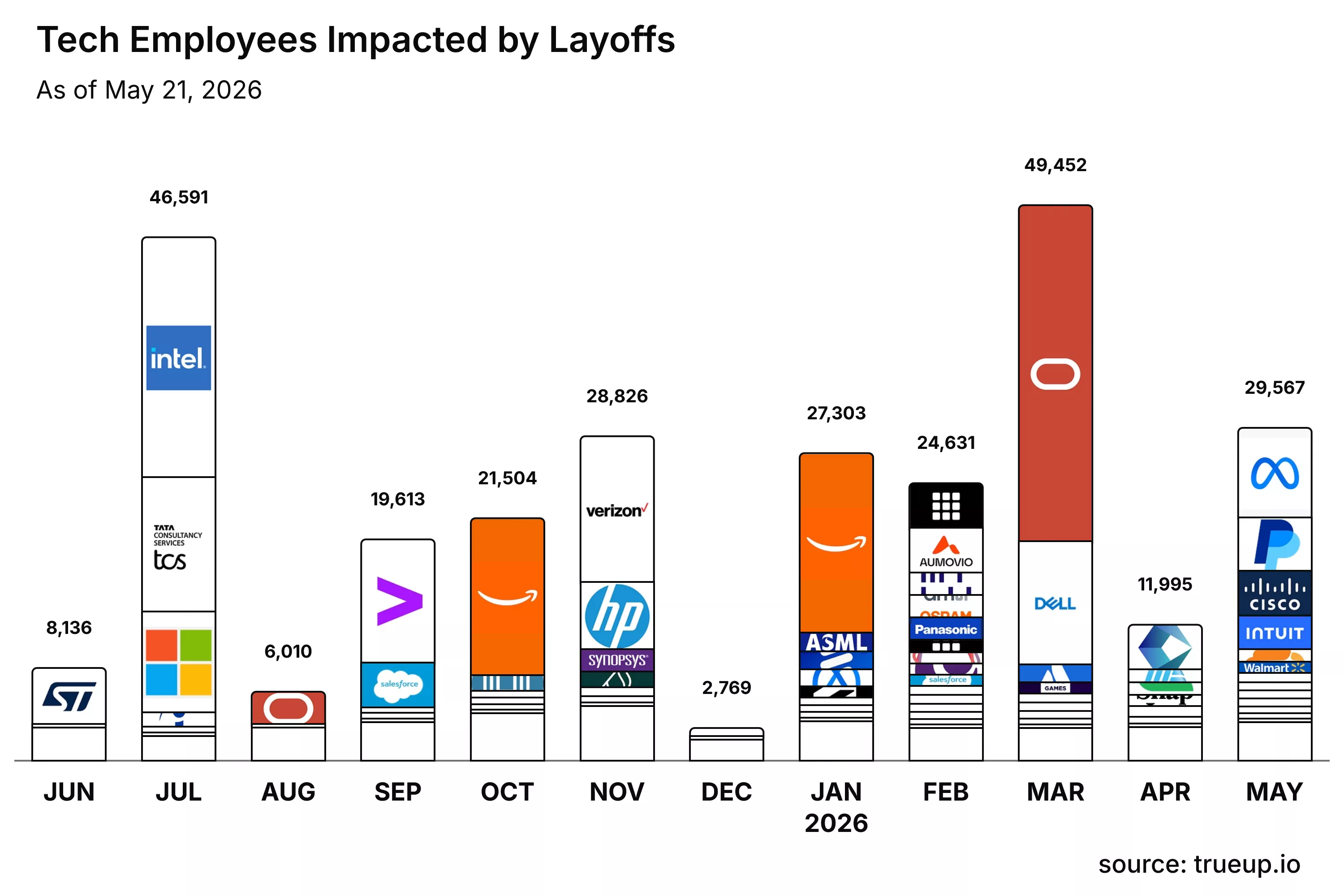
💡Understand how the 'AI-first' corporate pivot is reshaping the tech labor market and resource allocation.
⚡ 30-Second TL;DR
What Changed
Over 100,000 tech jobs lost in the first five months of 2026.
Why It Matters
The industry is undergoing a massive labor market shift as companies prioritize AI infrastructure and LLM development over legacy product lines.
What To Do Next
Upskill in AI-native development frameworks and LLM orchestration to remain competitive in a shifting job market.
Key Points
- •Over 100,000 tech jobs lost in the first five months of 2026.
- •AI transition is identified as a primary driver behind current workforce restructuring.
- •Meta serves as a key example of aggressive 'AI-first' corporate restructuring.
🧠 Deep Insight
Web-grounded analysis with 21 cited sources.
🔑 Enhanced Key Takeaways
- •The tech layoffs, exceeding 100,000 in the first five months of 2026, are driven by a strategic reallocation of resources towards AI infrastructure and development, occurring even as some companies like Meta report record revenues.
- •Meta specifically announced cutting approximately 8,000 jobs and canceling 6,000 open roles in May 2026, marking its third wave of layoffs in the year, following earlier reductions in January and March.
- •Alongside job cuts, Meta is actively reassigning around 7,000 employees into new AI-focused units, such as Applied AI Engineering and the Agent Transformation Accelerator, with a mandate to develop AI agents for various internal and external workloads.
- •The workforce reductions at Meta primarily impact support roles, including HR, marketing, communications, and recruitment, while engineering and AI research teams are largely being preserved or expanded.
- •Meta's capital expenditure for AI infrastructure is projected to reach between $125 billion and $145 billion in 2026, a substantial increase from previous years, indicating massive investments in NVIDIA GPUs, custom silicon, and advanced data centers.
🛠️ Technical Deep Dive
- Meta is developing its own specialized silicon, including the MTIA (Meta Training and Inference Accelerator) chip family, specifically designed for inference workloads.
- The company is building next-generation AI-optimized data centers that incorporate liquid-cooled AI hardware and high-performance AI networks to support large-scale AI training clusters.
- Meta's AI infrastructure includes massive GPU clusters, such as two clusters each with 24,000 NVIDIA H100 GPUs deployed in late 2023, and plans for a future 1-gigawatt cluster named Prometheus spanning multiple data center buildings.
- A strategic partnership with NVIDIA involves the large-scale deployment of NVIDIA CPUs, Blackwell and Rubin GPUs, and NVIDIA Spectrum-X Ethernet switches to enhance network efficiency and throughput.
- Meta continues to leverage and contribute to PyTorch, an open-source deep learning framework that it created in 2016, which offers flexibility and performance for AI research and production.
🔮 Future ImplicationsAI analysis grounded in cited sources
⏳ Timeline
📎 Sources (21)
Factual claims are grounded in the sources below. Forward-looking analysis is AI-generated interpretation.
Weekly AI Recap
Read this week's curated digest of top AI events →
👉Related Updates
Same topic
Explore #layoffs
Same product
More on ai-driven-enterprise-transformation
Same source
Latest from cnBeta (Full RSS)

PACA: Open-source tool for ancient fossil coordinate mapping

First atmosphere detected on habitable-zone exoplanet

Samsung Secures $200B Broadcom AI Infrastructure Deal

How AMD's 2006 ATI Acquisition Built Today's AI Empire
AI-curated news aggregator. All content rights belong to original publishers.
Original source: cnBeta (Full RSS) ↗