SpaceX Starship V3 booster explodes during 12th test flight
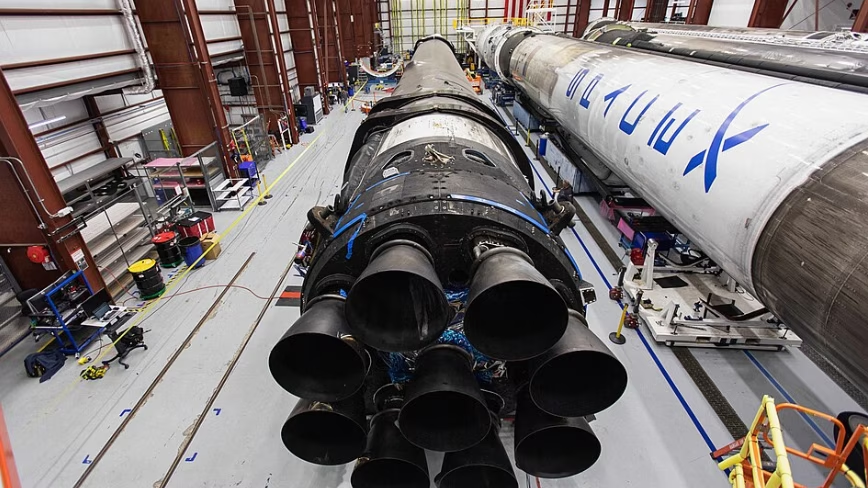
Critical infrastructure update on SpaceX's launch capabilities, impacting the future of satellite deployment logistics.
30-Second TL;DR
What Changed
Starship V3 debuted its 12th test flight from Starbase, Texas.
Why It Matters
The failure of the booster recovery highlights ongoing challenges in reusable launch vehicle technology. This impacts the reliability of rapid-turnaround space logistics essential for large-scale satellite constellation deployment.
What To Do Next
Monitor SpaceX's post-flight telemetry reports to understand the specific failure mode in the booster's descent control system.
Key Points
- •Starship V3 debuted its 12th test flight from Starbase, Texas.
- •Successfully deployed 20 mock Starlink satellites into orbit.
- •Super Heavy booster failed to achieve a controlled descent and was destroyed.
Deep Insight
Background and context from public sources — not the original article. 33 sources cited.
Enhanced Key Takeaways
- •The 12th test flight marked the debut of the upgraded Starship V3 vehicle, which is approximately 5 feet taller than its predecessor and features a complete design overhaul aimed at enabling operational missions.
- •The Super Heavy booster's destruction during descent was attributed to multiple Raptor engines failing to relight during the planned landing burn sequence, which led to the destruction of a significant portion of its aft section.
- •Beyond deploying 20 mock Starlink satellites, the Starship upper stage (Ship 39) also released two actual modified Starlink satellites equipped with imaging sensors to scan the spacecraft's heat shield and transmit data back to Earth.
- •This flight was the first to launch from a newly constructed Pad 2 at Starbase, a facility designed to better withstand the rigors of repeated launches by the world's most powerful rocket.
- •The test flight occurred just three weeks before SpaceX's anticipated Initial Public Offering (IPO), which is projected to be the largest in history with a target valuation ranging from $75 billion to $1.75 trillion.
Competitor Analysis
- Manufacturer
- SpaceX
- Classification
- Super Heavy-lift
- Height (m)
- 124.4
- Max Thrust (lbf)
- 18 million
- Payload to LEO (metric tons)
- 100+
- Reusability
- Full (both stages)
- Key Features
- Upgraded Raptor V3 engines, hot-staging, designed for Mars/Moon missions, in-space refueling capability
- Manufacturer
- NASA (Boeing, Aerojet Rocketdyne, Northrop Grumman, ULA)
- Classification
- Super Heavy-lift
- Height (m)
- 98 (Block 1)
- Max Thrust (lbf)
- 8.8 million
- Payload to LEO (metric tons)
- 27 (Block 1)
- Reusability
- No (expendable)
- Key Features
- Designed for Artemis lunar missions, Shuttle-derived components
- Manufacturer
- Blue Origin
- Classification
- Heavy-lift
- Height (m)
- 98
- Max Thrust (lbf)
- ~3.85 million
- Payload to LEO (metric tons)
- 45
- Reusability
- First stage reusable
- Key Features
- Designed for multiple reuses, Project Kuiper infrastructure
- Manufacturer
- ULA
- Classification
- Heavy-lift
- Height (m)
- 62
- Max Thrust (lbf)
- ~2.2 million
- Payload to LEO (metric tons)
- 27.2
- Reusability
- Future reusability (engines)
- Key Features
- Successor to Atlas V and Delta IV, advanced avionics
| Rocket System | Manufacturer | Classification | Height (m) | Max Thrust (lbf) | Payload to LEO (metric tons) | Reusability | Key Features |
|---|---|---|---|---|---|---|---|
| Starship V3 | SpaceX | Super Heavy-lift | 124.4 | 18 million | 100+ | Full (both stages) | Upgraded Raptor V3 engines, hot-staging, designed for Mars/Moon missions, in-space refueling capability |
| Space Launch System (SLS) | NASA (Boeing, Aerojet Rocketdyne, Northrop Grumman, ULA) | Super Heavy-lift | 98 (Block 1) | 8.8 million | 27 (Block 1) | No (expendable) | Designed for Artemis lunar missions, Shuttle-derived components |
| New Glenn | Blue Origin | Heavy-lift | 98 | ~3.85 million | 45 | First stage reusable | Designed for multiple reuses, Project Kuiper infrastructure |
| Vulcan Centaur | ULA | Heavy-lift | 62 | ~2.2 million | 27.2 | Future reusability (engines) | Successor to Atlas V and Delta IV, advanced avionics |
Technical Deep Dive
- Starship V3, when fully stacked, stands at an imposing 408 feet (124 meters) tall and is powered by 33 upgraded Raptor V3 engines on its Super Heavy booster, generating a combined 18 million pounds of thrust at liftoff.
- The Raptor V3 engines achieve 280 tons-force (tf) of thrust, representing approximately a 50% increase over Raptor 1, while also being lighter and more cost-effective.
- The Super Heavy booster for V3 features three grid fins, which are 50% larger than those on V2 and are positioned lower on the booster to mitigate heat exposure during hot-staging.
- Starship V3 incorporates an integrated 'hot stage' ring, allowing the Ship's engines to ignite before full separation from the Super Heavy booster, a design change intended to increase payload to low Earth orbit by an estimated 10%.
- The Starship upper stage (Ship 39) is equipped with six Raptor engines, including three vacuum-optimized (RVac) engines, though one RVac engine experienced an early shutdown during the ascent phase of this flight.
- The next-generation Starlink V3 satellites, which Starship is designed to deploy, are significantly more capable, targeting 1 Terabit per second (Tbps) downlink and 160-200 Gigabits per second (Gbps) uplink per satellite, and weigh approximately 2,000 kg each.
Future ImplicationsAI analysis grounded in cited sources
Timeline
- 2023-04First integrated flight test of Starship (Flight 1), ended with explosion.
- 2023-11Second orbital test flight (Flight 2), reached space but exploded before completing mission.
- 2024-06Fourth orbital flight (Flight 4) achieved full ascent burn and controlled splashdown of both stages.
- 2024-10Fifth orbital flight (Flight 5) marked the first successful Super Heavy booster recovery by the launch tower arms.
- 2025-10Eleventh Starship flight (Flight 11) successfully landed in the Indian Ocean.
- 2026-05Twelfth test flight (Flight 12), debut of Starship V3, deployed mock Starlink satellites, Super Heavy booster destroyed during descent.
Sources (33)
Factual claims are grounded in the sources below. Forward-looking analysis is AI-generated interpretation.
Weekly AI Recap
Read this week's curated digest of top AI events →
Related Updates



AI-curated news aggregator. All content rights belong to original publishers.
Original source: The Next Web (TNW) ↗
This is a summary, not the original. Read the source, or get the weekly briefing.
The weekly digest
One email a week. Unsubscribe anytime.