South Korea's Evolution into a High-End Industrial Company

💡Understand the industrial strategy of a key global player in the AI hardware supply chain.
⚡ 30-Second TL;DR
What Changed
Strategic shift towards high-end industrial specialization
Why It Matters
South Korea's focus on high-end manufacturing will likely accelerate investment in AI-integrated semiconductor and robotics infrastructure.
What To Do Next
Monitor South Korean semiconductor and robotics firms for new AI-integrated hardware partnerships.
Key Points
- •Strategic shift towards high-end industrial specialization
- •Structural economic challenges predicted for the next five years
- •Implications for global supply chain positioning
🧠 Deep Insight
AI-generated analysis for this event — not the original article.
🔑 Enhanced Key Takeaways
- •South Korea's 'strong outside, weak inside' phenomenon is driven by an over-reliance on semiconductor and automotive exports, which leaves the domestic consumption and service sectors vulnerable to global cyclical downturns.
- •The government's 'Industrial Strategy 2030' initiative aims to pivot from traditional manufacturing to AI-integrated robotics and advanced materials to mitigate the structural trade imbalance.
- •Demographic shifts, specifically the world's lowest fertility rate, are creating a severe labor shortage in high-end manufacturing, forcing companies to accelerate factory automation and unmanned production lines.
- •South Korea is increasingly decoupling its supply chain dependencies from single-market reliance, shifting focus toward 'friend-shoring' and localized production in Southeast Asia and North America.
- •The 'K-Chip Act' provides significant tax incentives and infrastructure support to domestic firms, attempting to secure a competitive edge in the global race for sub-3nm semiconductor fabrication.
🛠️ Technical Deep Dive
- Implementation of AI-driven predictive maintenance systems in semiconductor fabrication plants to reduce wafer defect rates by an estimated 15-20%.
- Transition to Gate-All-Around (GAA) transistor architecture in 3nm and 2nm nodes to improve power efficiency and performance density.
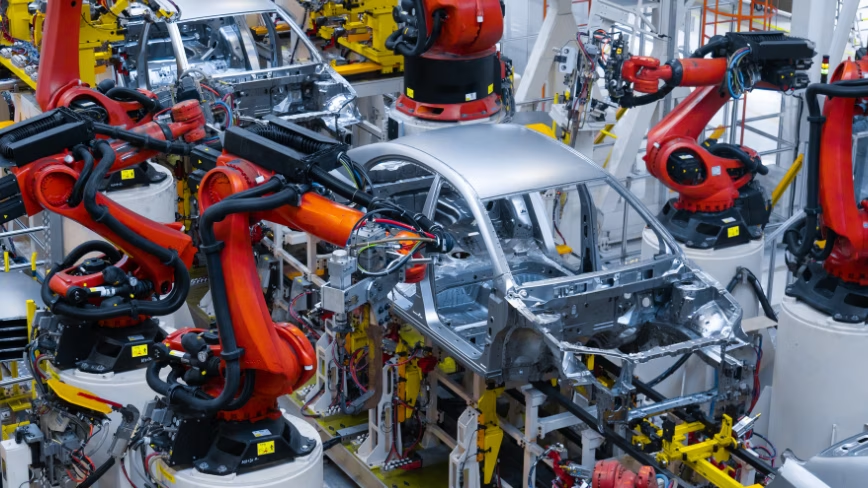
- Integration of autonomous mobile robots (AMRs) and collaborative robots (cobots) in automotive assembly lines to address the shrinking workforce.
- Development of high-bandwidth memory (HBM3E/HBM4) architectures specifically optimized for high-performance computing and generative AI workloads.
🔮 Future ImplicationsAI analysis grounded in cited sources
⏳ Timeline
Weekly AI Recap
Read this week's curated digest of top AI events →
👉Related Updates

AI-curated news aggregator. All content rights belong to original publishers.
Original source: 钛媒体 ↗
This is a summary, not the original. Read the source, or get the weekly briefing.
Weekly AI briefing
One email a week. Unsubscribe anytime.